Nuclear Physics
Topic hub: This is the main overview page for Topic 26. Use it as the starting point, then follow the branch and support notes for deeper treatment of specific subtopics.
Official 9749 scope map
The assessed Topic 20 route is: Rutherford evidence; nuclides and isotopes; nuclear equations and conservation; mass defect and binding energy; fission and fusion on the binding-energy curve; spontaneous/random decay and count-rate fluctuations; background radiation; , and radiation; the qualitative neutrino prediction; activity, exponential decay and half-life; and direct/indirect biological effects.
Nuclear-radius formulae, detailed strong-force/stability-band models, reactor engineering, positron emission, antiparticle notation, plasma and fusion-confinement methods are useful Enrichment, not additional 9749 recall requirements.
Overview
Nuclear Physics studies the structure, properties, and stability of atomic nuclei. It explains:
- what nuclei are made of
- why some nuclei are stable while others decay
- how mass can be converted into energy
- why energy is released in Nuclear Fission and Nuclear Fusion
This topic builds naturally from Atomic Structure and links to Radioactive Decay.
Nuclear Physics Branch Notes
The Nuclear Physics cluster is organised as one hub with branch notes:
- Radioactive Decay
- Half-Life
- Nuclear Equations and Conservation
- Beta-Decay Particle Context
- Nuclear Fission
- Nuclear Fusion
- Ionizing Radiation and Safety
Topic folders 27 to 32 are retained only as compatibility redirects.
Core Ideas
- nuclei contain protons and neutrons
- proton number, nucleon number, and neutron number describe nuclear composition
- isotopes have the same proton number but different neutron number
- Rutherford scattering reveals that nuclei are tiny compared with atoms
- nuclear mass is less than the sum of the separate nucleon masses
- mass defect corresponds to binding energy
- binding energy per nucleon measures average nuclear binding and guides interpretation of the qualitative curve
- nuclear equations are constrained by conservation of nucleon number, charge, energy, and momentum
- radioactive decay is random for individual nuclei but predictable statistically for large samples
- fission and fusion release energy when the products have greater total binding energy
Atom vs Nucleus
Atom
An atom consists of:
- a tiny central nucleus
- electrons surrounding the nucleus
Most of the atom’s volume is empty space.
Nucleus
The nucleus:
- contains almost all the mass of the atom
- is positively charged
- is extremely small compared with the atom
Typical sizes:
- atomic radius:
- nuclear radius:
So the nucleus is about times smaller in radius than the atom.
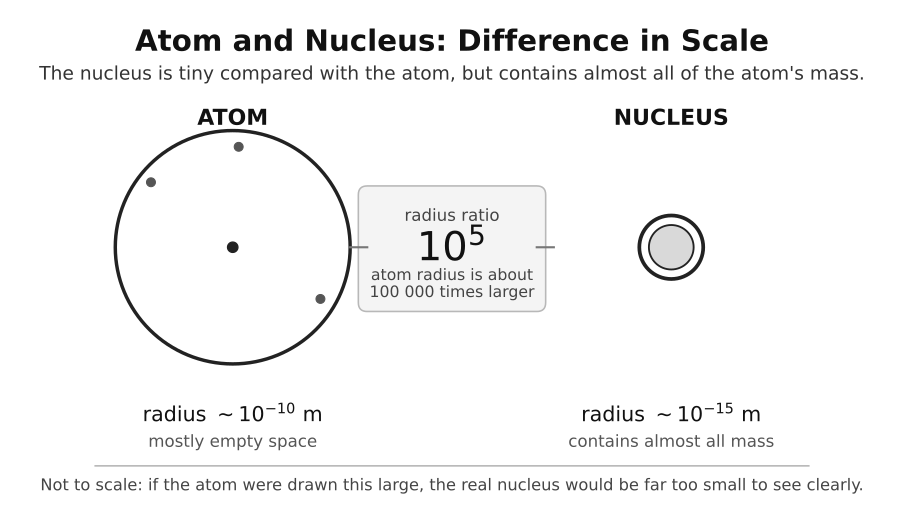
Figure: Both objects are schematic and not to scale. A typical nucleus is about times smaller in radius than an atom but contains nearly all the atom’s mass. The drawing does not represent electron trajectories or classical circular orbits.
Rutherford Evidence
The Geiger-Marsden alpha-particle scattering experiment supports this picture:
- most alpha particles passed through thin gold foil undeflected or only slightly deflected
- a very small fraction were scattered through large angles
- some were scattered backwards
This shows that most of the atom is empty space, while the positive charge and most of the mass are concentrated in a tiny nucleus.
Read the evidence as a chain:
| Observation | Reasoning | Inference |
|---|---|---|
| Most particles pass through with little or no deflection. | Most paths do not encounter a region producing a large force. | The strong-scattering region occupies only a tiny fraction of the atom. |
| Some are deflected. | Positive particles experience electrostatic repulsion. | Positive charge is present in the atom. |
| Very few are deflected through large angles or backwards. | A large momentum change needs a large impulse from a strong repulsive force during a close encounter. | Positive charge and nearly all mass are concentrated in a very small nucleus. |
The experiment establishes a nuclear atom; it does not establish classical electron orbits. See Atomic Structure for the full observation-to-inference treatment.
Nuclear Composition
The nucleus contains nucleons:
- protons
- neutrons
Key Numbers
- proton number:
- nucleon number, mass number:
- neutron number:
Meaning
- determines the element
- different gives different isotopes
- counts total nucleons
Nuclide Notation
A nuclide is written as:
where:
- = chemical symbol
- = nucleon number
- = proton number
Example:
- protons = 6
- neutrons = 8
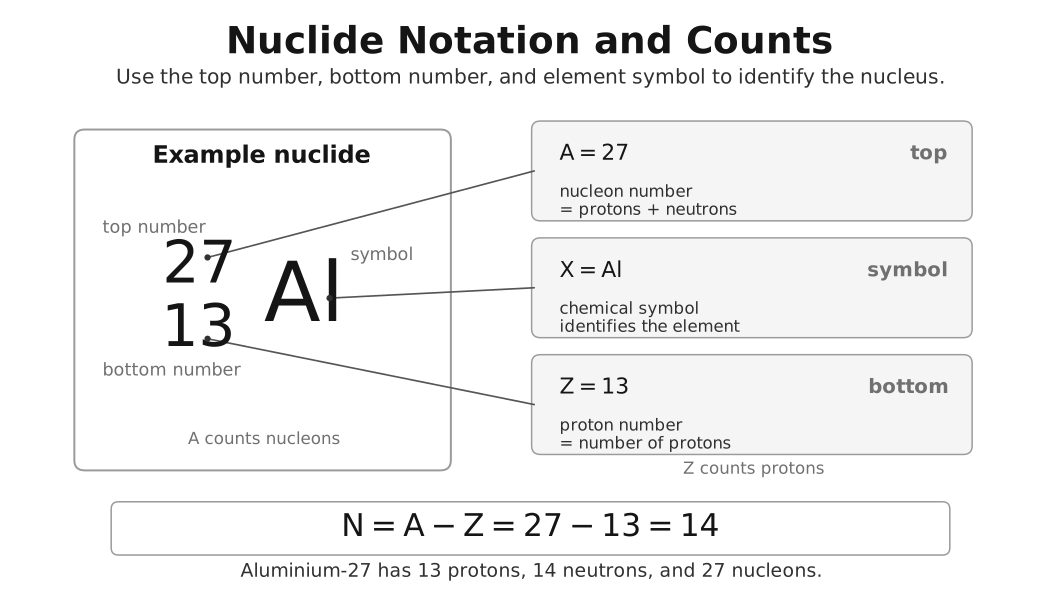 *Figure: Nuclide notation gives $Z$ and $A$ directly, while neutron number is found from $N=A-Z$. The carbon-14 example in the text and the worked nuclear equation in the figure serve different purposes: the first practises counting protons and neutrons; the second checks that the sums of nucleon number and charge number are conserved.*
Isotopes
Isotopes are atoms of the same element with:
- same proton number
- different neutron number
Examples:
Important Notes
- essentially the same electron arrangement and broadly similar chemical behaviour if neutral, although small isotope effects can occur
- different nuclear properties
- different masses
- some isotopes are radioactive
Do not confuse isotopes with ions. Isotopes differ in neutron number, while ions differ in electron number.
Enrichment: Nuclear Size and Density
Beyond explicit 9749 Topic 20 outcomes
The order-of-magnitude atom/nucleus comparison supports Rutherford reasoning. The empirical radius law and density deduction below are useful supplied-model context, not required recall.
Radius Relationship
Approximate nuclear radius:
where:
Implications
- larger nuclei have larger radius
- nuclear volume is proportional to
- since mass is also roughly proportional to , nuclear density is approximately constant for all nuclei
Nuclear density is very high compared with ordinary matter.
Enrichment: Strong Nuclear Force and Stability Band
Beyond explicit 9749 Topic 20 outcomes
This qualitative model explains how nuclei can remain bound, but detailed strong-force and neutron-stability-band knowledge is not an explicit syllabus outcome.
Protons repel each other electrically, so another force must hold nuclei together.
Strong Nuclear Force
- attractive between nucleons
- very strong at short distances
- acts over very short range only
- stronger than electrostatic repulsion at nuclear distances
Consequence
Without the strong nuclear force, nuclei would fly apart.
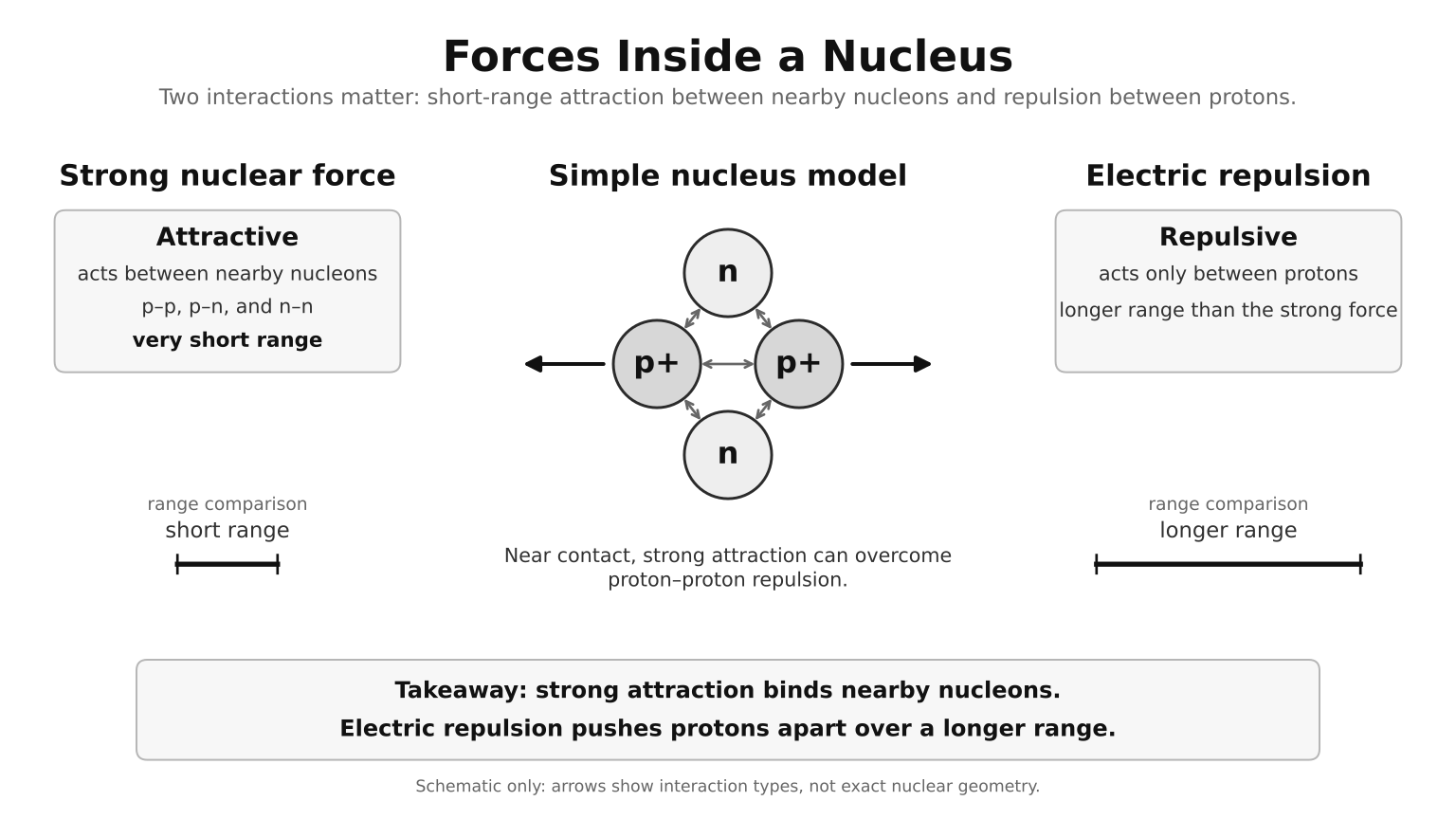
Enrichment figure: At nuclear distances a short-range attractive interaction can overcome proton-proton repulsion. The visual is schematic, not an exact force–distance graph or literal nuclear geometry.
Stability and Neutron Number
Stable light nuclei tend to have similar numbers of protons and neutrons, so .
For heavier nuclei, stability usually requires more neutrons than protons:
Extra neutrons contribute attractive nuclear force without adding proton-proton electrostatic repulsion. However, for very large nuclei, the short-range nuclear force cannot fully compensate for the increasing long-range repulsion between many protons.
Mass Defect Overview
The mass of a nucleus is less than the total mass of its separate nucleons.
This missing mass is the mass defect.
This mass difference corresponds to the lower rest energy of the bound nucleus. It has not vanished: total mass-energy is conserved.
Keep the mass convention consistent
With nuclear masses, compare the nucleus with separate proton and neutron masses. With atomic masses, electron masses must cancel across the calculation or be included explicitly. Do not silently mix atomic and nuclear masses.
See Mass Defect and Binding Energy.
Binding Energy Overview
Binding energy is the minimum energy needed to separate a nucleus completely into free nucleons.
Using Einstein’s relation:
So:
Meaning
Larger binding energy generally means a more tightly bound nucleus.
Binding Energy per Nucleon Overview
This is usually a better measure of nuclear stability than total binding energy.
Why
A heavy nucleus may have a large total binding energy simply because it contains many nucleons.
In nuclear reactions, the total number of nucleons is conserved. Therefore, comparing binding energy per nucleon helps us compare how tightly nucleons are bound on average in different nuclei.
If nucleons rearrange into products with greater total binding energy, their total rest mass is lower and energy is released. Binding energy per nucleon helps locate the trend, but the reaction energy must compare totals:
Stability Overview
Trend
Binding energy per nucleon:
- increases rapidly for light nuclei
- has a broad maximum in the iron–nickel region, near to
- decreases gradually for very heavy nuclei
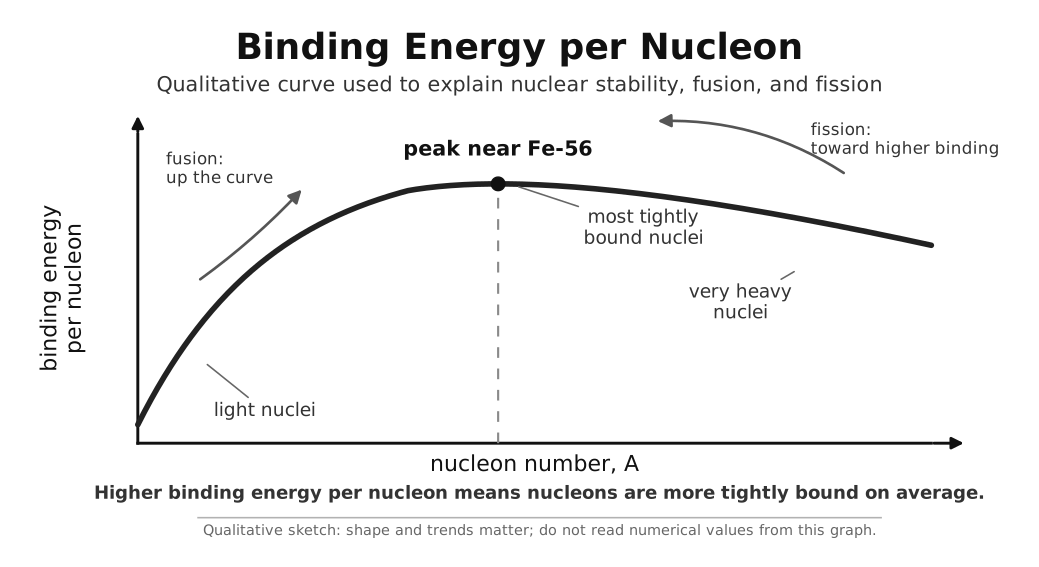
Figure: Binding energy per nucleon rises steeply for light nuclei, has a broad maximum in the iron–nickel region, and falls gradually for very heavy nuclei. It measures average binding, not a universal prediction of half-life or every decay mode. A nuclear reaction releases energy only when the products have greater total binding energy than the reactants, equivalently a smaller total rest mass.
Interpretation
- nuclei near the broad maximum are among the most tightly bound per nucleon
- very heavy nuclei may release energy by fission
- very light nuclei may release energy by fusion
This explains energy release in:
Link to Radioactive Decay, Measurement and Biology
Some nuclei are unstable and decay spontaneously.
The decay time of one nucleus is random, but a large ensemble has a predictable mean exponential trend. Repeated equal-duration count readings fluctuate around that trend; these fluctuations are evidence of the random nature of decay.
If is the number of undecayed nuclei, the activity is
Meaning of changes here
In the nuclear-notation sections, means nucleon number. In the decay equation below, means activity. The meaning is determined by the local definition and units.
A detector does not normally count every decay, and its measured count rate includes background:
Ionising radiation can damage a critical molecule directly, or indirectly by ionising water and creating reactive radicals. See Ionizing Radiation and Safety.
Examples include emission of:
- alpha particles
- beta particles
- gamma radiation
See Radioactive Decay.
Short Worked Examples
Example 1: Neutron Number
For:
Example 2: Identify Isotopes
Are and isotopes?
Yes.
- same
- different , so they have different neutron numbers
Example 3: Compare Stability
If nucleus X has greater binding energy per nucleon than nucleus Y:
- nucleons in X are more tightly bound on average
- this comparison alone does not determine every decay mode or half-life
Exam Relevance
Students should be able to:
- interpret nuclide notation correctly
- distinguish isotopes from ions
- infer the existence and small size of the nucleus from Rutherford evidence
- relate mass defect to binding energy
- calculate reaction energy from a change in total binding energy or rest mass
- distinguish random individual decay from predictable ensemble behaviour
- correct measured count rate for background and use
- explain the qualitative neutrino prediction and direct/indirect biological effects
Formula Sheet
Nuclear Composition
Enrichment: Radius
Mass-Energy
Binding Energy per Nucleon
Common Exam Traps Overview
Students often confuse:
- with
- atom mass with nucleus mass
- total binding energy with binding energy per nucleon
- binding energy per nucleon with total binding-energy change in a reaction
- larger nucleus with more stable nucleus
- isotope with ion
- activity with detector count rate
- random individual events with an unpredictable ensemble trend
See Nuclear Physics Common Exam Traps.
Quick Revision Summary
- nucleus contains protons and neutrons
- = protons, = total nucleons
- isotopes have same , different
- strong nuclear force binds nucleons
- nuclear mass is less than the sum of separate nucleons
- missing mass gives binding energy
- stability depends strongly on binding energy per nucleon
- reaction energy depends on the increase in total binding energy
- individual decay is random, while large-sample decay is statistically predictable
- measured count rate must be corrected for background before decay analysis
Links
- Atomic Structure
- Quantum Physics
- Mass Defect and Binding Energy
- Radioactive Decay
- Half-Life
- Nuclear Equations and Conservation
- Beta-Decay Particle Context
- Nuclear Fission
- Nuclear Fusion
- Ionizing Radiation and Safety
- Nuclear Physics Common Exam Traps
Provenance
- anchor note: Nuclear Physics Anchor Notes
- Topic 27 to Topic 32 pages were consolidated into Topic 26 branch notes on 2026-06-27, with compatibility redirects retained at the old numbered paths.