Uncertainty Propagation Methods
Branch note: This page deepens one part of Measurement.
Overview
Many physical quantities are not measured directly. Instead, they are calculated from measured quantities using formulas.
Examples:
- speed from distance and time
- density from mass and volume
- resistance from voltage and current
- gradient from graph data
When measured quantities contain uncertainty, the final calculated result must also contain uncertainty.
This page explains the standard H2 Physics methods for combining uncertainties.
What these rules mean
The 9749 rules are simplified maximum/worst-case uncertainty assessments, not exact statistical propagation laws. Equal signs below state the assessed maximum uncertainty under this syllabus convention.
See also:
Core Ideas
- Addition and subtraction combine absolute uncertainties.
- Multiplication, division, and powers combine fractional or percentage uncertainties.
- The final uncertainty should be rounded sensibly and quoted with a matching final value.
Why It Matters
Most useful experimental results are calculated from measured quantities, so uncertainty must be carried through the calculation rather than ignored.
Definition
Uncertainty propagation is the method used to combine uncertainties from measured quantities into the uncertainty of a calculated result.
In syllabus wording, actual uncertainty means absolute uncertainty (for example, ), rather than fractional or percentage uncertainty.
Key Representations
Core Principle
If measured quantities are uncertain, any derived quantity is also uncertain.
Example:
If and have uncertainty, then must also have uncertainty.
Notation
Measured quantity:
Where:
- = measured value
- = absolute uncertainty
Fractional uncertainty:
Percentage uncertainty:
1. Addition and Subtraction
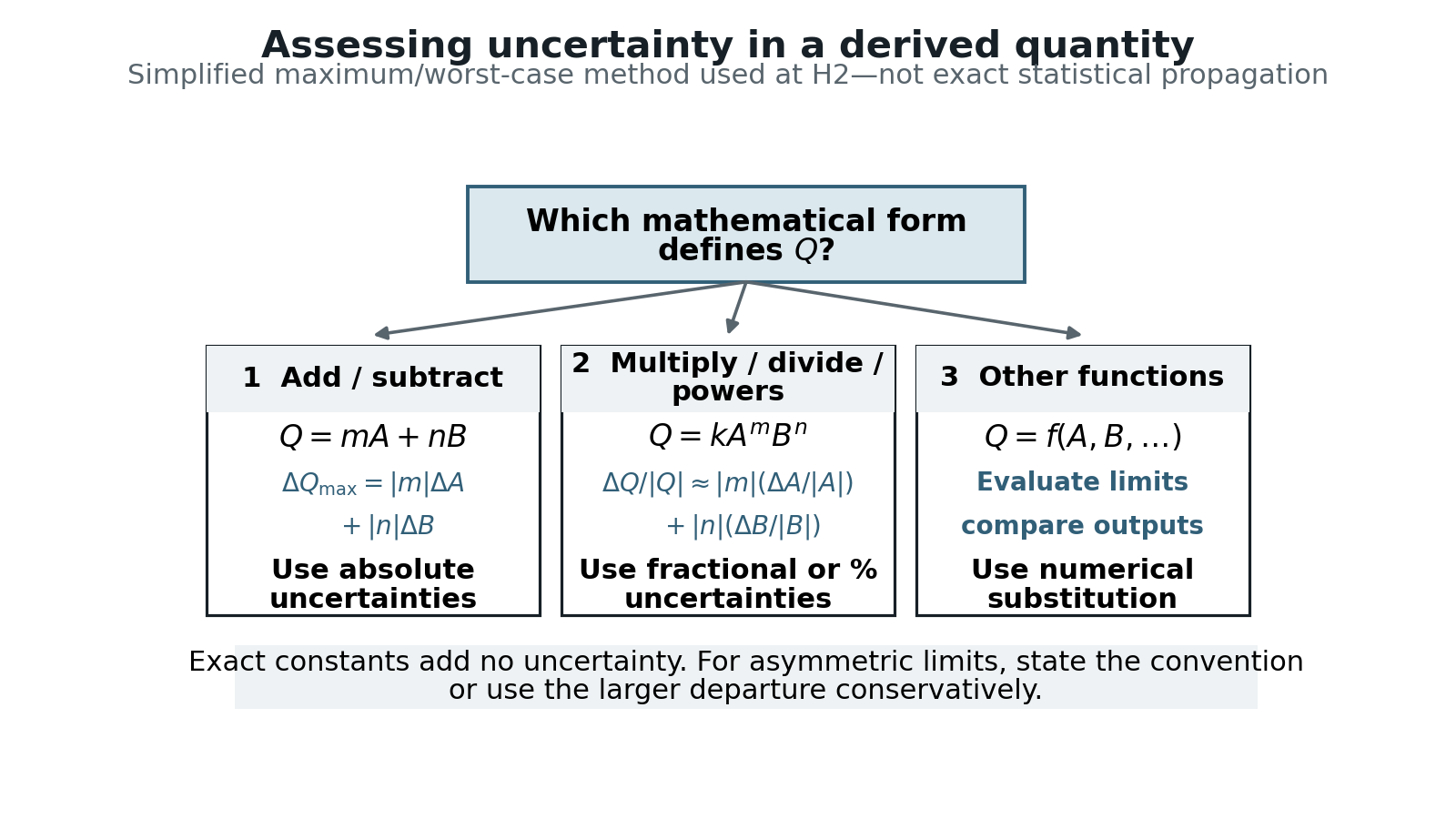
Figure: Choose the method from the mathematical structure. Add absolute uncertainties for sums and differences; add fractional or percentage uncertainties for products, quotients and powers; use limiting-value numerical substitution for other functions. These are maximum-uncertainty assessments.
Rule
For:
or
Add absolute uncertainties:
More generally, for exact numerical constants and ,
An exact numerical constant contributes no uncertainty of its own. If a quantity described as a “constant” was measured and has a stated uncertainty, that uncertainty must still be propagated.
Why?
Worst-case uncertainty occurs when both values shift in the direction that maximises the error.
Example 1: Addition
Then:
Uncertainty:
Final answer:
Example 2: Subtraction
Uncertainty still adds:
So:
2. Multiplication and Division
Rule
For:
or
Add fractional uncertainties:
Example 3: Multiplication
Value:
Fractional uncertainty:
Absolute uncertainty:
Final answer:
Example 4: Division
Where:
Value:
Fractional uncertainty:
Absolute uncertainty:
So:
3. Powers
Rule
For:
Multiply the fractional uncertainty by the magnitude of the power:
Example 5: Area of Square
Side length:
Area:
Fractional uncertainty:
Absolute uncertainty:
Final answer:
Example 6: Volume of Sphere (radius term)
Since:
Then:
4. Combined Expressions
For the general product-of-powers form
where is exact, the assessed maximum fractional uncertainty is
For expressions like:
Use:
(Signs in formula do not matter for uncertainty addition.)
5. Max-Min Method
When Used
Useful when:
- formula is complicated
- involves trigonometric or logarithmic functions
- quick estimation needed
For each measured input, use its allowed upper and lower values and determine which combination actually gives and . For a non-monotonic function, “put every input at its maximum” may not maximise the result; inspect the function over the stated uncertainty interval.
Method
- Calculate the central result from the stated central inputs.
- Test the allowed input extremes that could produce and .
- Use one of these conventions explicitly; do not mix their centre and uncertainty:
Retain the central result and use the larger departure conservatively:
then report .
Or use the limiting interval’s midpoint and half-range:
then report .
Example 7
Where:
Central value:
The extra displayed zero is retained here as a guard digit so that the final central value can be quoted to the same decimal place as its uncertainty.
Maximum:
Minimum:
So:
Retaining the central result, the conservative final statement is
Two uncertainty digits are retained here so that rounding does not reduce the stated maximum departure below . The alternative midpoint/half-range convention would use and ; its centre must not be silently replaced by .
Example 8: Numerical substitution for a trigonometric expression
Suppose , where and . Over this interval, increases with and decreases with , so
The departures from the central value are and . A conservative one-significant-figure uncertainty is therefore , giving
If limiting values are asymmetric about the central result, state the convention used: take the larger departure conservatively, or report a midpoint and half-range if that is the required convention.
6. Percentage Uncertainty Shortcut
Sometimes easiest to convert all uncertainties into percentages.
Example:
Percentage uncertainty:
If:
Then:
7. Rounding Rules
Uncertainty
- In this course, quote uncertainty to 1 significant figure normally.
- Retain 2 significant figures when the leading digit is 1, or when a stated examination/data convention requires it, to avoid an unnecessarily coarse rounded uncertainty.
- Other sensible conventions may be accepted when applied consistently; do not switch conventions merely to improve agreement with an expected value.
Measured Value
- Round to the same decimal place as the uncertainty
Example
Exam Relevance
In exams, propagation questions usually test whether you choose the correct uncertainty rule for the mathematical form of the calculated quantity.
Common Exam Mistakes
- adding percentage uncertainties for addition
- adding absolute uncertainties for multiplication
- forgetting power multiplier
- rounding too early
- giving more precision than justified
- forgetting units
Fast Revision Summary (Pattern-Based)
| Type of Mathematical Expression | Uncertainty Rule |
|---|---|
| or | |
| or | |
| $\Delta Q/Q= | |
| (constant ) | $\Delta Q= |
| $\Delta Q/Q= |
Complex Case
Use max-min method.
How to Use This Table
- Identify the form of the equation
- Match it to the row
- Apply the corresponding rule
Quick Examples
- If → use absolute uncertainties
- If → use fractional uncertainties
- If → multiply fractional uncertainty by 2
Key Insight
- Addition / subtraction → absolute uncertainty
- Multiplication / division / powers → fractional uncertainty
Worked Mini Drill
If:
Find:
Value:
Fractional uncertainty:
Absolute uncertainty:
Final answer: