Power and Efficiency
Branch role: This page distinguishes average from instantaneous power and develops efficiency as consistent input–output energy accounting.
Overview
This branch note treats power as the rate of energy transfer and efficiency as a matched input-output comparison over the same system and interval.
Core Ideas
- Average power uses a finite energy transfer divided by a finite time.
- Instantaneous mechanical power can be written as for the force doing the work.
- Efficiency compares useful output with total input and is always tied to a clearly defined device or process.
Exam Relevance
Use this note for vehicle, lift, slope, motor and device-efficiency questions where the key decision is which energy or power is useful and which is input.
Power is a rate
Power measures how rapidly work is done or energy is transferred. The SI unit is the watt:
A more powerful machine can perform the same work in less time. Power alone does not state the total energy transferred.
Average power
Over a finite interval,
Average power depends on the total transfer and elapsed time, not necessarily on the force or velocity at either endpoint.
Instantaneous mechanical power
For a force whose point of application moves with instantaneous velocity ,
Since an infinitesimal work is
and ,
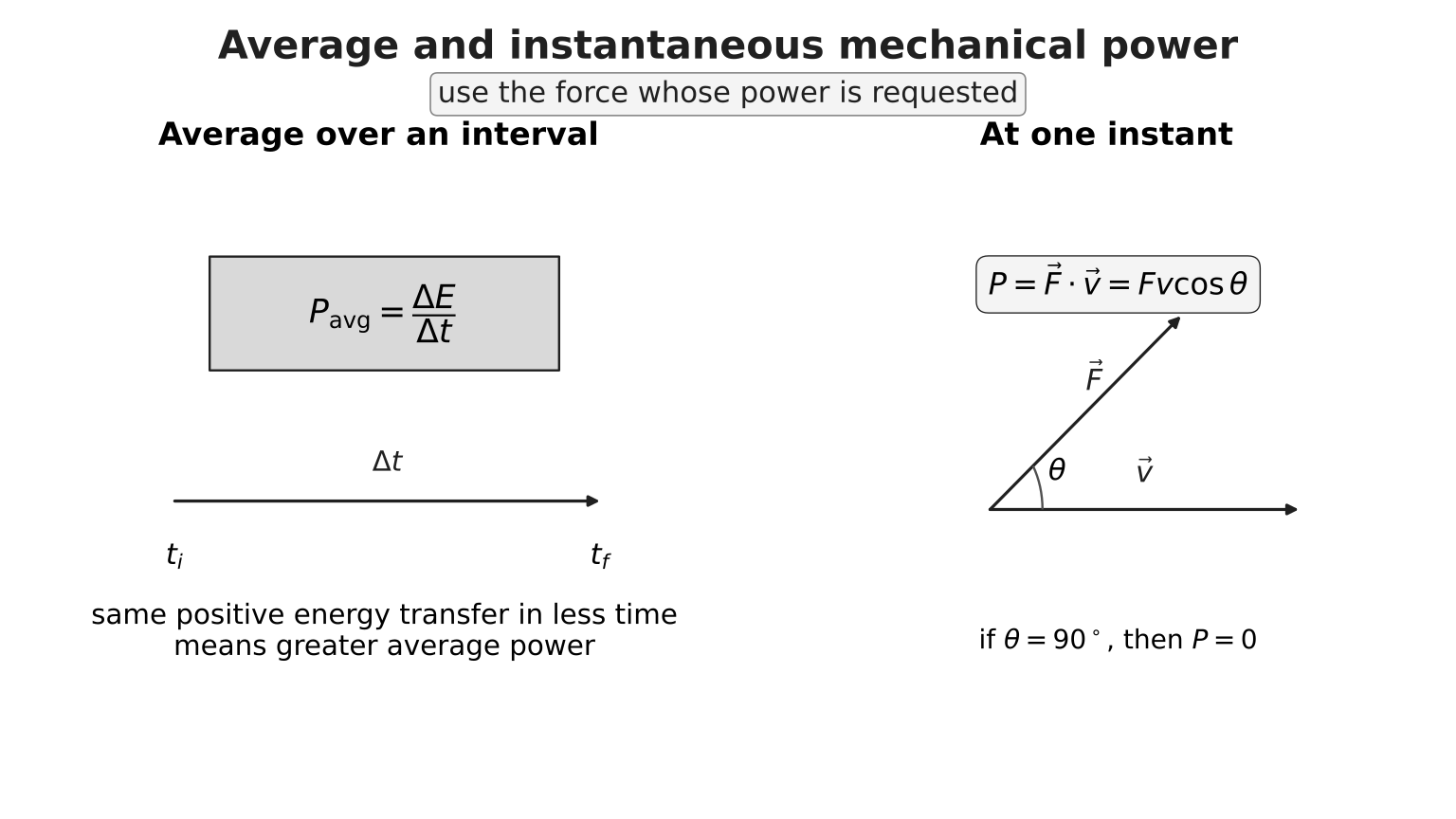
Figure: Average power uses a finite energy transfer divided by a finite time. Instantaneous mechanical power uses the current force and velocity of the point of application. The parallel component transfers energy; a perpendicular force gives zero power even when it changes the velocity direction.
Which force belongs in ?
Use the force whose power is asked for:
- engine power: use engine/driving force;
- power dissipated by drag: use drag force and obtain a negative signed power or quote the positive dissipation rate;
- rate of change of kinetic energy: use resultant-force power, .
These are not interchangeable.
Constant-speed motion
At constant velocity,
but individual forces and their powers need not be zero. On a level road, if a car moves at constant speed against resistance ,
The engine’s useful mechanical power is
The resistive force removes mechanical energy at the same rate, so the kinetic energy stays constant.
Lifts and slopes
For a lift of total mass rising at constant speed against a constant frictional force ,
so
For a vehicle moving uphill at constant speed along angle against resistance ,
and
If the vehicle accelerates, include in the force equation before using .
Efficiency
Efficiency is the fraction of total input converted to the intended useful output:
For steady operation or matched time intervals,
Percentage efficiency is
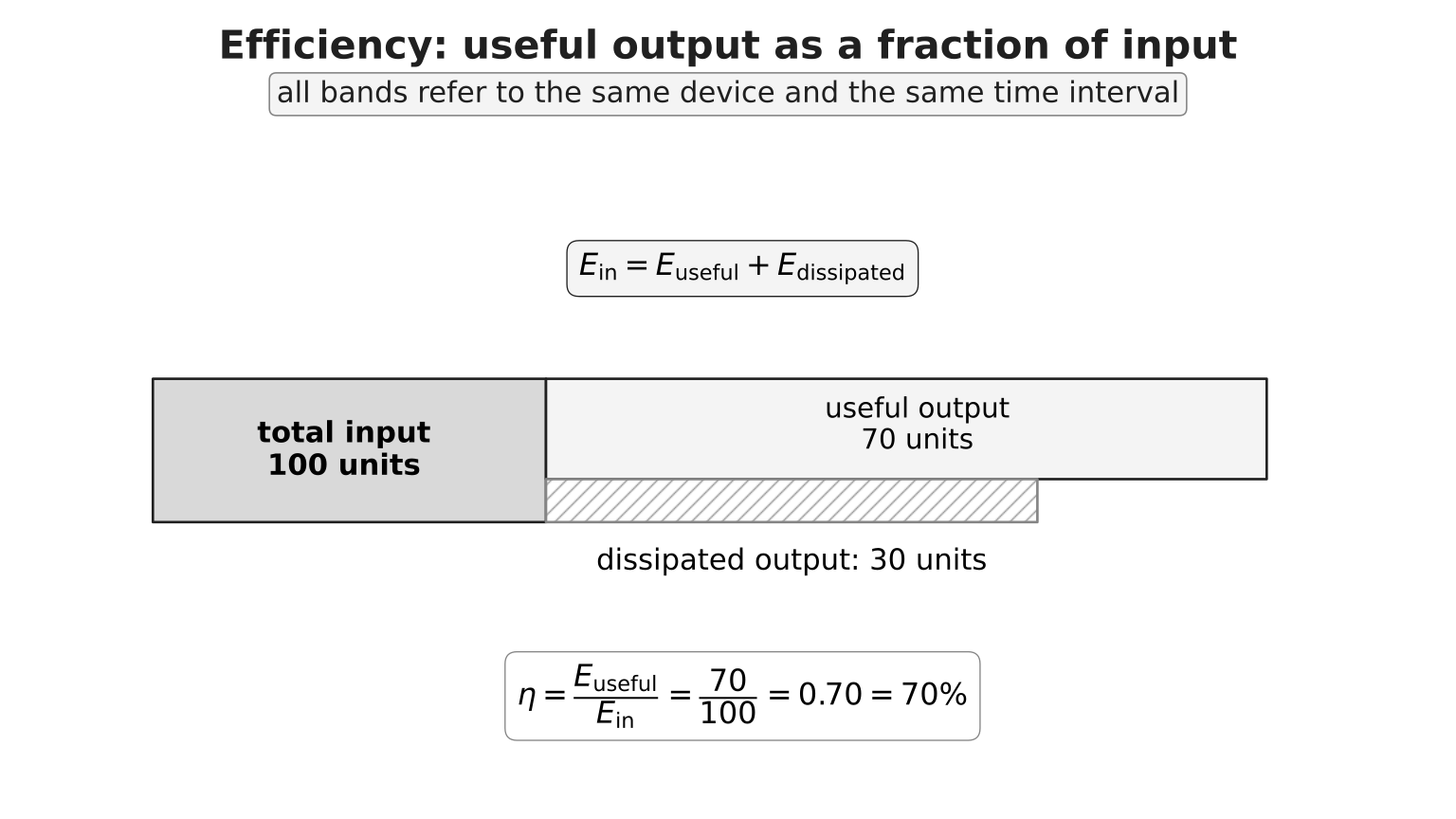
Figure: The total input divides into useful and dissipated outputs over the same interval. Band widths represent energy amounts, so the useful-output width divided by the input width is . The dissipated output remains energy, commonly increasing internal energy of the device and surroundings.
For a passive energy-conversion device,
An answer above signals mismatched quantities, an inverted ratio or inconsistent units.
Worked examples
7.1 Average versus final instantaneous power
A car of mass accelerates uniformly from rest to in against constant resistance .
The acceleration is
Hence the constant engine force is
For uniform acceleration, the average speed is , so
At ,
The final instantaneous power is twice the average because the force is constant while speed rises linearly from zero.
7.2 Lift efficiency
A lift gains GPE at while the motor receives electrical power:
The remaining
is dissipated, for example through heating and sound.
7.3 Falling water
Water falls through height at mass flow rate . The rate of GPE decrease is
If a turbine–generator has efficiency , its electrical output is
This illustrates why a mass flow rate, not total mass alone, is needed for continuous power.
Common errors
- Confusing energy in joules with power in watts.
- Using instead of .
- Using resultant force when the question asks for engine power.
- Assuming constant speed means individual forces and powers are zero.
- Using average speed in an instantaneous-power calculation without justification.
- Dividing input by useful output when calculating efficiency.
- Mixing energies measured over different time intervals in an efficiency ratio.
- Describing dissipated energy as destroyed.
Summary
| Quantity | Relationship | Condition |
|---|---|---|
| average power | finite interval | |
| instantaneous power by a force | velocity of its point of application | |
| energy efficiency | same device/process | |
| power efficiency | steady or matched interval |