Energy Forms and Conservation
Branch role: This page develops system-based energy accounting and the conditions under which mechanical energy is conserved.
Overview
This branch note deepens the Topic 06 energy-accounting idea: energy is not used up, but it may be transferred between stores or dissipated into less useful forms depending on the chosen system boundary.
Core Ideas
- Conservation of total energy is an accounting principle for a clearly chosen system.
- Mechanical energy is conserved only under additional conditions, such as negligible dissipative forces.
- Work, heating, electrical transfer and radiation describe energy transfer pathways, not separate substances.
Exam Relevance
Use this note when a question asks where energy has gone, whether mechanical energy is conserved, or how to define a system boundary before writing an energy equation.
Conservation is an accounting principle
Energy is a scalar quantity measured in joules. The principle of conservation of energy states:
Energy cannot be created or destroyed. It may be transferred between systems or transformed between forms, while the total energy of an isolated system remains constant.
An isolated system has no energy transfer across its boundary. For it,
This does not mean every individual form of energy remains constant.
Forms relevant to H2 Physics
| Energy store or carrier | What it describes | Typical example |
|---|---|---|
| kinetic | macroscopic motion | moving trolley |
| gravitational potential | configuration of masses | raised object–Earth system |
| elastic potential | deformation | compressed spring |
| electric potential | configuration of charges | charge in an electric field |
| internal | microscopic kinetic and interaction energies | warmer brake and wheel |
| chemical | molecular configuration | fuel, battery, food |
| nuclear | nuclear configuration | fission, fusion, decay |
| electromagnetic radiation (energy carrier) | energy transported by EM waves between systems | light from a lamp |
The first seven rows describe energy stored in a system; electromagnetic radiation is an energy carrier between systems. Similarly, sound transfers energy by a mechanical wave rather than acting as a separate stored “substance”. In exam explanations, name both the source and receiving system where possible.
Stores, transfers and transformations
Examples:
- falling body: gravitational potential energy decreases while kinetic energy increases;
- braking car: kinetic energy decreases while internal energy of brakes, tyres, road and surroundings increases;
- lamp: electrical transfer produces radiation and increases internal energy;
- motor lifting a load: electrical input raises gravitational potential energy and also produces dissipative heating.
Avoid saying energy is “used up”. Say it is transferred or transformed, and identify the destination.
System boundary first
The same event can be described with different correct equations.
Object-only system
For a falling object alone, if gravity is the only force doing work, its work is the net work:
Object–Earth system
Gravity is represented internally through gravitational potential energy:
when air resistance and other transfers are negligible.
Do not include both and in the same accounting equation for the same interaction; that double-counts the transfer.
Mechanical energy
Mechanical energy is
where includes the potential energies chosen for the system.
It is conserved when no net external or non-conservative transfer changes it:
This condition is narrower than total-energy conservation.
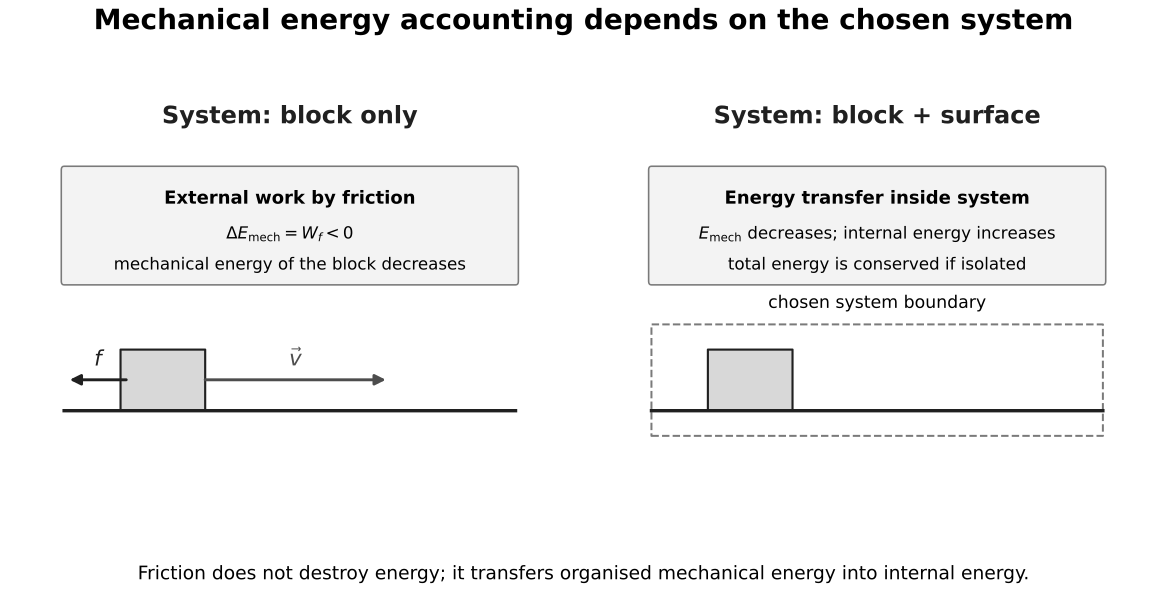
Figure: For a block sliding horizontally on a rough surface, a block-only system has decreasing because friction does negative external work on the block. Expanding the isolated system to include both the block and the surface shows the corresponding increase in internal energy. The figure therefore distinguishes “mechanical energy decreases” from the incorrect statement “energy disappears”.
Transfer equation
When potential energies are already included and an external non-conservative force does work,
This notation is a bookkeeping choice. State which forces are represented by and which are included in .
For a wider system that includes the surfaces experiencing friction,
A reliable solution method
- Draw or state the system boundary.
- Choose initial and final states.
- List energy stores that change.
- Identify work, heating or radiation across the boundary.
- Write an energy equation before substituting numbers.
- Check signs using physical meaning.
- Check that calculated kinetic energy is non-negative and that the assumed final state is reachable.
Worked examples
7.1 Falling through air
A ball falls from rest and reaches .
Using unrounded values, the gravitational potential-energy decrease is
The kinetic-energy increase is
Thus
is transferred from mechanical energy, principally into internal energy of the air and ball.
If the average drag magnitude is requested,
7.2 Spring and rough surface
A spring initially stores . It launches a block that later has of kinetic energy. If other stores are unchanged, the energy transferred into internal energy is
The efficiency of this conversion to block kinetic energy is
7.3 Can the body reach the height?
A body starts with kinetic energy and must gain GPE while friction transfers to internal energy. The required energy is , exceeding the available . The assumed final point is not reached. A negative computed is a warning to revisit the physical endpoint, not a permissible energy value.
Common errors
- Applying mechanical-energy conservation merely because total energy is conserved.
- Calling internal-energy increase “lost energy” without naming its destination.
- Double-counting gravity as both external work and GPE change.
- Ignoring the system boundary in a friction problem.
- Assuming frictional work is always simply without checking whether is constant and whether is path length along the contact.
- Accepting a negative final kinetic energy instead of concluding the stated final position is unreachable.
Summary
| Statement | Condition |
|---|---|
| isolated system | |
| definition for chosen mechanical stores | |
| no net transfer changes mechanical energy | |
| conservative interactions represented by ; other external work explicit |