Heat Capacity and Latent Heat
Branch note: This page deepens one part of Thermal Physics A.
Overview
This page focuses on how thermal energy changes the temperature or state of a substance.
Two major possibilities when energy is supplied:
-
Temperature changes
Use:or
-
State changes at constant temperature
Use:
This page supports:
Definition
Heat capacity describes energy needed to change temperature. Latent heat describes energy needed to change state without temperature change.
Why It Matters
This topic explains why water heats slowly, why metals heat quickly, why melting and boiling occur at constant temperature, and how calorimetry questions are really conservation-of-energy problems.
Key Representations
Core Ideas
- Heat capacity describes energy needed for a temperature rise of a particular object.
- Specific heat capacity describes energy needed per unit mass per kelvin.
- Latent heat describes energy transferred during a change of state at constant temperature.
- Heating curves separate sloped temperature-change regions from flat phase-change regions.
- Calorimetry is conservation of energy applied to thermal transfers.
Exam Relevance
Use this branch for formula choice in thermal-energy questions, multi-stage heating calculations, calorimetry and mixing, heating-curve interpretation, and distinguishing temperature change from change of state.
Heat, Temperature and Internal Energy
Heat
Heat is energy transferred due to a temperature difference.
Unit:
Temperature
Temperature describes thermal state and determines the direction of spontaneous thermal-energy transfer.
Internal Energy
Internal energy is the total microscopic energy of particles:
- random kinetic energy
- intermolecular potential energy
Supplying heat usually increases internal energy.
Heat Capacity
Definition
Heat capacity of an object is the thermal energy required to raise its temperature by (or ).
Formula
Where:
- = thermal energy supplied
- = heat capacity
- = temperature rise
Unit
Notes
Heat capacity depends on:
- mass of object
- material of object
A larger object usually has a larger heat capacity.
Specific Heat Capacity
Definition
Specific heat capacity is the thermal energy required to raise the temperature of 1 kg of a substance by .
Formula
Where:
- = mass
- = specific heat capacity
Unit
Meaning of Large or Small Specific Heat Capacity
Large
Needs more energy for same temperature rise.
Examples:
- water
For equal masses receiving equal net energy under comparable loss conditions:
- its temperature changes less
- it generally warms or cools more slowly for the same net power
- useful in engine cooling and climate moderation
Small
Needs less energy for same temperature rise.
Examples:
- many metals
Implications:
- heats quickly
- cools quickly
Comparing Heat Capacity and Specific Heat Capacity
Heat Capacity
Applies to entire object.
Specific Heat Capacity
Property of material.
Relation:
Worked Example 1
A block has heat capacity:
Find heat needed to raise temperature by .
Worked Example 2
A mass of water is heated from to .
Take:
Calorimetry and Mixing Problems
Core Principle
For an insulated system:
This follows conservation of energy.
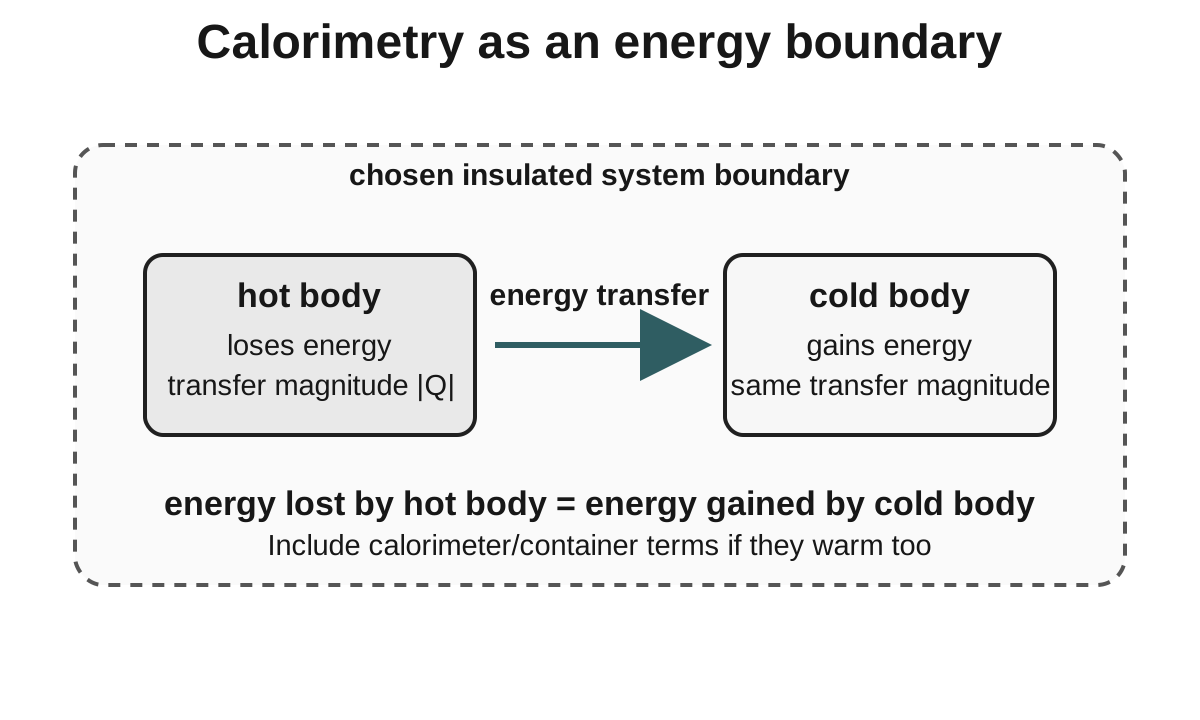
Figure: Draw a system boundary around every component included in the energy balance. For an effectively insulated boundary, the magnitude of energy lost by the initially hotter components equals the energy gained by the initially colder components. If a calorimeter or container changes temperature, include its energy change rather than treating it as an unexplained loss.
Typical Mixing Setup
Hot object placed in cooler water.
Final temperature becomes common equilibrium temperature.
Use:
where:
- hot object cools
- cold object warms
Worked Example 3
A copper block at is placed in water at .
Take:
Find final temperature .
Water temperature changes much less because water has large thermal capacity.
Important Assumptions in Calorimetry
Usually assume:
- no heat loss to surroundings
- no evaporation
- container heat capacity negligible (unless given)
- final equilibrium reached
If calorimeter has heat capacity , include:
Latent Heat
Meaning
The specific latent heat is the magnitude of energy transferred per unit mass to change phase at constant temperature under specified conditions. During the reverse change, the same magnitude of energy is released.
For a pure substance changing phase at fixed pressure, the energy changes particle arrangement and interparticle potential energy rather than increasing mean random kinetic energy.
The formula applies to the mass that changes state while already at the phase-change temperature. If the substance starts below or above that temperature, include the relevant stage before or after the phase change.
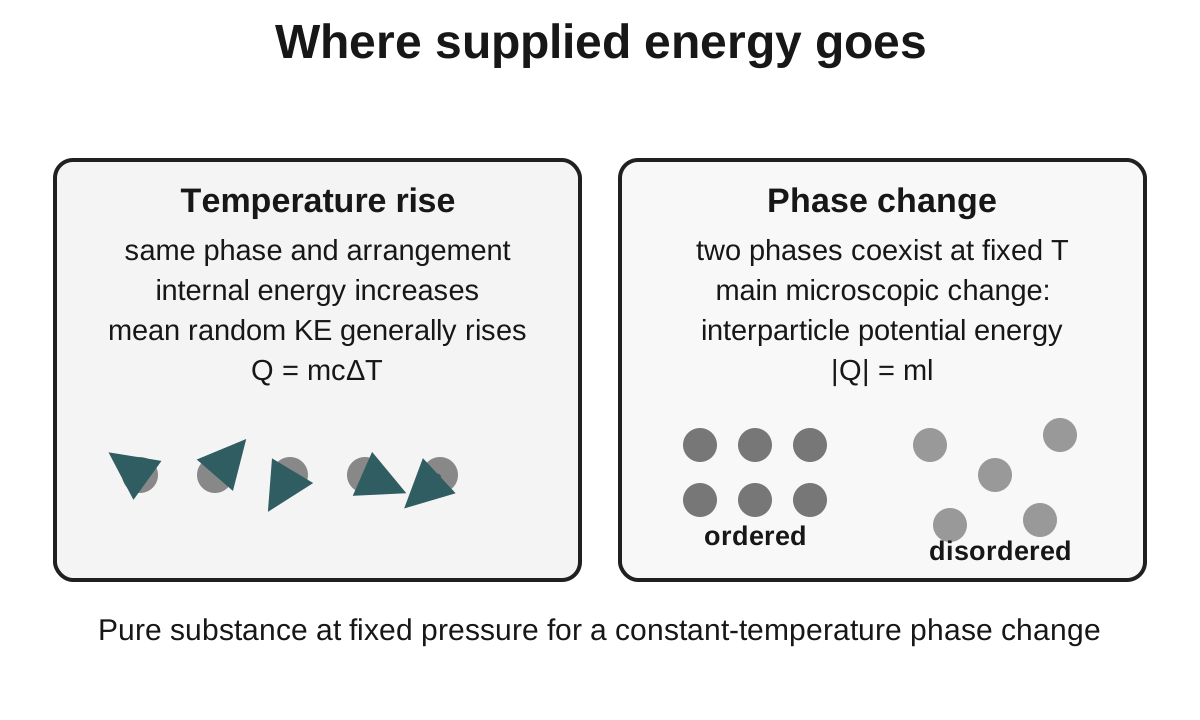
Figure: Energy supplied within one phase can increase mean random kinetic energy and temperature, modelled by . During a phase change of a pure substance at fixed pressure, both phases coexist; mean random kinetic energy and temperature remain constant while interparticle potential energy changes, modelled by .
Specific Latent Heat
Formula
Where:
- = mass
- = specific latent heat
Unit
Types of Latent Heat
Specific Latent Heat of Fusion
Energy required to change:
- solid liquid
at constant temperature for a pure substance at fixed pressure.
Specific Latent Heat of Vaporisation
Energy required to change:
- liquid gas
at constant temperature for a pure substance at fixed pressure.
Usually:
because particles separate much more fully.
Worked Example 4
Energy to melt ice at :
Take:
Worked Example 5
Energy to boil away water at :
Take:
Heating Curves
A heating curve shows temperature against time or energy supplied.
Typical stages:
- solid warms
- melting plateau
- liquid warms
- boiling plateau
- gas warms
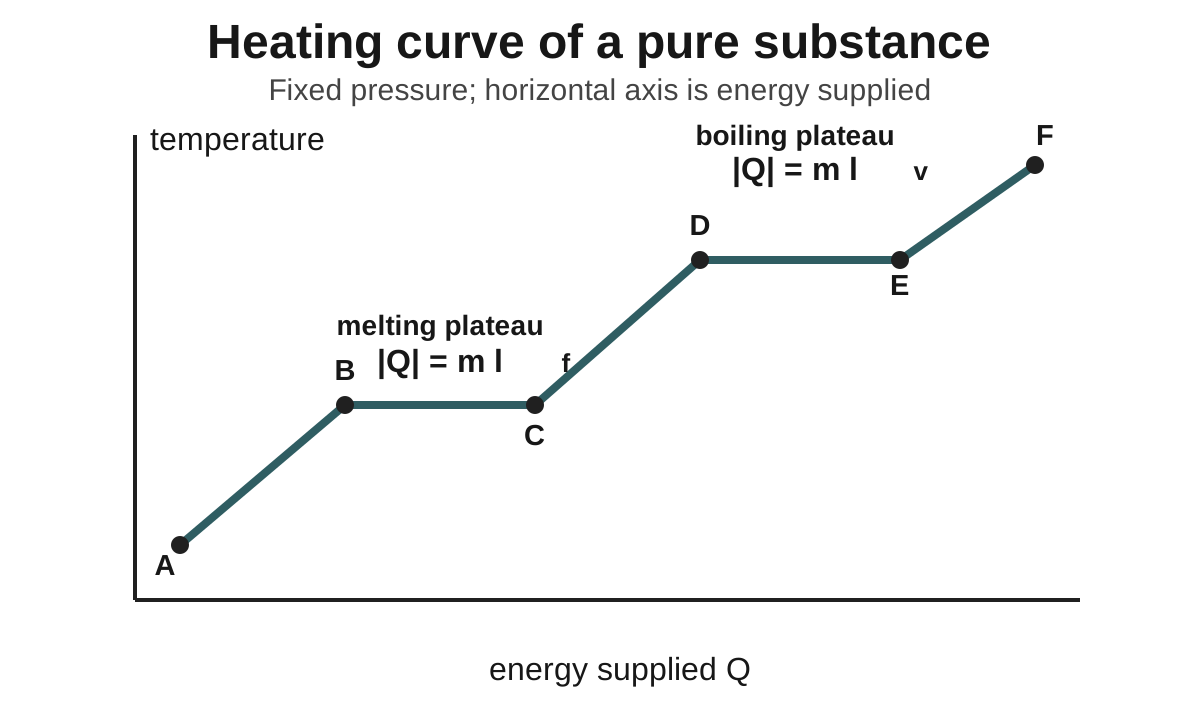
Figure: For a pure substance at fixed pressure, sloping regions represent single-phase warming and use . Flat regions represent coexistence of two phases and use . If the horizontal axis is time, the net heating power must be constant before horizontal widths can be compared as energy intervals.
Read the graph section by section: sloping parts use , while flat parts use .
Interpretation of Sloping Sections
Temperature rises:
Use:
Energy increases average kinetic energy.
Interpretation of Flat Sections
Temperature constant:
Use:
Energy increases separation of particles or intermolecular potential energy.
Multi-Step Energy Problems
Sometimes combine formulas.
Example: Ice at to steam at :
- Warm ice
- Melt ice
- Warm water
- Boil water
Use the correct equation for each stage.
Worked Example 6
Find energy to convert ice at to water at .
Take:
Step 1: Melt ice
Step 2: Heat water
Total
Links
- Thermal Physics A
- Thermal Measurement and Scales
- Thermal Practicals
- Thermal Physics A Common Exam Traps
- Work, Energy and Power
Summary
The key skill is deciding whether the energy supplied is:
- raising temperature
- changing state
- or doing both in stages
Once that is clear, the formula choice usually becomes straightforward.