Thermal Practicals
Supporting practical enrichment
This page develops experimental-transfer skills using methods in the older anchor notes. The 2026 syllabus requires the thermal quantities and energy reasoning, but it does not prescribe this complete apparatus list. Learn the core definitions first.
Overview
This page focuses on experimental determination of thermal quantities in H2 Physics.
Main practical themes:
- specific heat capacity of solids
- specific heat capacity of liquids
- continuous-flow calorimetry
- specific latent heat of fusion
- specific latent heat of vaporisation
- electrical heating methods
- heat-loss correction methods
- apparatus interpretation
- common sources of error
Most practicals use electrical energy:
Where:
- = current
- = potential difference
- = heating time
This page supports:
Definition
Thermal practicals are experiments where electrical energy is converted into thermal energy and related to temperature rise or change of state.
Why It Matters
This topic develops practical skills in setting up apparatus safely, identifying heat losses, interpreting apparatus, choosing the right thermal model, and explaining how correction methods improve accuracy.
Key Representations
Core Ideas
- Electrical heating methods usually start from .
- The thermal model then depends on whether temperature changes or state changes.
- Heat losses, thermometer lag, poor insulation, and non-uniform temperature are common practical limitations.
- Good answers explain apparatus roles, assumptions, and correction methods, not only formulas.
- Practical questions often test whether the measured energy input is equal to the useful thermal energy gained.
Exam Relevance
Use this branch for practical questions involving electrical heating, specific heat capacity, latent heat, calorimetry, continuous-flow methods, heat-loss corrections, apparatus roles, and sources of uncertainty.
Core Experimental Principle
Electrical energy supplied is converted into thermal energy.
In an idealised energy boundary, if losses and the heat capacities of the heater/container are negligible:
Then combine with:
or
depending on the process.
Determination of Specific Heat Capacity of a Solid
Standard Heated Metal Block Method
A metal block contains:
- electric heater
- thermometer or temperature probe
- insulation around block
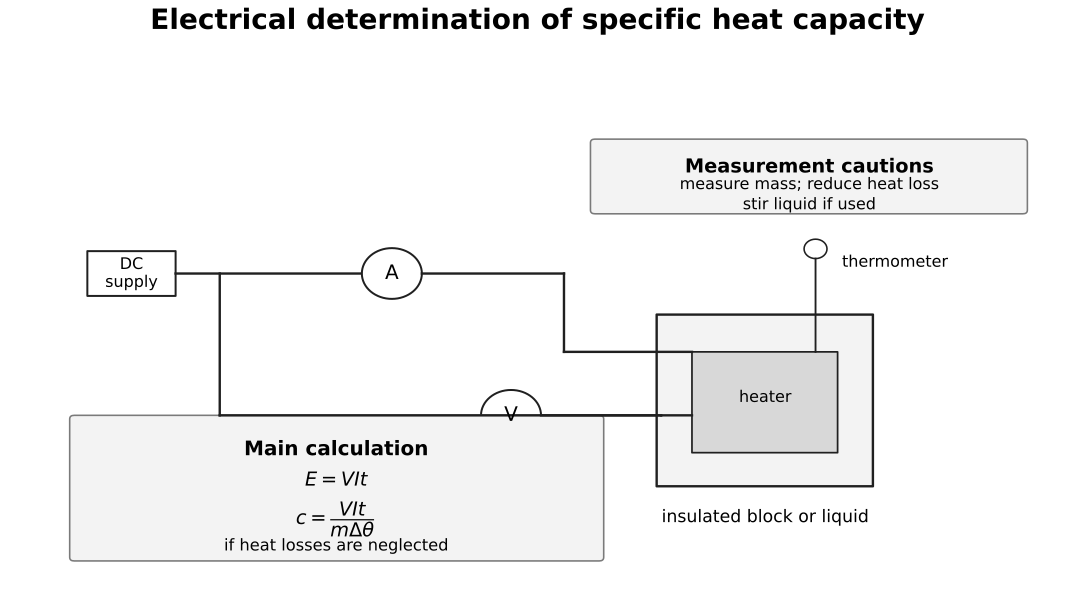
Figure: In an electrical specific-heat-capacity experiment, electrical energy supplied by the heater is compared with the thermal energy gained by the sample.
Measure:
- mass
- current
- voltage
- heating time
- temperature rise
Formula
Assuming negligible heat loss:
Hence:
Why Use a Metal Block?
Metals:
- conduct heat well
- become nearly uniform in temperature
- easy to machine holes for heater and probe
Experimental Precautions
- insulate block well
- ensure heater fits tightly
- thermometer inserted deeply
- record stable initial temperature
- avoid drafts
- measure mass accurately
Worked Example 1
Given:
Find .
Determination of Specific Heat Capacity of a Liquid
Calorimeter Method
Liquid placed in insulated calorimeter with:
- immersion heater
- thermometer
- stirrer
Measure:
- mass of liquid
- electrical input
- temperature rise
Formula (Ignoring Container)
More Accurate Formula
If calorimeter heat capacity :
So:
Importance of Stirring
Stirring helps:
- uniform temperature
- more accurate thermometer reading
- faster equilibrium
Continuous-Flow Method for Liquids
Principle
Liquid flows continuously through a heated tube.
Measure:
- mass flow rate
- inlet temperature
- outlet temperature
- electrical power
Formula
If heat loss is negligible:
Hence:
Advantages
Compared with static calorimeter:
- less heat stored in apparatus
- easier steady-state measurement
- more suitable for liquids
Two-Trial Heat-Loss Correction
Real Situation
Some power is lost to surroundings:
Where:
- is the mass-flow rate in
- is the approximately steady heat-loss power in watts
Repeat with a different flow rate while reproducing the inlet temperature, outlet temperature, mean apparatus temperature and steady operating conditions as closely as possible.
Then:
Subtract equations to eliminate .
This gives more accurate .
Why Keep Same Temperature Difference?
Because heat loss depends strongly on temperature difference between apparatus and surroundings.
Keeping the same is useful but is not sufficient by itself; the apparatus must have a similar temperature distribution relative to the surroundings so that is approximately the same in both trials.
Determination of Specific Latent Heat of Fusion
Typical Ice Method
Crushed melting ice in funnel.
Heater inserted into ice.
Water produced is collected.
Use second identical setup without heater to estimate environmental melting.
Why Must Ice Be Melting?
At the stated pressure, ice already coexisting with water is at its melting temperature (approximately at standard atmospheric pressure).
Therefore no initial warming term is needed in that specified condition.
This is only true if the ice is already melting at . If the ice starts below , an additional warming term is needed before melting.
Formula
Let:
- = water collected with heater
- = water collected without heater
Mass melted by heater only:
Then:
So:
Worked Example 2
Given:
Determination of Specific Latent Heat of Vaporisation
Boiling Method
Liquid is boiled electrically.
Steam or vapour produced is condensed and collected.
Measure:
- electrical input
- mass vaporised
- time
Formula (Idealised)
Real Case With Heat Loss
Repeat with second power setting:
Subtract to remove .
Apparatus Interpretation Skills
You may be asked:
- why insulation is used
- why stirring is needed
- why thermometer is placed centrally
- why crushed ice is used
- why second control setup is needed
- why steady state is required
These are common exam questions.
Common Sources of Error
Heat Loss to Surroundings
Causes measured values to be too high or too low depending on setup.
Poor Thermal Contact
Heater not fitted tightly into metal block.
Temperature Lag
Thermometer responds slowly.
Incomplete Stirring
Liquid temperature non-uniform.
Evaporation or Splashing
Mass measurement inaccurate.
Reading Errors
Stopwatch, ammeter, voltmeter, thermometer.
Improving accuracy and managing trade-offs
- use insulation
- use digital sensors
- repeat and average to reduce random scatter; this does not remove a systematic heat-loss bias
- wait for steady readings
- stir continuously
- reduce drafts
- use two-trial correction methods
A larger temperature rise reduces the fractional uncertainty in a temperature measurement, but it also increases the temperature difference from the surroundings and usually increases heat loss. A good design chooses a measurable rise without making this loss excessive; it does not treat “larger ” as an unconditional improvement.
Worked Example 3
Continuous flow heater:
- flow rate
- temperature rise
Find .
Power:
Then:
(close to water)
Data Analysis Tips
Graph Method
If experiment is repeated for different powers:
Plot:
- power vs
Gradient may give .
Intercept may represent heat loss.
Summary
Thermal practicals are mainly about tracking where electrical energy goes, identifying losses, and justifying how the method improves accuracy.
For a solid or liquid being heated with negligible losses:
so:
For a liquid, if the calorimeter also absorbs energy:
For mixing calorimetry:
For latent heat of fusion or vaporisation:
This applies to the mass that changes state at the phase-change temperature. If the substance starts below the phase-change temperature, warming terms must be included.
For a continuous flow calorimeter:
where is mass flow rate.
Useful plots include against , against , and temperature against time. With continued heating of a pure substance at fixed pressure, a temperature plateau can indicate a phase change while two phases coexist.
Real systems lose energy by conduction, convection, radiation, and evaporation. Reduce unwanted transfer using insulation, a lid, reduced draughts and an appropriate short heating duration. Repeat-and-average reduces random scatter, not systematic heat loss. A larger reduces fractional reading uncertainty but usually increases heat loss, so it is a design trade-off rather than an unconditional improvement.
Common Exam Traps
Do not assume is exact unless heat losses are negligible.
Include container heat capacity if given.
Stir liquids for uniform temperature.
Avoid measuring temperature too late after heating stops because cooling begins immediately.
For latent heat of fusion, ice should be dry before measuring mass; surface water causes error.
Convert units carefully: g to kg, min to s, and kJ to J.
Check zero error and calibration for thermometers and balances.