Electric Capacitance
Overview
Electric capacitance studies how charge can be stored on conductors separated by an insulator, how much energy is stored during charging, and how capacitors behave in DC circuits.
This inserted topic sits naturally between:
It uses circuit ideas such as charge, potential difference, current, resistance, and energy, but it also prepares for electric-field reasoning because a charged capacitor creates an electric field between its plates.
A capacitor is best understood as a temporary store of separated charge and electric potential energy. Unlike a resistor, which dissipates electrical energy when current flows through it, a capacitor stores energy in the electric field between its plates. This makes capacitors important in timing circuits, smoothing circuits, camera flashes, memory elements, and many transient circuit behaviours.
Main ideas:
- capacitance measures charge stored per unit p.d.
- capacitor energy is the work done to move charge onto the plates
- dielectrics increase capacitance qualitatively
- capacitor combinations follow rules opposite in form to resistor combinations
- RC circuits charge and discharge exponentially
- the time constant controls the pace of change
Core Ideas
Capacitor questions are usually won by identifying which quantity is shared, fixed, or changing.
For a single capacitor:
For capacitor networks:
- parallel capacitors share the same p.d.
- series capacitors store the same charge magnitude
For RC circuits:
- a discharging capacitor has , , and current magnitude all decaying exponentially
- a charging capacitor has and building up while current decays
For energy:
- the stored energy is the area under a against graph
- the factor appears because the p.d. rises during charging
Mental Map: What Changes and What Stays the Same?
A useful mental map for this topic is:
- charge storage: a capacitor stores separated charge, not net charge
- p.d.: separated charge creates a p.d. across the plates
- capacitance: measures how much charge is stored per unit p.d.
- energy: charging requires work because more charge is pushed onto plates that already have charge
- parallel networks: same p.d., charges add
- series networks: same charge, p.d.s add
- RC circuits: resistance controls how quickly charge flows; capacitance controls how much charge can be stored
Exam Relevance
Capacitance is calculation-heavy but conceptually compact. Common question types include direct use of , energy stored, network combinations, time-constant interpretation, exponential graph reading, and determining values at a stated time.
Important exam habit:
- decide first whether the problem is about charge storage, stored energy, a network, or a time-varying RC process
- identify what is shared or fixed
- choose the matching relation
- check limiting behaviour at and after a long time, if the circuit involves switching
Definition of Capacitance
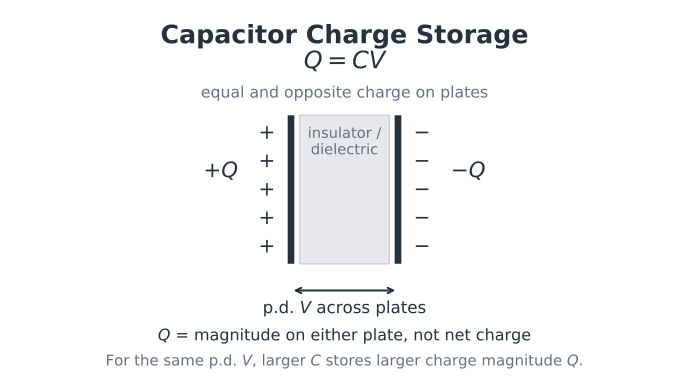
Capacitance is defined as the charge stored per unit potential difference across a pair of conductors:
where:
- is the magnitude of charge stored on either plate
- is the p.d. across the capacitor
- is the capacitance
Unit:
The farad is a large unit, so practical capacitors are often measured in:
Common conversions:
Physical Meaning
A capacitor with larger capacitance can store more charge for the same p.d.
Equivalently:
- for a given , larger gives larger stored
- for a given , larger gives smaller p.d.
This is why capacitance is a measure of charge-storage ability.
Caption: A capacitor stores charge separation: its plates carry equal and opposite charges, and . The stored charge magnitude on either plate is related to the p.d. across the plates by .
Stored Charge Is Not Net Charge
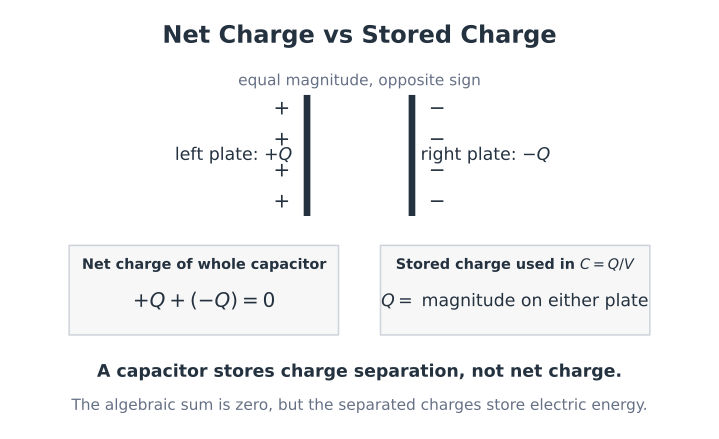
In capacitor questions, usually means the magnitude of charge on either plate, not the net charge of the whole capacitor.
If the plates carry and , the algebraic net charge of the two plates together may be zero. However, the capacitor still stores charge separation and energy.
This is why we say a capacitor stores charge even though the total charge of the two-plate system may be zero.
Caption: For a charged capacitor, the two plates carry equal and opposite charges, so the net charge of the whole capacitor is zero. In , means the magnitude of charge on either plate; the capacitor stores charge separation and electric energy.
Capacitors and Dielectrics
A simple capacitor consists of two conducting plates separated by an insulating region.
The insulating material between the plates is called a dielectric.
Qualitatively, placing a dielectric between the plates increases the capacitance. A useful way to think about this is:
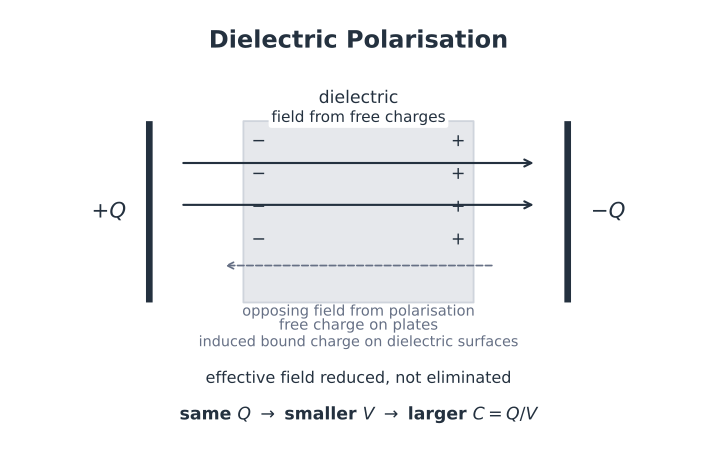
- the dielectric becomes polarised in the electric field
- induced charges in the dielectric partly oppose the field due to the capacitor plates
- the effective electric field between the plates is reduced for the same stored charge
- the p.d. across the plates is therefore reduced for the same
- since , a smaller for the same means a larger capacitance
Caption: A dielectric polarises in the electric field between capacitor plates. The induced bound charges partly oppose the field from the free plate charges, reducing the p.d. for the same stored charge . Hence increases.
Dielectric Breakdown
If the electric field inside the dielectric becomes too large, the dielectric may stop behaving as an insulator.
This is called dielectric breakdown.
Consequences:
- charge may suddenly pass through the dielectric
- a spark or short circuit may occur
- the capacitor may be damaged
Syllabus guardrail:
- qualitative dielectric effects are useful
- quantitative permittivity and dielectric-constant calculations are not assumed here unless specifically introduced by a teacher or question
Energy Stored in a Capacitor
Charging a capacitor requires work because the battery or external source must separate charge between the two plates.
The battery does not create charge. Instead, it removes electrons from one plate, leaving that plate positively charged, and pushes electrons onto the other plate, making that plate negatively charged. As this charge separation grows, the plates create an electric field and a p.d. across the capacitor.
Once a p.d. has built up, further charge separation becomes harder. The external source must continue moving charge in a way that increases the separation of positive and negative charge, against the electric effect of the charges already stored on the plates.
For a small additional amount of charge separated through a p.d. , the work done is:
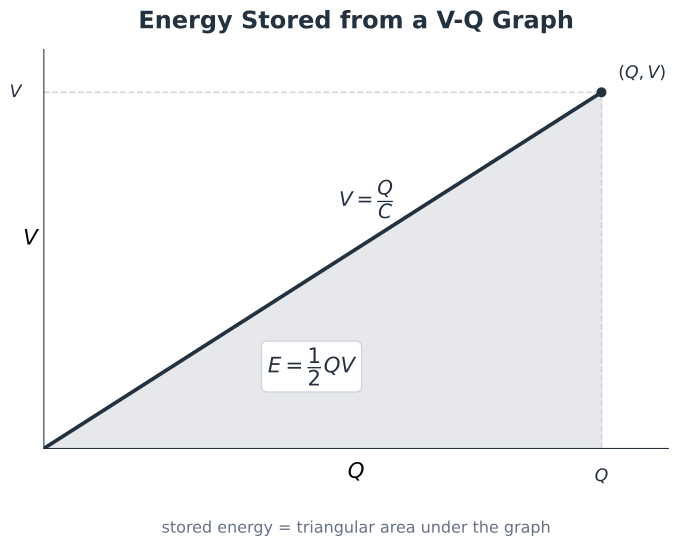
At the start of charging, the capacitor is uncharged and . As charge accumulates, the p.d. increases according to:
So the p.d. rises linearly with the charge stored.
The stored energy is therefore the area under a against graph:
Using during the charging process:
Since the final p.d. is , this can also be written as:
Using :
So the three equivalent forms are:
The factor appears because the p.d. is not constant during charging. It rises from to the final value , so the average p.d. during charging is .
Caption: During charging, the p.d. across a capacitor rises linearly with stored charge. The energy stored is the triangular area under the - graph, giving .
Why Capacitor Energy Is Not Simply
For a charge moving through a constant p.d. , the energy transferred is .
For a capacitor being charged from zero, the p.d. is not constant. It starts at and gradually rises to its final value .
The average p.d. during charging is therefore:
So the work done in charging is:
Choosing an Energy Formula
| Given information | Best formula | Why it is useful |
|---|---|---|
| and | Direct area-under-graph form | |
| and | Useful when the capacitor p.d. is known | |
| and | Useful when charge is fixed | |
| Capacitor isolated | Track | Charge on the capacitor cannot easily change |
| Capacitor connected to an ideal battery | Track | The battery fixes the p.d. across the capacitor |
A useful warning:
- if is fixed, increasing increases because
- if is fixed, increasing decreases because
This difference matters in questions involving isolated capacitors, batteries, switches, or dielectrics.
Capacitor Networks
Capacitor combinations look algebraically opposite to resistor combinations.
The reason is not a trick of formulas. It comes from which quantity is shared.
The safest method is:
- identify whether the capacitors share the same p.d. or store the same charge magnitude
- write for each capacitor if needed
- combine charges or p.d.s according to the circuit connection
- only then use the shortcut formula
Capacitors in Parallel
In parallel:
- all capacitors are connected across the same two nodes
- each capacitor has the same p.d.
- total charge is the sum of charges stored on the capacitors
Since:
and each :
Therefore:
Parallel capacitors increase the total charge-storage capacity.
Worked Example: Parallel Capacitors
A capacitor and a capacitor are connected in parallel across a supply.
Find:
- the equivalent capacitance
- the charge on each capacitor
- the total charge stored by the parallel combination
Since the capacitors are in parallel, they share the same p.d.:
The equivalent capacitance is:
The charge on the capacitor is:
The total charge stored by the parallel combination is:
Check using the equivalent capacitance:
Capacitors in Series
In series:
- the same charge magnitude appears on each capacitor
- the total p.d. is split across the capacitors
- the equivalent capacitance is smaller than the smallest individual capacitance
Since:
and each :
Therefore:
For two capacitors in series, this can also be written as:
Why the Smaller Capacitor Gets the Larger P.D.
In series, each capacitor stores the same charge magnitude .
Since:
for the same , a smaller gives a larger .
This is a common exam idea: in a series capacitor chain, p.d. is divided inversely with capacitance.
Caption: In series, each capacitor stores the same charge magnitude . The supply p.d. is split across the capacitors according to , so the smaller capacitance has the larger p.d.
Worked Example: Series Capacitors
Two capacitors, and , are connected in series across a supply.
Find:
- the equivalent capacitance
- the charge on each capacitor
- the p.d. across each capacitor
The equivalent capacitance is found from:
where capacitance is in .
So:
The charge on the equivalent series combination is:
In series, each capacitor stores the same charge magnitude:
The p.d. across the capacitor is:
Check:
The smaller capacitor has the larger p.d.
Network Rule Summary
| Connection | Shared quantity | What adds? | Combined capacitance |
|---|---|---|---|
| Parallel | same p.d. | charges add | |
| Series | same charge | p.d.s add |
Caption: Parallel capacitors share the same p.d. and add directly. Series capacitors store the same charge magnitude and add by reciprocals.
Capacitors in Switching Circuits
Many capacitor questions involve a switch that has just been closed or has been closed for a long time.
The two most important moments are:
- the instant just after switching, usually written as
- the final steady state after a long time, often written as
At the Instant Just After Switching
If the capacitor is initially uncharged:
- the p.d. across it is initially zero
- it may act like a short circuit momentarily, in the ideal limiting sense
- current can be large at the start, limited mainly by resistance in the circuit
This does not mean a capacitor is actually a wire. It only describes the initial instant for an uncharged capacitor in an idealised switching model.
After a Long Time in a DC Circuit
After a long time in a steady DC circuit:
- the capacitor becomes fully charged
- the current in the capacitor branch becomes zero
- the capacitor behaves like an open circuit
- the capacitor p.d. can often be found from the surrounding resistor network
Caption: In a DC switching circuit, an initially uncharged capacitor has zero p.d. at and allows a large initial charging current. After a long time, the capacitor is fully charged, current through the capacitor branch is zero, and the capacitor behaves like an open circuit.
RC Circuits
An RC circuit contains a resistor and capacitor connected so that the capacitor charges or discharges through the resistor.
The resistor controls how quickly charge can flow.
The capacitor controls how much charge can be stored for a given p.d.
Together, they produce exponential change.
For the main syllabus, you normally apply the exponential equations rather than derive them. For a concise explanation of where the exponential forms come from, see Why RC Curves Are Exponential.
Time Constant
The time constant is:
Unit:
since:
The time constant tells how quickly the circuit approaches its final state.
After one time constant:
- a discharging quantity falls to of its initial value
- a charging quantity rises to of its final value
So:
- discharging: about remains after
- charging: about of the final value is reached after
Useful values:
| Time | Charging or | Discharging , , or current magnitude |
|---|---|---|
The rule of thumb is that a capacitor is often treated as almost fully charged or almost fully discharged after about .
Caption: In an RC circuit, capacitor p.d. rises exponentially during charging and decays exponentially during discharging. After one time constant , charging reaches about of the final value, while discharging leaves about remaining.
Discharging a Capacitor
When a charged capacitor discharges through a resistor, the stored charge decreases, so the p.d. across the capacitor also decreases.
The current is largest at the start and then decreases as the capacitor loses charge.
For discharge:
The signs of current depend on the direction convention chosen. In many exam questions, the current equation above refers to magnitude.
Finding Time During Discharge
If a discharging quantity has fallen to a fraction of its initial value, logarithms may be needed.
For example, from:
we get:
Taking natural logarithms:
So:
The same method applies to or current magnitude during discharge.
Charging a Capacitor
When a capacitor charges from a steady DC source of p.d. , charge and capacitor p.d. build up toward their final values.
For charging:
Here is the final stored charge magnitude for a simple series RC charging circuit connected to a supply .
The current magnitude decreases exponentially:
At the start:
- the uncharged capacitor acts like a short circuit momentarily in the ideal limiting sense
- current is largest
- capacitor p.d. is zero
After a long time:
- the capacitor is fully charged
- capacitor p.d. approaches the supply p.d.
- current approaches zero
- the capacitor behaves like an open circuit in steady DC
Initial Charging Current
For a simple series RC circuit connected to a supply , the initial capacitor p.d. is zero if the capacitor is initially uncharged.
So the initial current is limited by the resistor:
As the capacitor charges, its p.d. rises and opposes further charge flow. Therefore, current decreases exponentially.
Syllabus Guardrail
You should be able to use the exponential models in numerical and graph questions.
You are not expected to derive them from differential equations unless your teacher explicitly asks for that as enrichment. If you want the underlying reason, use the optional branch note Why RC Curves Are Exponential.
Graph Skills for Capacitor Questions
Capacitor questions often test graph interpretation.
Important graph facts:
- area under a against graph gives energy stored
- gradient of a against graph is
- charging and graphs rise quickly at first, then level off
- discharging , , and current magnitude graphs fall quickly at first, then level off
- current during charging decays because the capacitor p.d. increasingly opposes the supply
Worked Example 1: Direct Capacitance
A capacitor stores when the p.d. across it is .
Find its capacitance.
So:
Worked Example 2: Energy Stored
A capacitor is charged to .
Find the energy stored.
Worked Example 3: One Time Constant
A capacitor discharges through a resistor with .
If the initial p.d. is , find the p.d. after .
Since :
Worked Example 4: Charging Current
A capacitor is charged through a resistor from a supply.
Find:
- the time constant
- the initial current
- the current after
First convert units:
The time constant is:
The initial current is:
After :
Worked Example 5: Finding Time from an Exponential Decay
A capacitor initially has a p.d. of . It discharges through a resistor with .
Find the time taken for the p.d. to fall to .
Use:
Substitute values:
Take natural logarithms:
So:
Worked Example 6: Energy Change When Charge Is Fixed
An isolated capacitor has capacitance and charge . Its stored energy is:
If a dielectric is inserted while the capacitor remains isolated, its capacitance increases.
Since remains fixed, the stored energy decreases.
This may seem surprising if one remembers only:
The resolution is that the capacitor is isolated, so is not fixed. As increases and stays fixed, the p.d. decreases:
The correct formula choice depends on what is fixed.
Problem-Solving Strategy
Use this pipeline before choosing formulas.
-
Identify the situation:
- single capacitor
- energy storage
- capacitor network
- charging or discharging
- switching circuit
-
Decide what is shared or fixed:
- same p.d. in parallel
- same charge in series
- fixed if connected to an ideal battery
- fixed if isolated
-
Choose the relevant formula:
- for parallel
- for series
- exponential equations for RC circuits
-
Check limiting behaviour:
- what happens at ?
- what happens after a long time?
- should the answer increase or decrease if increases?
-
Check units:
- convert to
- convert to
- check that is in seconds
Formula Summary
Capacitance
Energy Stored
Capacitor Networks
Parallel:
Series:
Time Constant
Discharge
Charge
Common Exam Traps
1. Forgetting the Factor in Stored Energy
Wrong idea:
- capacitor energy is
Correction:
- capacitor p.d. rises during charging
- the average p.d. during charging is
- use
2. Reversing Series and Parallel Rules
Wrong idea:
- capacitors combine like resistors
Correction:
- parallel capacitors add directly
- series capacitors add by reciprocals
The reason is the shared quantity:
- parallel: same p.d.
- series: same charge
3. Assuming Series Capacitors Have the Same P.D.
Wrong idea:
- components in series must always have the same p.d.
Correction:
- series capacitors have the same charge, not necessarily the same p.d.
- use
- smaller capacitance gives larger p.d. for the same charge
4. Assuming Parallel Capacitors Have the Same Charge
Wrong idea:
- components in parallel must store the same charge
Correction:
- parallel capacitors have the same p.d.
- charge depends on capacitance through
- larger capacitance stores larger charge at the same p.d.
5. Treating Charging Current as Constant
Wrong idea:
- the charging current stays equal to
Correction:
- is only the initial current for a simple series RC circuit with an initially uncharged capacitor
- as the capacitor charges, its p.d. rises
- current decreases exponentially
6. Mixing Initial and Final Values
For discharging:
- , , and are initial magnitudes
For charging:
- use for the final charge when you want to avoid ambiguity
- some textbooks use for the final maximum charge during charging
- read the question’s notation carefully
In this topic, is used for the final charging value, while is kept for initial values in discharge and initial current.
7. Ignoring Long-Time Behaviour
In steady DC after a long time, a fully charged capacitor behaves like an open circuit.
This is often the key to finding the final capacitor p.d. in switching-circuit questions.
8. Using the Wrong P.D. in
Wrong idea:
- use the supply p.d. automatically for every capacitor
Correction:
- in is the p.d. across that particular capacitor
- in a network, this may not equal the supply p.d.
9. Forgetting Unit Conversions
Common conversions:
Always convert before calculating , energy, or charge in SI units.
10. Thinking a Capacitor Blocks Current at All Times
A capacitor blocks steady DC after a long time, but current can flow during charging and discharging.
This is why RC circuits have transient current even though the final steady current may be zero.
11. Confusing Current Direction with Current Magnitude
During discharge, current may be opposite in direction to the original charging current.
Many equations give the magnitude of current:
If a sign convention is required, define the positive direction clearly.
12. Assuming Larger Capacitance Always Means Larger Energy
If is fixed:
so larger means larger .
If is fixed:
so larger means smaller .
The conclusion depends on whether the capacitor is connected to a battery or isolated.
One-Page Mental Model
A capacitor stores separated charge.
The p.d. is caused by the separated charge.
Capacitance tells how much charge is needed to produce a given p.d.
Charging requires work because the p.d. grows as more charge is added.
Energy stored is therefore the area under the - graph.
In networks:
- parallel means same p.d.
- series means same charge
In RC circuits:
- the resistor controls how fast charge flows
- the capacitor controls how much charge can be stored
- together they produce exponential change
Quick Revision Summary
- capacitance measures charge stored per unit p.d.
- means charge magnitude on one plate, not net charge of both plates
- dielectrics increase capacitance qualitatively
- dielectric breakdown occurs when the insulating material can no longer withstand the electric field
- energy stored is
- parallel capacitors share p.d. and capacitances add
- series capacitors share charge and reciprocals add
- in series, the smaller capacitor has the larger p.d.
- time constant is
- discharging quantities decay as
- charging and build as
- for charging, is the final stored charge magnitude in a simple series RC circuit
- charging current decays as
- after about , a capacitor is usually close to its final state
- in steady DC after a long time, a fully charged capacitor behaves like an open circuit
Figure Source
The SVG and PNG figures in this topic are generated from:
content/topics/14_electric_capacitance_A/assets_src/generate_capacitance_figures.py