Magnetic Fields Common Exam Traps
Support note: Use this as a final-check layer after the hub and branches. It targets direction, geometry, assumptions and notation.
Overview
This support note collects common mistakes in Magnetic Fields, especially direction-rule, viewpoint, formula-domain, and notation errors.
Core Ideas
- Use conventional current, not electron drift, for the right-hand grip rule.
- State the viewing direction before using clockwise or anticlockwise.
- Dot and cross symbols describe vector direction into or out of the page.
- Choose a formula only after identifying the field source and observation point.
Exam Relevance
Use this page as a pre-exam checklist for magnetic-field sketches, solenoid pole identification, proportional reasoning, and avoiding Topic 17 force-law contamination.
1. Using the wrong grip-rule mapping
Straight wire
- thumb conventional current;
- curled fingers magnetic field.
Coil or solenoid
- curled fingers conventional current around turns;
- thumb internal field and north-pole direction.
Do not write the straight-wire mnemonic as a universal rule for every geometry.
2. Forgetting the viewing direction
Clockwise and anticlockwise are incomplete unless the observer’s viewpoint is known.
- current out of page straight-wire field anticlockwise as seen by the reader;
- current into page field clockwise.
For a coil end, say “as viewed from this end” before assigning N or S.
3. Treating dot and cross as charges
is an arrow tip pointing out of the page; is an arrow tail pointing into the page. The symbol may describe , or . Identify the vector from the label.
4. Choosing a formula before identifying geometry
| Expression | Use only for |
|---|---|
| external point a perpendicular distance from a long straight wire in air/free space | |
| centre of a flat -turn coil with closely coincident turns of radius | |
| central region of a long, closely wound air-core solenoid |
The symbols and are not interchangeable labels:
- is the perpendicular distance from a straight wire;
- is the coil radius.
5. Confusing and
- is a number of turns and has no unit.
- is turns per unit length and has unit .
For a solenoid, calculate before using .
6. Applying the air-core equation to a ferrous core
predicts the central field of an ideal long air-core solenoid. A ferrous core magnetises, strengthens and redistributes the field. Its effect is material-dependent, so there is no universal multiplier.
7. Reading field lines too literally
- Field lines are a model, not physical paths.
- Closer lines indicate stronger only within the same consistently drawn diagram.
- Magnetic field lines form closed loops.
- They do not cross where ; at a null point, field direction is undefined.
- Outside a finite solenoid, the field is weak, not exactly zero.
8. Calling the coil-centre field “the strongest field”
The syllabus formula gives the field at the centre. Say that contributions reinforce there and the field is perpendicular to the coil plane. Do not claim that the centre is globally strongest around an ideal thin wire.
9. Confusing a flux pattern with magnetic flux
A magnetic flux pattern is a field-line diagram. Magnetic flux through an area is a separate scalar quantity developed in Topic 18.
10. Forgetting what reverses and what scales
At fixed geometry:
- increasing increases ;
- reversing reverses but preserves the pattern shape;
- straight wire: ;
- coil centre: ;
- long air-core solenoid: .
State what is held constant whenever you make a proportional comparison.
11. Confusing field with force
describes a magnetic field; it is not a force. Whether a current-carrying conductor or moving charge experiences a force depends on its orientation or velocity. Those conditions and formulae are covered in Magnetic Force.
12. Multiple-source field questions
Magnetic fields add as vectors:
Determine each direction first. Add magnitudes only when contributions point in the same direction; subtract only after defining a common axis and showing that they oppose.
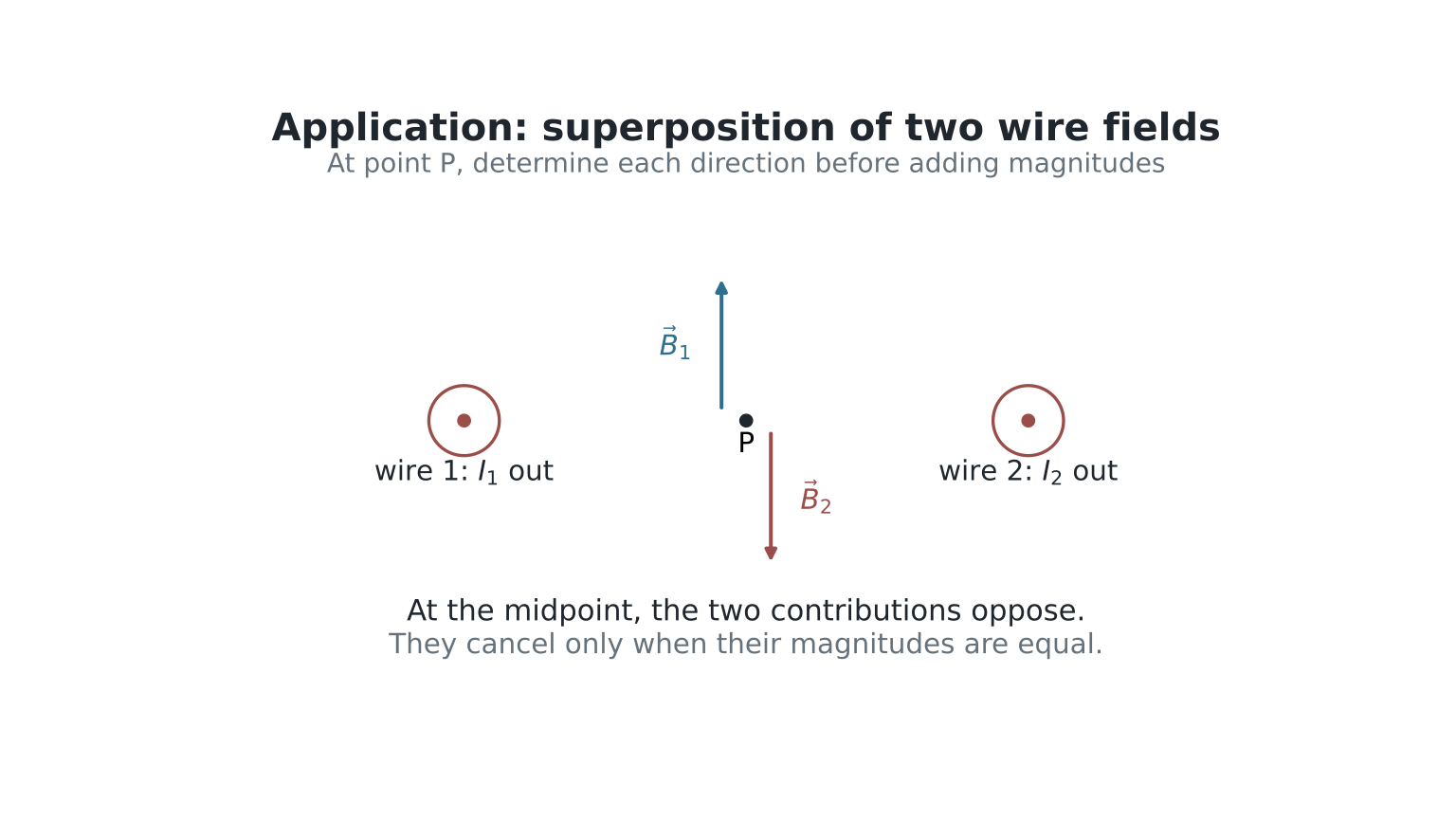
Figure: In multiple-source field questions, determine each magnetic-field direction first, then add vector components. Equal currents do not guarantee cancellation unless the point is symmetrically placed so the field magnitudes are equal and opposite.
13. Unit and constant check
Convert all lengths to metres before substitution.
Final checklist
- I identified the geometry and observation point.
- I stated or checked the ideal-model assumptions.
- I used conventional current.
- I used the correct grip-rule mapping.
- I distinguished , , and .
- I gave a vector direction as well as a magnitude where required.
- I did not apply the air-core formula to a ferrous core without extra data.
- I did not confuse field production with magnetic force.