Solenoids and Electromagnets
Branch note: This page explains how the fields of many turns combine, how to identify solenoid poles and why a ferrous core strengthens the field.
Overview
This branch focuses on the solenoid model, pole identification, the long-air-core solenoid expression, and the qualitative effect of a soft ferrous core.
Core Ideas
- A solenoid field is produced by current in many turns whose internal fields reinforce.
- A long solenoid has a strong, nearly uniform central field and a weaker external return field.
- The air-core expression applies only to the central region of an ideal long air-core solenoid.
- A soft ferrous core becomes magnetised and strengthens the field, but the effect is material-dependent.
Exam Relevance
Use this page for solenoid pole questions, proportional comparisons involving and , and explanations of why ferrous cores strengthen electromagnets.
1. From one loop to a solenoid
A solenoid is a long helical coil containing many closely spaced turns. Each turn produces a magnetic field. In the central region:
- contributions from the turns reinforce strongly inside;
- the field is approximately parallel to the axis and approximately uniform for a long solenoid;
- outside a finite solenoid, contributions largely cancel, so the field is much weaker but not exactly zero.
The external field has the same overall topology as a bar magnet: field lines leave the north end, enter the south end and complete their loops through the interior.
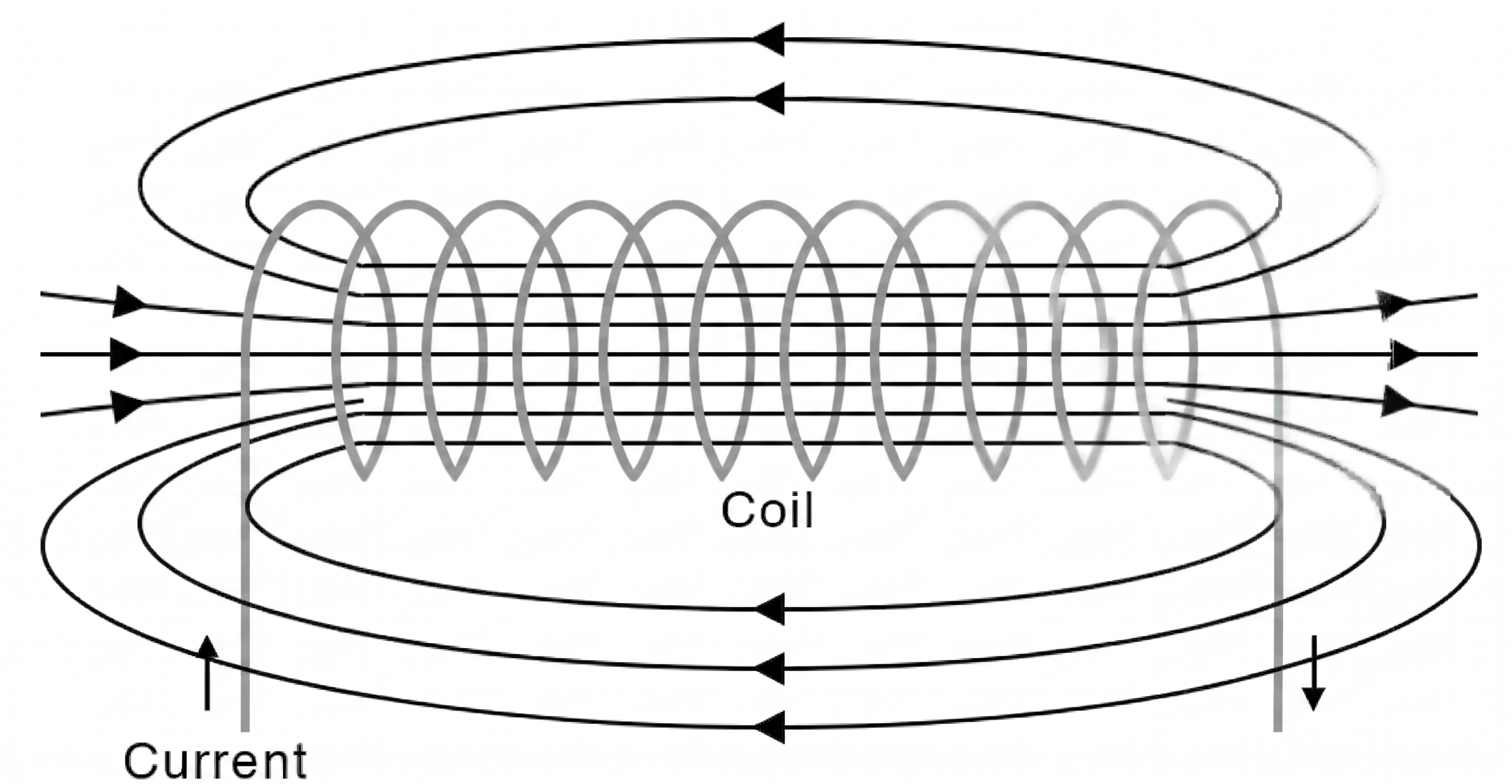
Figure: A solenoid behaves like a bar magnet because the field lines leave one end, return outside, and complete their loops through the interior. The central internal field is strong and nearly uniform for a long solenoid.
2. Identifying the poles
Use conventional current.
- Curl your right-hand fingers in the current direction around the turns.
- Your thumb points along the internal field and towards the north pole.
An equivalent end-on check is:
- anticlockwise current as seen from an end that end is north;
- clockwise current as seen from an end that end is south.
Always state the viewing end when describing clockwise or anticlockwise current.
3. Air-core field expression
For the central region of a long, closely wound air-core solenoid,
Thus, within the ideal model:
- increasing increases if is fixed;
- increasing the turns per unit length increases if is fixed;
- merely saying “more turns” is incomplete unless the length is fixed.
Worked example
A air-core solenoid has 500 turns and carries .
4. What a ferrous core does
A ferrous material becomes magnetised in the field produced by the solenoid. Its magnetisation contributes to the total field and provides a high-permeability path that concentrates the field through the core.
Therefore, inserting a suitable soft-ferrous core increases the magnetic flux density for the same current and turn density.
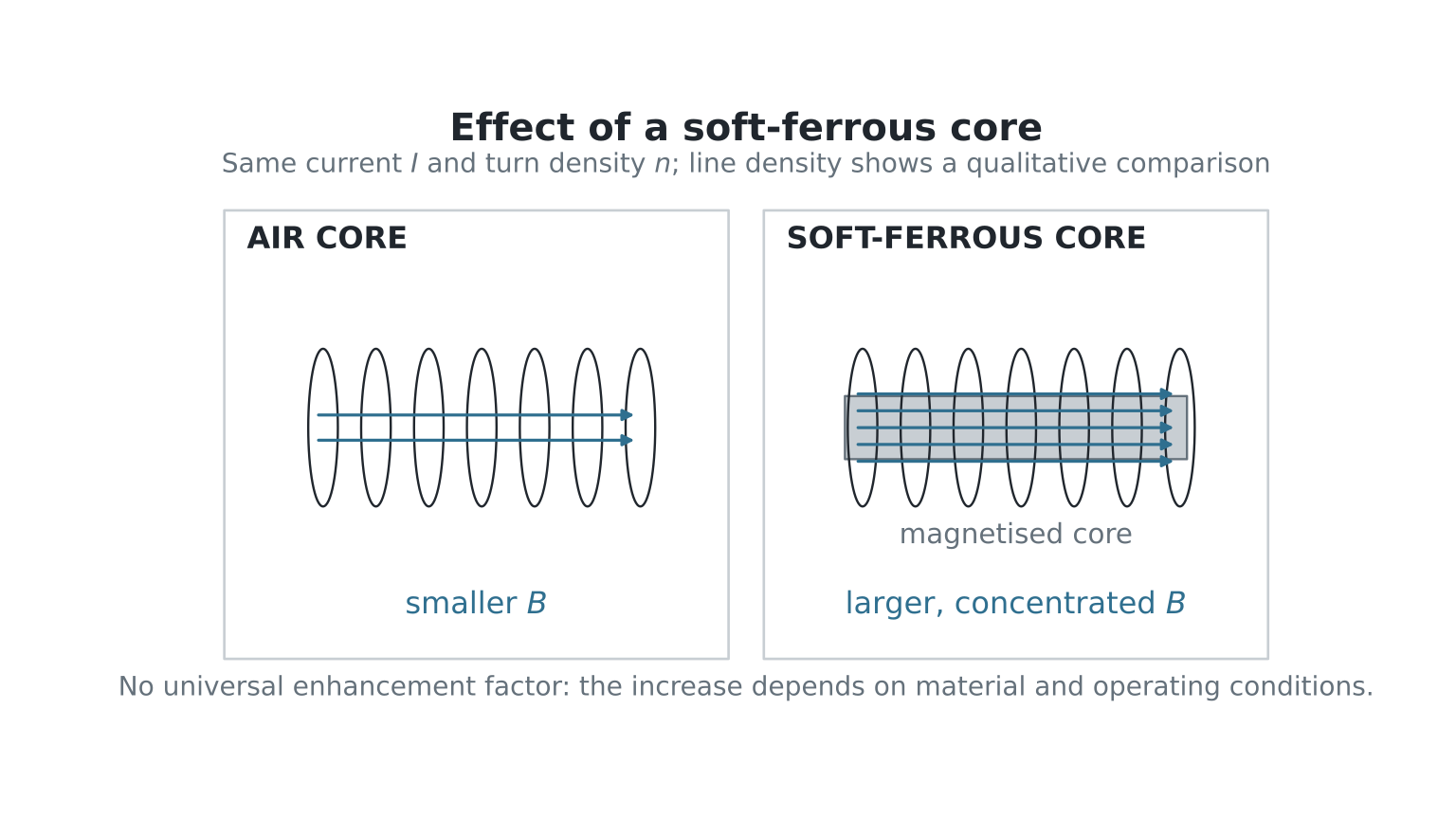
Figure: A ferrous core strengthens and concentrates the field by becoming magnetised. The effect depends on the material and operating conditions, so the air-core expression is not used unchanged for a cored solenoid unless extra data are supplied.
No universal multiplier
The increase depends on the material, field strength, shape, magnetic history and possible saturation. The air-core expression is not used unchanged to calculate the cored field unless additional data or a material model is supplied.
The core preserves the broad N–S pole orientation, but it can redistribute and concentrate the field; it does not simply multiply by the same factor everywhere.
5. Solenoid and electromagnet are related, not identical terms
- An air-core solenoid already produces a field whenever current flows.
- An electromagnet is a current-controlled magnetic device, commonly built from a coil or solenoid with a ferrous core to obtain a stronger field.
- Switching off the current removes the coil’s field. A real soft-ferrous core loses most of its magnetisation because it has low retentivity, although small residual magnetisation may remain.
This is why “the core creates the field” is wrong: current creates the solenoid field, and the magnetised core strengthens and concentrates it.
6. Comparing changes correctly
| Change | What must be fixed? | Air-core prediction |
|---|---|---|
| double | unchanged | doubles |
| double | and unchanged | doubles, so doubles |
| double | and unchanged | halves, so halves |
| reverse | $ | I |
| insert ferrous core | same and | increases qualitatively; simple air-core formula no longer predicts its value |
7. Enrichment: materials and devices
Enrichment
The syllabus requires the qualitative influence of a ferrous core. The material and device details below are useful context, not extra core formulae.
Soft iron compared with steel
Soft iron is easily magnetised and has relatively low retentivity, so it is suitable when the field should follow the current and largely disappear after switch-off. Steel has greater retentivity and is more suitable for permanent magnets.
A microscopic domain model can explain this qualitatively: an applied field makes many magnetic regions align more strongly. Real magnetisation is not perfectly reversible, so remanence and hysteresis may occur.
Applications
Relays, lifting magnets, buzzers and electromagnetic actuators use a controllable magnetic field. A stronger field can be obtained by increasing current, increasing turns per unit length and using a suitable core. Engineering measures such as reducing air gaps are magnetic-circuit design ideas and require more detail than the core 9749 relation.
8. Common explanation pattern
For “explain why the core strengthens the electromagnet,” write a causal chain:
- the solenoid field magnetises the ferrous core;
- the core’s magnetisation produces an additional field in the same general direction;
- the field becomes more concentrated through the core;
- hence is larger for the same and .
Do not quote a fixed enhancement factor.