Magnetic Fields from Currents
Branch note: This page develops the three current-produced field patterns required by the 9749 syllabus. It starts with direction, then adds magnitude and formula limits.
Overview
This branch explains how conventional current produces magnetic fields around a straight wire, a circular coil, and a long solenoid.
Core Ideas
- Reversing current reverses while preserving the geometric pattern.
- The right-hand grip rule must be matched to the geometry: straight wire versus coil or solenoid.
- Each formula has a specific observation point or region and an air/free-space model.
- Multiple magnetic fields add vectorially.
Exam Relevance
Use this page for sketching current-produced fields, selecting the correct field expression, identifying direction with the right-hand grip rule, and making proportional comparisons.
1. Current creates a magnetic field
A steady conventional current produces a steady magnetic field. The field is a vector, so a complete answer may require both its magnitude and direction.
Changing the current magnitude changes . Reversing the current reverses while leaving the geometric pattern unchanged.
2. Direction rules and viewpoints
Straight conductor
Right thumb conventional current; curled fingers circular field direction.
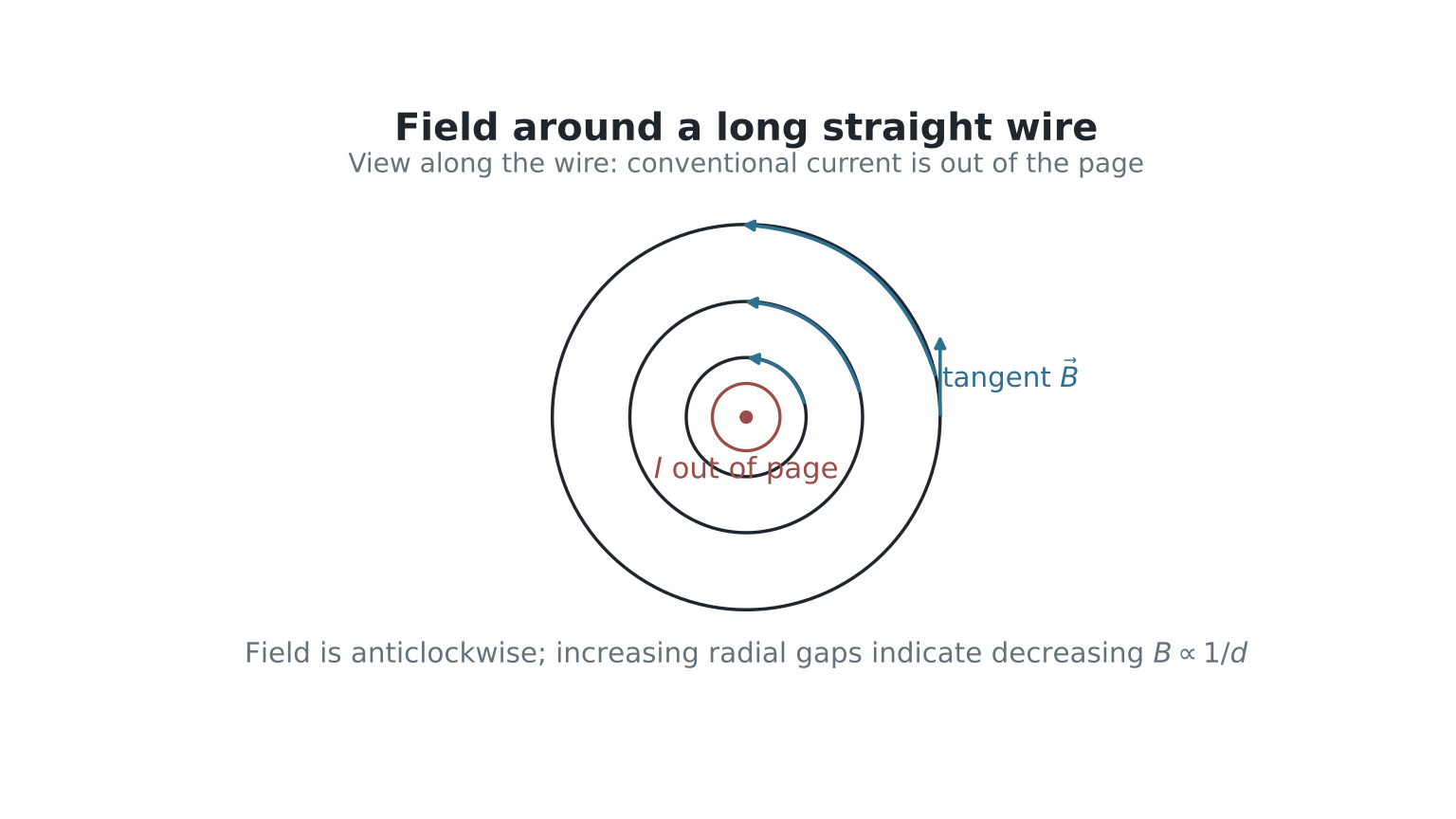
Figure: For a straight wire perpendicular to the page, the magnetic field circles the wire. Current out of the page gives anticlockwise field lines; reversing the current reverses the field direction.
For a wire perpendicular to the page:
| Current | Field as seen by the reader |
|---|---|
| out of page | anticlockwise |
| into page | clockwise |
Coil or solenoid
Curl the fingers in the conventional-current direction around the turns. The thumb points along the field through the coil or inside the solenoid and towards the north pole.
This is the same physical right-hand grip idea but a different assignment from the straight-wire version.
3. Long straight wire
Field lines are concentric circles centred on the wire. At every point, is tangent to the appropriate circle.
For an external point at shortest perpendicular distance from a long straight wire in air or free space,
The wire must be long relative to the distances considered, and the point should be far from the ends. The expression is not the field formula inside a conductor of finite radius.
At fixed , . At fixed , .
Worked example
For and ,
The formula alone does not supply clockwise or anticlockwise direction; use the grip rule.
4. Flat circular coil
A circular loop can be viewed as many short current elements. At the centre, their field contributions point in the same axial direction and reinforce.
For closely coincident turns of common radius in air or free space,
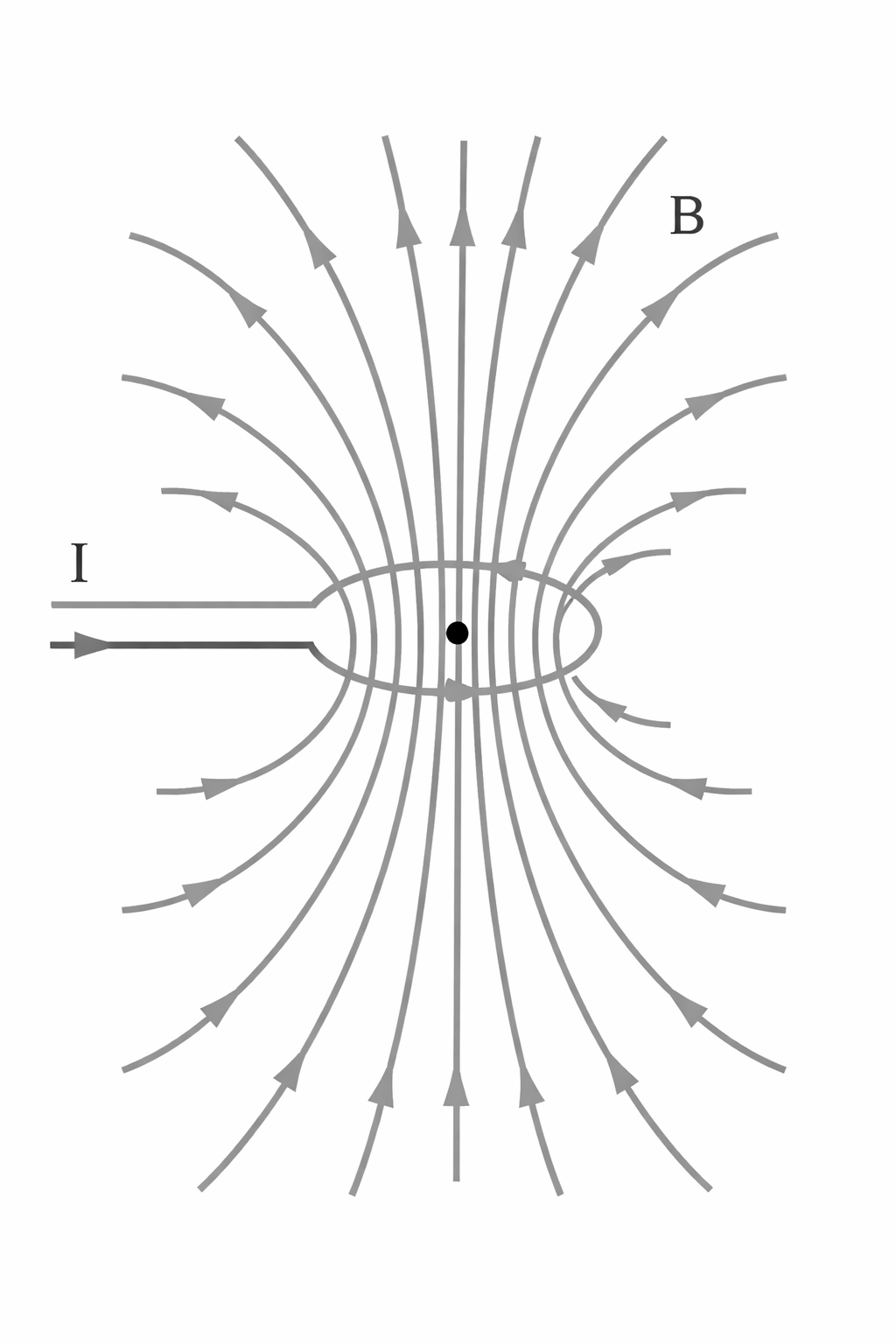
Figure: At the centre of a flat circular coil, field contributions from the turns reinforce along the coil axis. The equation applies at the centre of closely coincident turns, not everywhere around the coil.
At fixed and , doubling doubles the centre field. At fixed and , doubling halves it.
Warning
The formula applies at the centre. It does not say that the field is uniform throughout the coil or globally greatest at the centre.
Worked example
For , and ,
5. Long solenoid
A solenoid is a helical coil with many turns. In the central region of a long solenoid, fields from neighbouring turns reinforce inside. Outside a finite solenoid, contributions largely—but not exactly—cancel.
For a long, closely wound air-core solenoid,
The field is approximately uniform in the central region and the external pattern resembles that of a bar magnet.
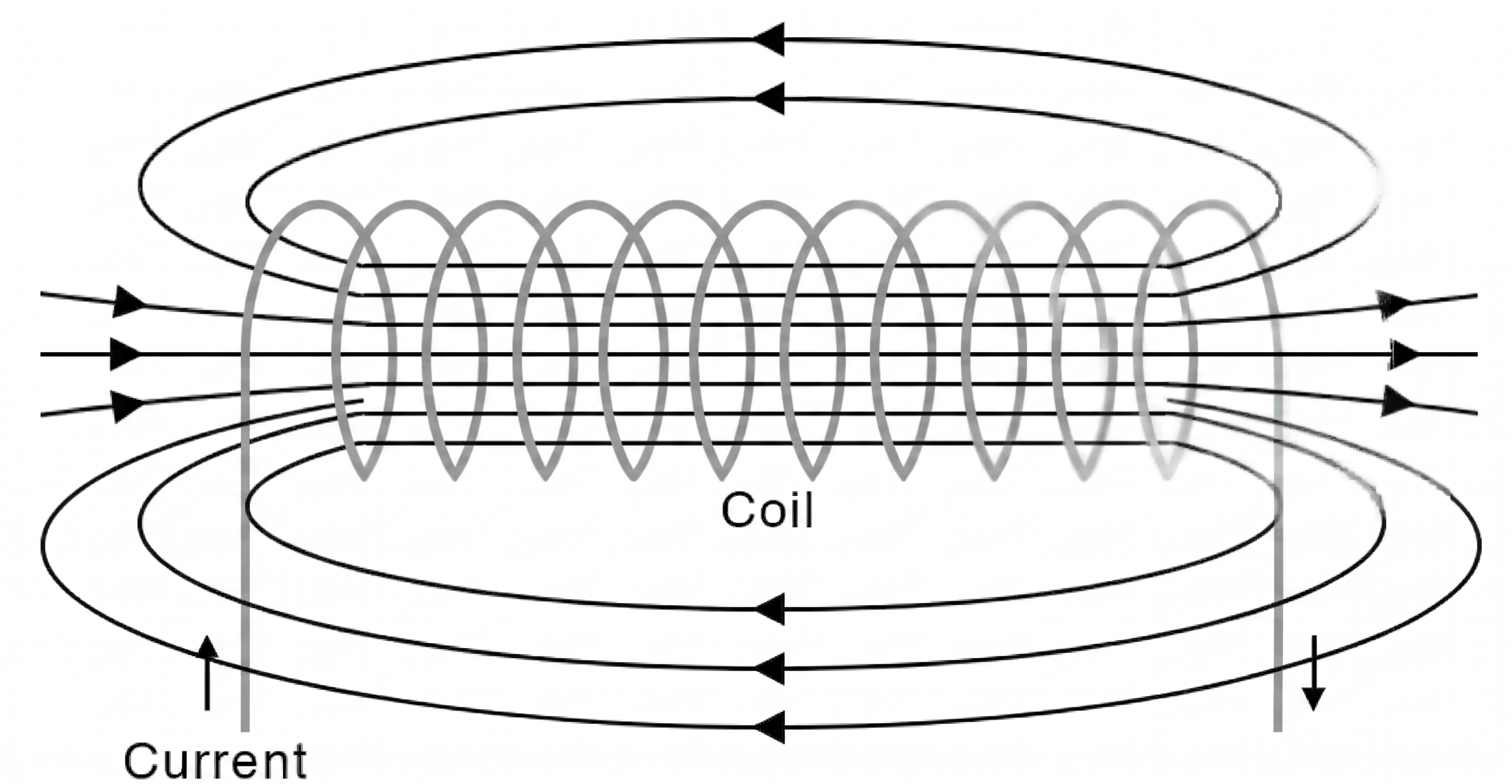
Figure: The solenoid field is approximately uniform only in the central region of a long solenoid. The external field is weaker but not exactly zero, and the whole pattern forms closed loops.
Worked example
A solenoid has 1000 turns and carries .
Do not substitute a ferrous core into this air-core formula without an additional material model.
6. Formula selection table
| Geometry | Required location | Magnitude in air/free space | Direction |
|---|---|---|---|
| long straight wire | external point at perpendicular distance | thumb=current, fingers= | |
| flat -turn circular coil | centre of common-radius turns | fingers=current, thumb= | |
| long air-core solenoid | central region, away from ends | , | fingers=current, thumb= and N |
Here
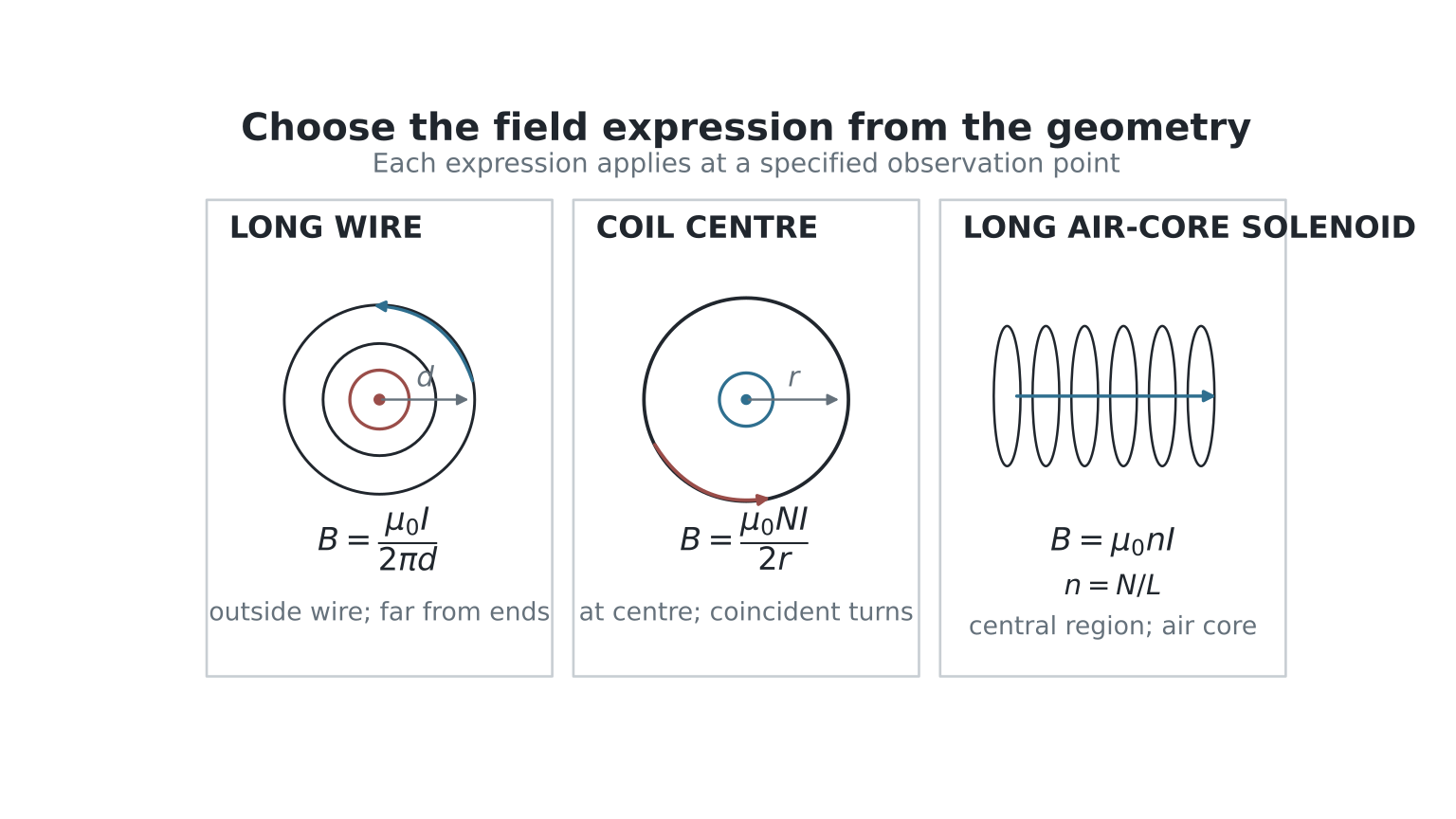
Figure: Choose the formula only after identifying the source geometry and observation point. The symbols , , , , and refer to different physical quantities and should not be interchanged.
7. Application: field superposition
Magnetic fields obey vector superposition:
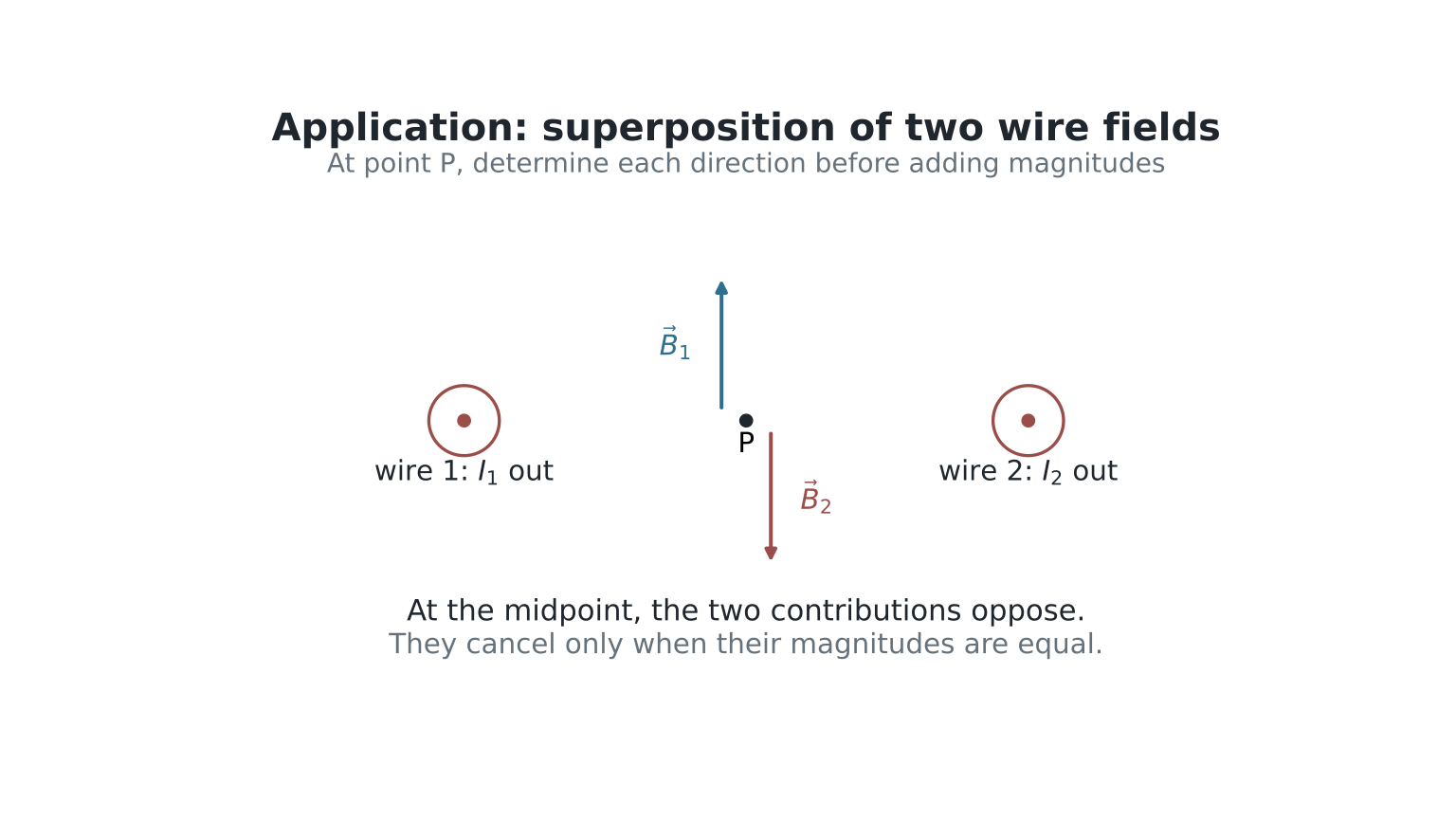
Figure: Magnetic fields from multiple wires add as vectors. At the midpoint between equal currents out of the page, the two field contributions oppose; cancellation depends on equal magnitudes and opposite directions, not on current values alone.
At a chosen point:
- find the direction of each contribution using the grip rule;
- calculate each magnitude with the correct distance;
- choose a positive direction and add signed components.
Two fields of equal magnitude cancel only if they point in exactly opposite directions. Equal currents alone do not guarantee cancellation; geometry and distance matter.
Enrichment
Quantitative multiple-wire superposition is a useful application rather than an explicit outcome (a)–(d). It prepares you for the force between parallel currents in Topic 17.
8. Fast reasoning checks
- A larger current strengthens the field but does not reverse it.
- Reversing current reverses the field but does not change its shape.
- For a coil, use total turns ; for a solenoid, use turn density .
- State what is held constant in every proportional comparison.
- A formula gives magnitude; a hand rule gives direction.