Alternating Current Generators
Overview
An alternating-current generator converts mechanical energy into electrical energy by electromagnetic induction. A coil rotates in a magnetic field, so its magnetic flux linkage changes. Faraday’s law then gives an induced emf whose polarity reverses periodically.
The 2026 H2 Physics 9749 syllabus requires candidates to explain simple applications of electromagnetic induction. The anchor notes use a rotating-coil generator as one such syllabus-consistent application, and its sinusoidal output connects naturally to Topic 18. Detailed multi-pole machines and power-station engineering are labelled enrichment.
Core Ideas
- Rotation changes the angle between the coil’s area vector and the magnetic field.
- Uniform rotation in a uniform field gives sinusoidal flux linkage.
- Induced emf depends on the rate of change of flux linkage, not its instantaneous value.
- The emf reverses every half-turn.
- A generator can have induced emf on open circuit; external current flows only when the circuit is complete.
- As useful enrichment, loading can be connected to the Lenz-law torque that opposes rotation.
Model and assumptions
The simple model uses:
- a rigid, flat coil of identical turns and constant area ;
- a uniform magnetic flux density ;
- constant angular speed ;
- one pair of magnetic poles, so one revolution gives one electrical cycle;
- negligible edge effects.
These assumptions make the output exactly sinusoidal.
Construction of a simple generator
The induction principle is the syllabus core. The slip-ring and brush details below provide supporting context for how the rotating coil connects to a stationary circuit.
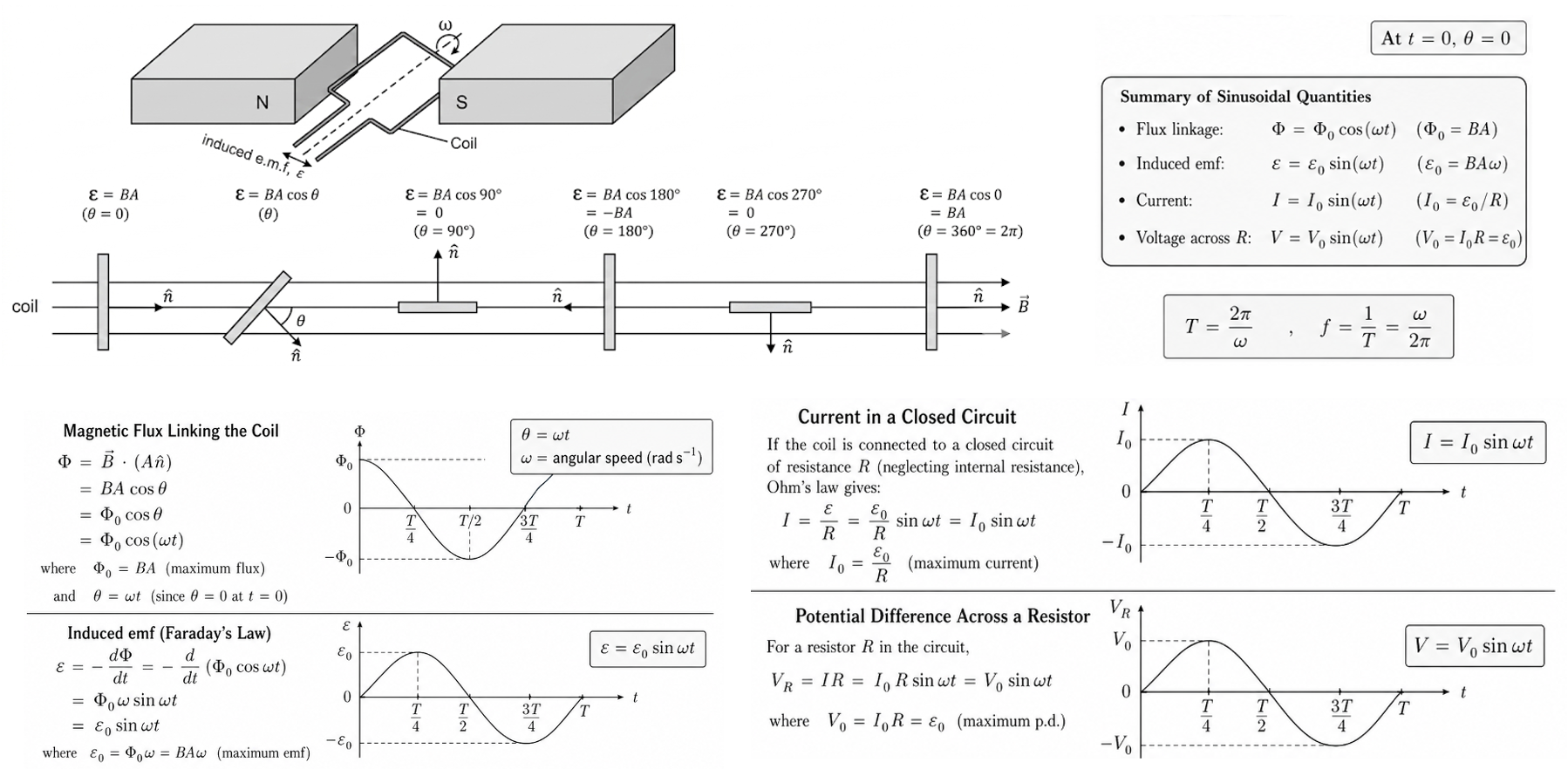
Figure: A simple two-pole generator. The N and S pole pieces establish an approximately uniform field. Mechanical input rotates the coil and shaft. The coil ends connect to two separate slip rings, while stationary brushes connect the rotating assembly to an external load.
| Component | Function |
|---|---|
| rotating coil | changes its flux linkage and develops induced emf |
| magnetic pole pieces | provide magnetic flux density |
| shaft | supplies mechanical rotation |
| two slip rings | rotate with the coil and preserve the two coil-end connections |
| stationary brushes | maintain sliding contact with the rotating rings |
| external load | receives electrical energy when the circuit is complete |
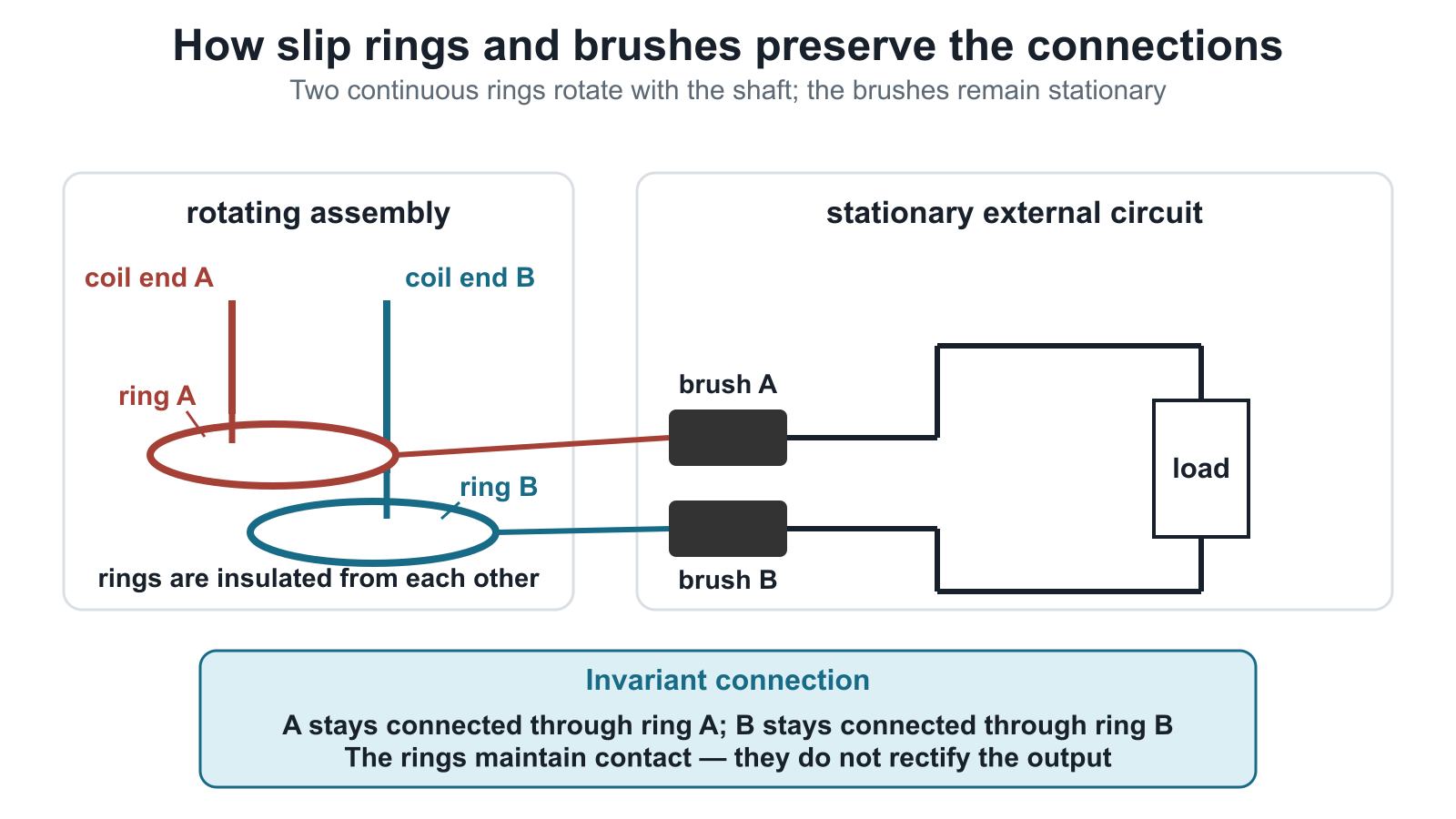
Figure: Supporting construction view. Coil end A remains connected to ring A and coil end B to ring B. The rings are continuous and insulated from each other. The brushes are stationary. Slip rings maintain contact; they do not reverse or rectify the connections.
Geometry and flux linkage
Let be the unit vector normal to the coil plane. Define as the angle from to .
For one turn, the magnetic flux is measured in webers (Wb):
For turns, the flux linkage is measured in weber-turns (Wb turn; dimensionally Wb):
The symbol is used here as shorthand for .
- : the coil normal is parallel to and .
- : the coil normal is perpendicular to and .
The induced emf is measured in volts (V). For uniform rotation, is in radians when
with in . The general flux-linkage model is then
We now choose , so the coil begins at maximum positive flux linkage:
Deriving the induced emf
Faraday’s law is
For the chosen starting orientation and terminal polarity,
The peak emf is
and therefore
Reversing the chosen terminal labels reverses the sign of but not its magnitude, period or physical cause.
Connecting orientation, flux linkage and emf
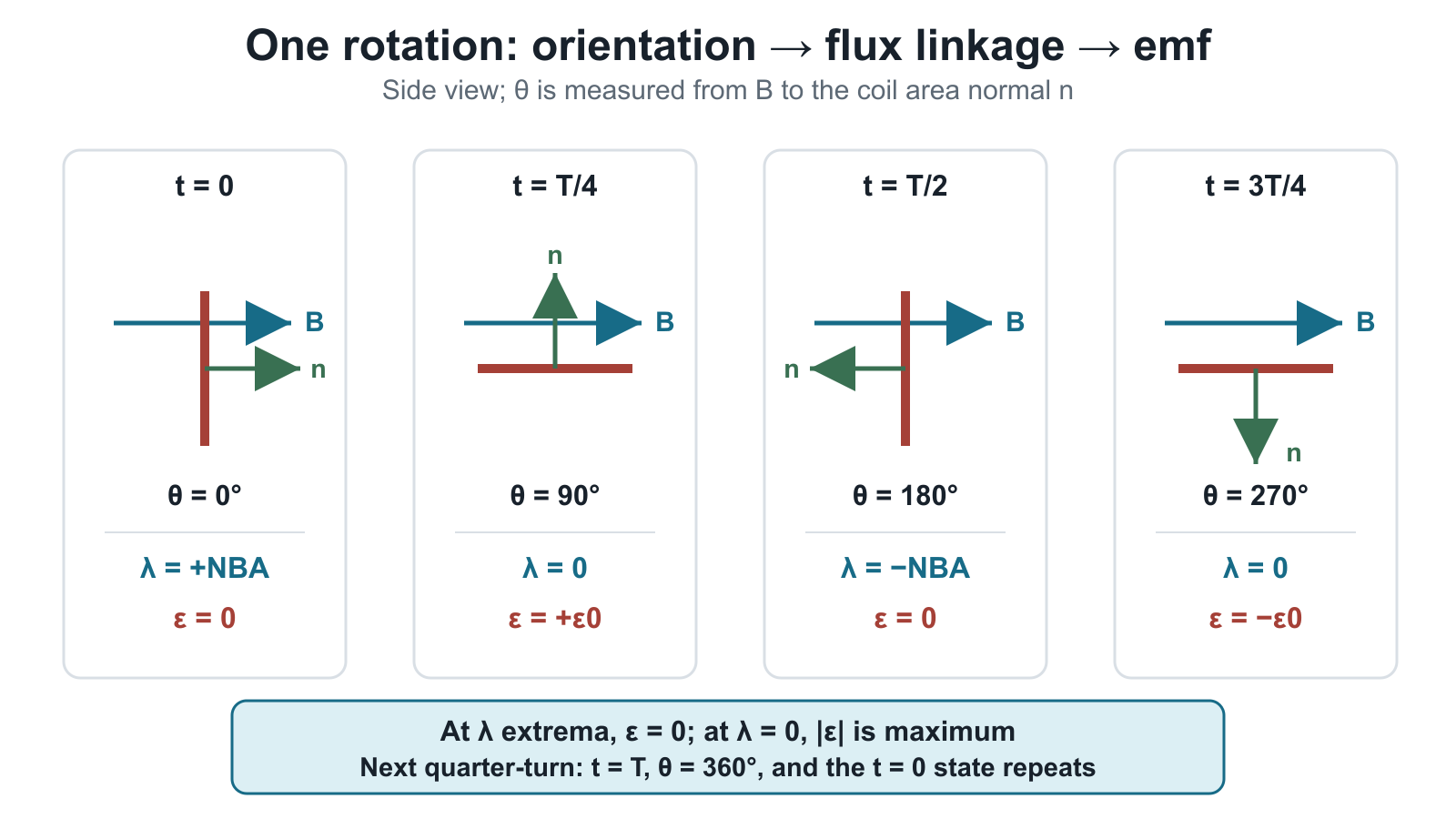
Figure: One rotation divided into quarter-turns. The area vector, not the coil plane, defines . The listed and values use the same reference convention as the equations above.
| Time | Angle | Flux linkage | Emf |
|---|---|---|---|
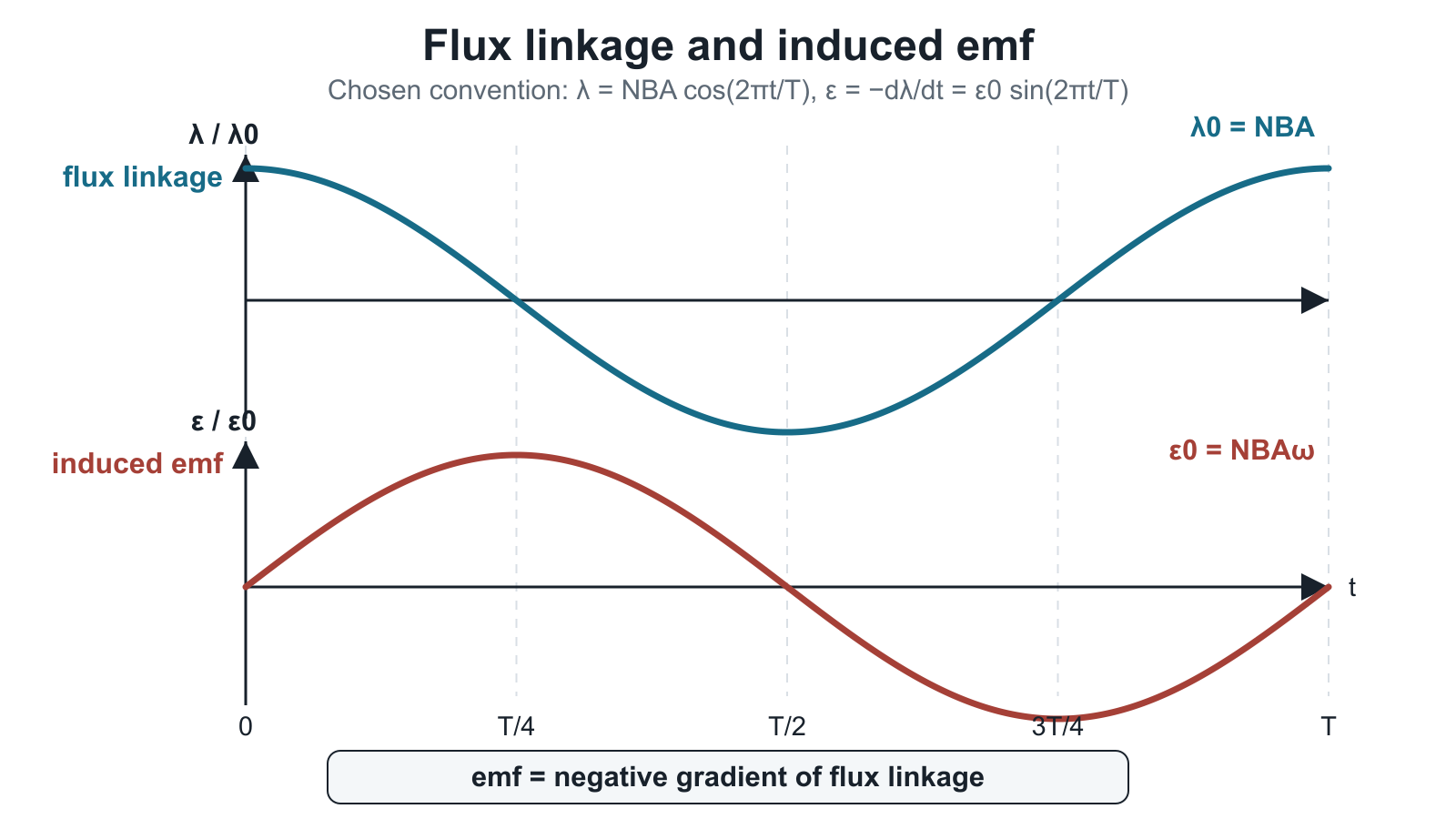
Figure: Analytical cosine flux-linkage and sine emf curves. At a flux-linkage maximum or minimum, its gradient is zero and so is the emf. At a flux-linkage zero crossing, the gradient magnitude and emf magnitude are greatest. The emf sign is opposite to the flux-linkage gradient.
See AC Generator Waveforms for a fuller graph-reading method.
Frequency and period
For this simple one-pole-pair model, one revolution gives one electrical cycle:
Enrichment: A generator with pole pairs has . The simple equality is therefore not universal.
Effects of changing parameters
From
changing , or scales the peak emf but not the rotational frequency. Changing changes both peak emf and frequency.
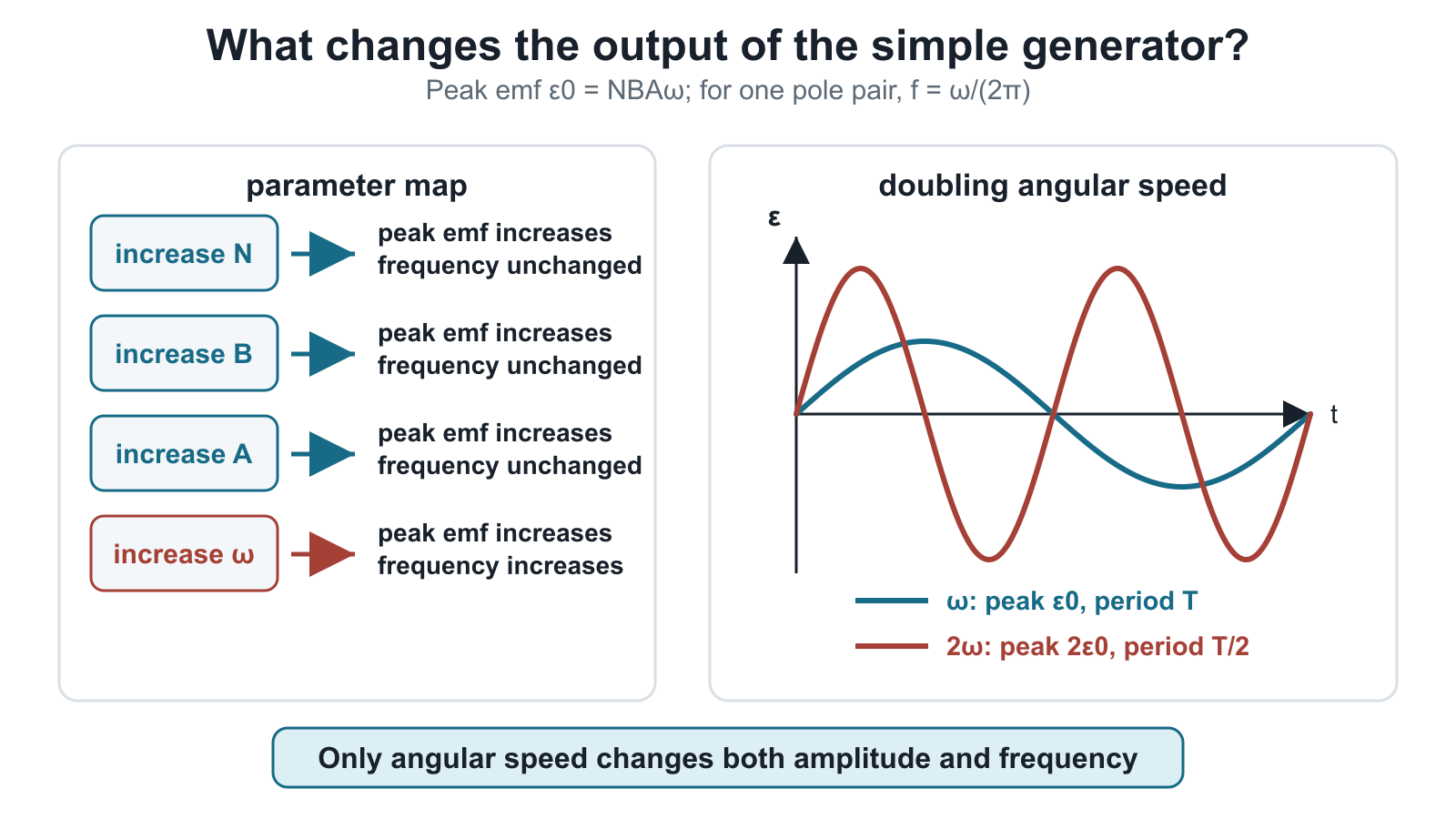
Figure: For fixed geometry, , and change amplitude only. Doubling doubles the peak emf and frequency and halves the period. The inset curves are plotted from the exact sine functions.
RMS output
For this sinusoidal emf,
This factor is waveform-specific. See RMS and AC Power.
Open circuit and closed circuit
Changing flux linkage induces emf whether or not a load is connected.
- Open circuit: terminal emf exists, but no sustained external current flows.
- Closed circuit: the emf drives current through the coil and load.
Enrichment: loading and opposing torque
Under load, magnetic forces on the current-carrying coil sides produce a torque opposing rotation, in accordance with Lenz’s law. To maintain the same angular speed, the prime mover must supply greater torque as load current increases. Mechanical input power becomes electrical output power plus losses.
Worked Example 1: output quantities
A simple two-pole generator has
Its peak emf is
Its frequency and rms emf are
Worked Example 2: changing speed
If increases by while , and remain constant,
Peak emf and frequency both increase by , while
Brief Common Mistakes
- measuring from the coil plane instead of its normal;
- confusing magnetic flux, flux linkage and emf;
- thinking maximum flux linkage gives maximum emf;
- treating as the emf at every instant;
- saying slip rings reverse the current;
- assuming load current exists on open circuit;
- using without the simple one-pole-pair condition.
See Alternating Current Generators Common Exam Traps.
Exam Relevance
A strong explanation follows
State the angle and terminal-polarity conventions before assigning graph signs. For graph questions, use rather than a memorised phase slogan.
Formula Sheet
For the declared simple-model convention,
Links
- Electromagnetic Induction
- AC Generator Waveforms
- Alternating Current Generators Common Exam Traps
- Alternating Current
- RMS and AC Power
Summary
A simple rotating-coil generator produces sinusoidal flux linkage and emf:
The mechanical input supplies the electrical output and must overcome the Lenz-law opposing torque when a load draws current.