Beta-Decay Particle Context
Support note: This page supports Nuclear Physics by providing enrichment context beyond the explicit H2 syllabus.
Enrichment — beyond H2 Physics 9749 syllabus scope
The only assessed bridge on this page is the qualitative statement that beta-decay energy and momentum evidence led to prediction of a neutral particle called the neutrino. Positron emission is not required, and knowledge of antineutrinos or antiparticles is not required.
The syllabus requires only a qualitative understanding that conservation of energy and momentum in beta decay led to the prediction of the neutrino.
Detailed treatment of positron emission, antineutrinos, antiparticles, and particle-level beta-decay equations is retained below only as optional modern-physics context.
Overview
Beta-Decay Particle Context is kept as a compact enrichment page for the nuclear-physics block. Its H2-relevant bridge is the qualitative idea that conservation of energy and momentum in beta decay led to the prediction of the neutrino. The fuller particle-level notation is modern-physics context.
Most examinable nuclear-decay content remains in:
This page supplies the adjacent particle-level context needed to read those equations correctly.
| Core H2 Physics | Enrichment |
|---|---|
| alpha decay | beta-plus decay |
| beta-minus decay | positrons |
| gamma emission | antineutrinos |
| qualitative neutrino prediction | antiparticles |
| conservation laws | particle-level beta-decay details |
Core Ideas
These core ideas are enrichment context for this page, not additional explicit H2 examinable requirements.
- beta-minus decay can be written at particle level as a neutron changing into a proton, an electron, and an antineutrino
- beta-plus decay can be written at particle level as a proton changing into a neutron, a positron, and a neutrino
- the emitted beta-minus electron is created in the nuclear transformation; it is not an orbital electron from the atom
- neutrinos and antineutrinos are neutral particles included in fuller beta-decay descriptions
- their role here is mainly qualitative: they help account for conservation of energy and momentum
- broad particle families, quarks, hadrons, weak interactions, and Feynman diagrams are outside this page’s H2 scope
Enrichment: Particle-Level Beta Decay
At nuclide level, beta decay changes the proton number but not the nucleon number.
Enrichment: Fuller Beta-Minus Particle Equation
In beta-minus decay, a neutron changes into a proton. The emitted electron is created in the nuclear transformation.
At nuclide level:
Key effects:
- proton number increases by 1
- nucleon number stays the same
- an antineutrino appears in the fuller particle-level equation
Enrichment: Beta-Plus Decay and Positron Emission
In beta-plus decay, a proton changes into a neutron and a positron is emitted.
At nuclide level:
Key effects:
- proton number decreases by 1
- nucleon number stays the same
- a neutrino appears in the fuller particle-level equation
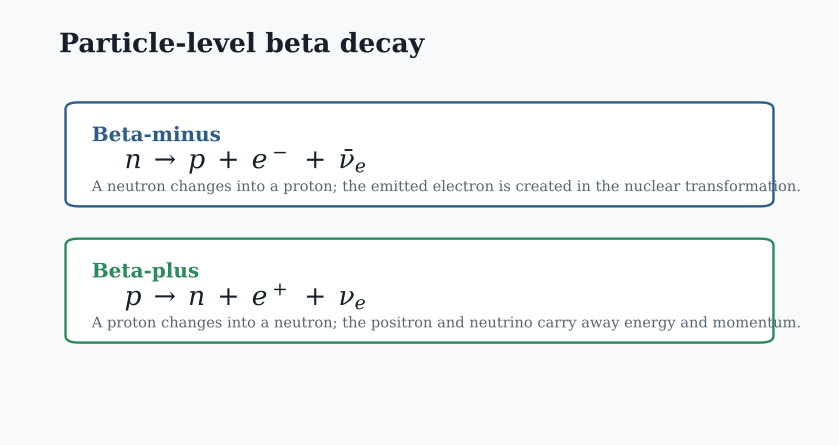
Enrichment figure: In the fuller particle-level equations, beta-minus decay emits an antineutrino while beta-plus decay emits a neutrino. For core H2 answers, the required point is only that beta-decay evidence led to the prediction of a neutral particle called the neutrino; positron and antiparticle details are enrichment.
Core H2 Bridge: Qualitative Neutrino Prediction
Beta particles are emitted with a continuous range of energies. Measurements showed that the daughter nucleus and beta particle alone could not account for the observed energy and momentum in each event.
Because energy and momentum must still be conserved, physicists predicted an additional neutral, very weakly interacting particle called the neutrino. It can carry part of the released energy and momentum.
The detailed distinction between neutrinos and antineutrinos is enrichment rather than explicit H2 syllabus content.
The following notation is enrichment rather than required terminology:
- neutrino:
- antineutrino:
- electric charge: zero
- mass: very small compared with the electron
This page uses and as compact symbols. It does not require lepton-flavour labels or a classification table.
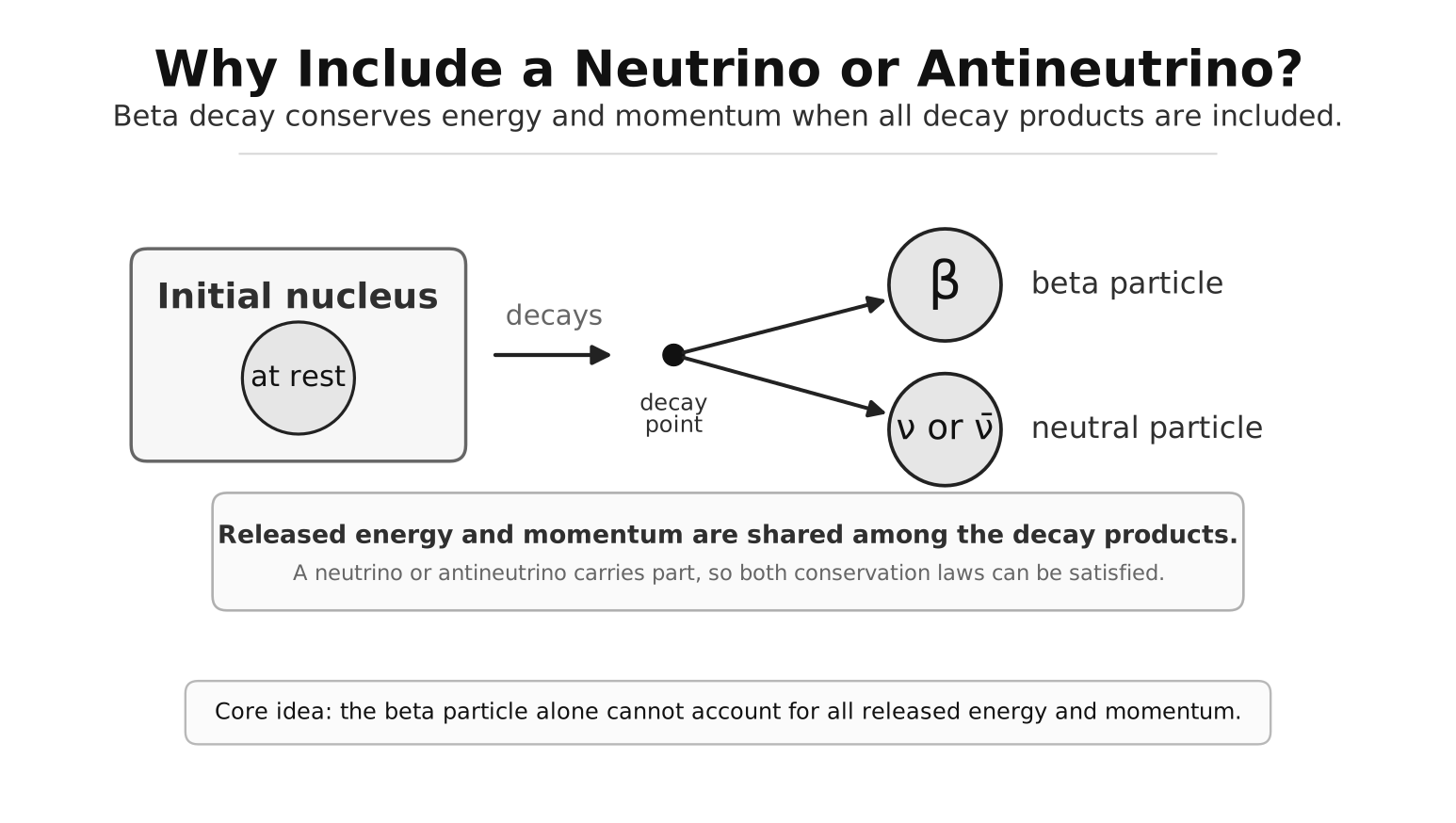
Figure: Evidence → inference. For a given nuclear transition, daughter nucleus plus beta particle alone would give fixed beta energy after recoil is included, but the observed beta spectrum is continuous and the two visible products do not complete the momentum balance. An additional neutral, very weakly interacting particle carries the missing energy and momentum. In a core 9749 answer, call it the neutrino; antiparticle notation is not required.
Enrichment: Conservation Link
In nuclear processes, the key conserved quantities here include:
- electric charge
- nucleon number
- momentum
- mass-energy
For beta decay:
- charge conservation is reflected by the change between neutron and proton plus the emitted charged beta particle
- nucleon number remains unchanged because a neutron and proton are both nucleons
- energy and momentum conservation are completed qualitatively by allowing the neutrino or antineutrino to carry part of the released energy and momentum
At this level, the important idea is qualitative. Students are not expected to calculate neutrino energies or momenta here.
Scope Boundary
This page does not attempt a full treatment of:
- particle families
- quark structure
- hadron and lepton classification
- weak-interaction mechanisms
- particle accelerators
- Feynman diagrams
- detector history
- antimatter beyond the positron needed for beta-plus decay
These are not required by 9749 syllabus scope. The assessed focus remains the nature of , and radiation, simple nuclear equations, and the qualitative neutrino prediction from conservation reasoning.
Enrichment: Common Traps
- Do not say that the beta-minus electron was already inside the nucleus.
- In enrichment particle-level equations, do not omit the distinction between and .
- Do not treat the neutrino as charged; it has zero electric charge.
- Do not add lepton-family labels unless a question explicitly supplies or requires them.
- Do not turn a compact conservation point into a broad particle-classification answer.
- Do not confuse nuclide-level equations with particle-level equations.
Exam Relevance
Core H2 Physics
- explain qualitatively that conservation of energy and momentum in beta decay led to the prediction of the neutrino
- keep beta-minus decay as the core H2 beta-decay example
- use generic
neutrinoterminology unless a question supplies further notation
Enrichment
- recognise the fuller particle-level beta-decay equations
- distinguish neutrino and antineutrino notation in fuller equations
- recognise beta-plus decay and positron emission as modern-physics context
Quick Revision Summary
Core H2 Bridge
- conservation of energy and momentum in beta decay led to the prediction of the neutrino
- beta-minus decay remains the core H2 beta-decay case
Enrichment
- beta-minus:
- beta-plus:
- the beta-minus electron is created during the nuclear transformation
- neutrinos and antineutrinos are included to help account for energy and momentum
- this page is an enrichment boundary note, not a full particle-physics chapter
Links
- Prerequisite: nuclear physics
- Related: radioactive decay
- Related: conservation laws in physics