Conservation Laws in Physics
Topic hub: Begin here for the cross-topic conservation framework, then use the linked specialist topics for full operational methods.
Overview
Conservation laws connect many apparently different parts of H2 Physics. A collision, an electrical junction and a nuclear reaction do not use the same equations, but they share one powerful style of reasoning:
- choose a system;
- identify what can cross its boundary;
- track a physical quantity before and after an interaction;
- require the accounting to balance.
The active 9749 curriculum framework treats conservation as a core idea. This page is therefore a cross-topic synthesis, not a replacement for the detailed methods in:
Core Ideas
What does “conserved” mean?
A physical quantity is conserved when interactions cannot create or destroy the total amount of .
For a closed system, none of the tracked quantity crosses the system boundary. Therefore:
For an open system, may enter or leave. The correct accounting is:
This is not a failure of conservation. The system total changes by exactly the net transfer across its boundary.
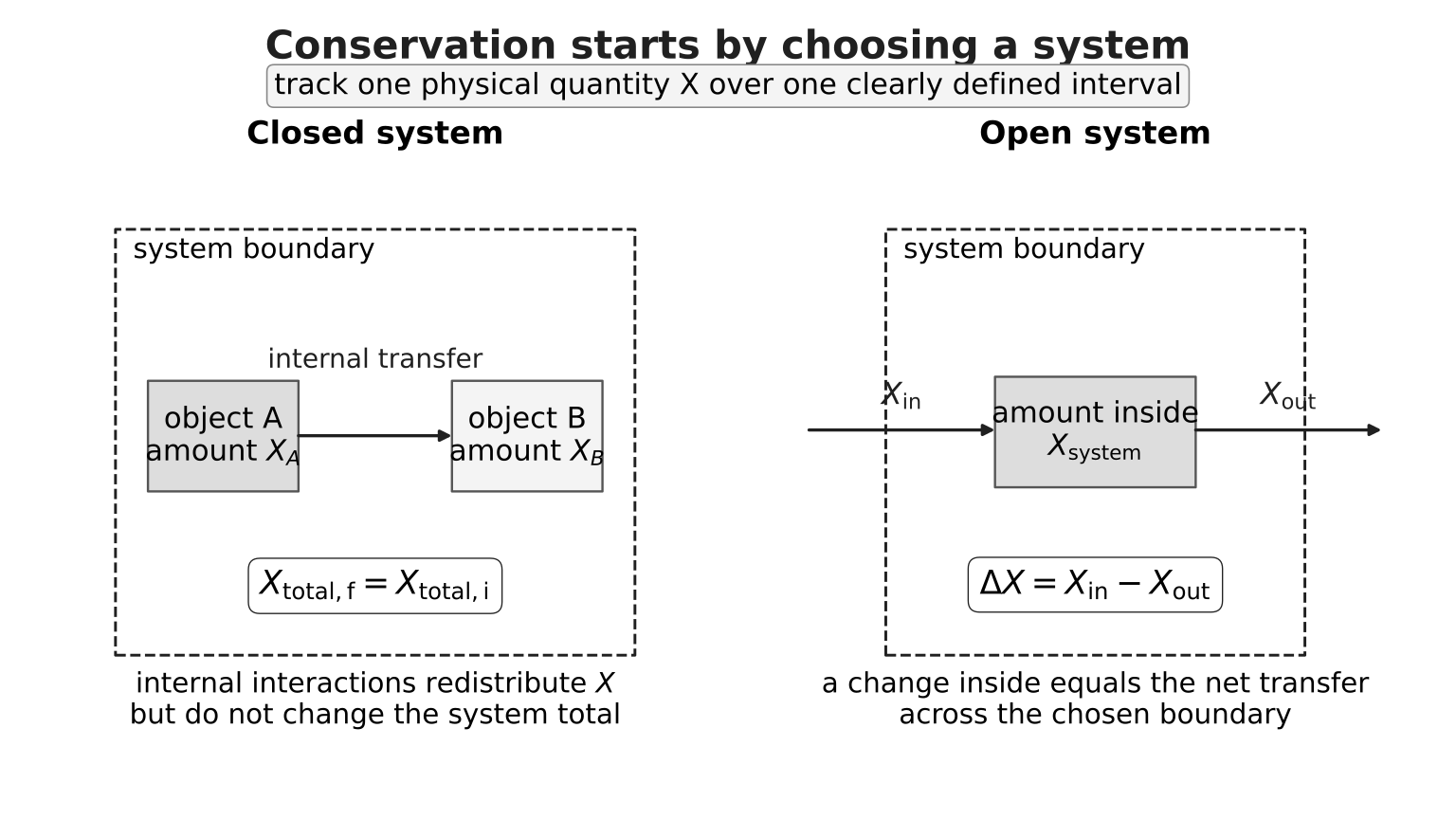
Figure: The same conservation principle can be used for closed and open systems. In a closed system, internal interactions can redistribute the tracked quantity but cannot change its total. In an open system, the change inside equals the amount transferred in minus the amount transferred out during the chosen interval.
Why the system boundary matters
Consider a sliding block slowed by friction:
- for the block alone, energy leaves its mechanical store because friction does negative work across the boundary;
- for the block plus surface, that interaction is internal and the decrease in mechanical energy appears as increased internal energy.
The event is unchanged. Only the accounting boundary changes.
This is why statements such as “energy is lost” or “momentum is conserved” are incomplete unless the system and conditions are clear.
A General Conservation Workflow
Step 1: Choose the system
Draw or imagine a boundary around the objects, particles or region being analysed.
Step 2: Choose the interaction interval
“Before” and “after” must refer to clearly defined instants. In a collision, the interval is usually short enough that external impulse can be negligible even though external forces exist.
Step 3: Identify transfers across the boundary
Examples include:
- work by an external force;
- heating through thermal contact;
- radiation entering or leaving;
- momentum transfer through external impulse;
- charge flowing through connecting wires.
Step 4: Select the relevant conserved quantity
Do not assume that every familiar quantity is conserved. For example, total momentum may be conserved in an inelastic collision while kinetic energy decreases.
Step 5: Write a signed or vector equation
Use directions consistently for vector quantities such as momentum. Include all relevant energy stores and transfers for scalar energy accounting.
Step 6: Check the result
Ask whether the direction, unit, magnitude and limiting behaviour are physically sensible.
Conservation of Linear Momentum
Linear momentum is:
Define the total system momentum as . For a system over an interaction interval:
where is the resultant external impulse.
If the resultant external impulse is zero or negligible:
This condition is more useful than merely saying “no external force”: during a brief collision, external forces such as weight may act, but their impulse can be negligible compared with the collision impulse.
Worked example: explosion from rest
An object initially at rest breaks into fragments and . Let right be positive. Then:
Hence:
The fragments have equal momentum magnitudes in opposite directions. They do not necessarily have equal speeds: the smaller-mass fragment has the larger speed.
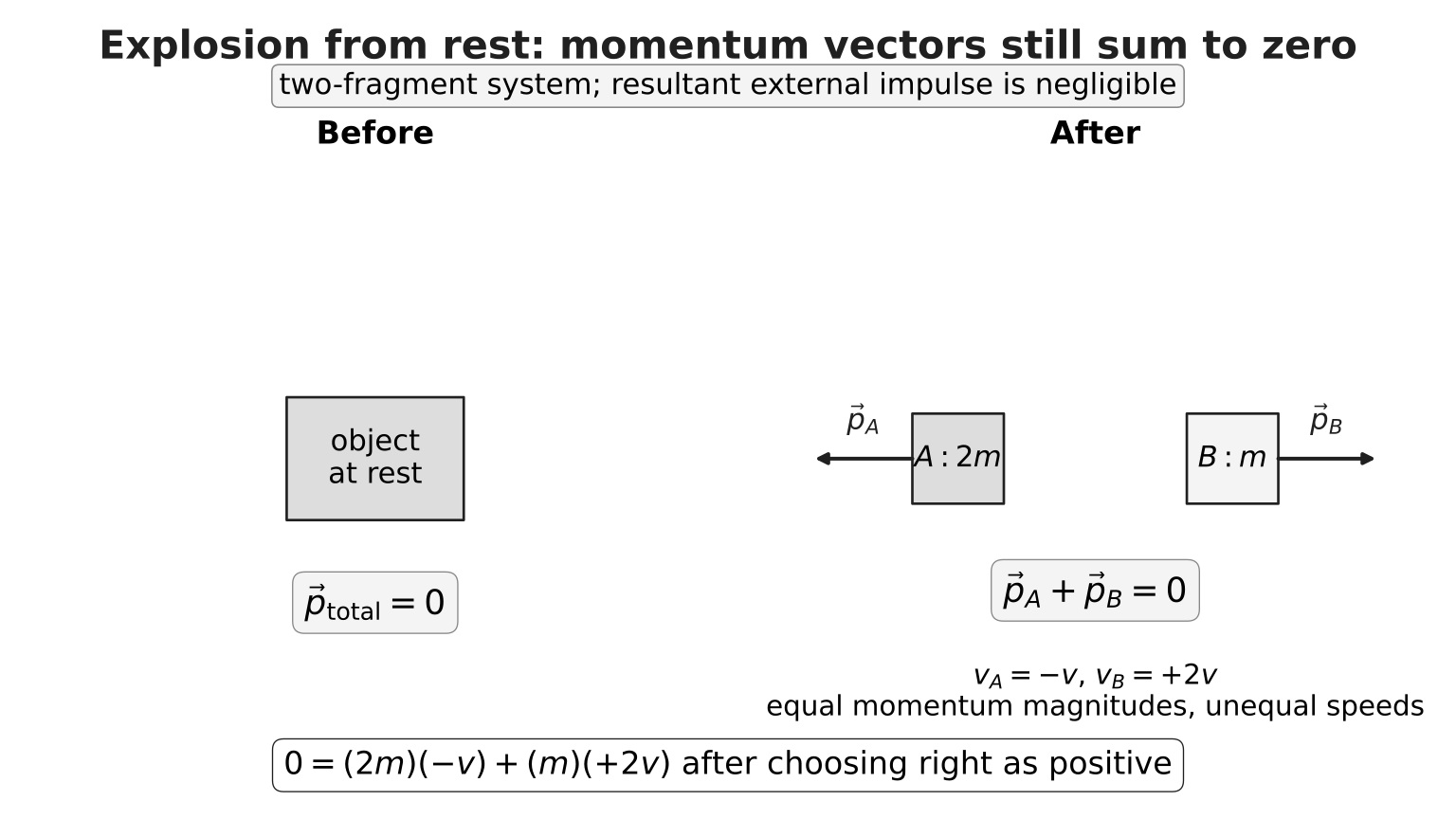
Figure: The isolated two-fragment system begins with zero momentum. After the explosion, the momentum vectors are equal in magnitude and opposite in direction, so their vector sum remains zero. Equal momentum magnitudes imply equal speeds only when the fragment masses are equal.
Momentum versus kinetic energy
For an isolated collision:
- total momentum is always conserved;
- total kinetic energy is conserved only for a perfectly elastic collision;
- total energy is still conserved in an inelastic collision, but some kinetic energy becomes internal energy, deformation or sound.
Detailed collision methods are in Momentum Conservation and Collisions.
Conservation of Energy
Energy conservation means that energy is transferred or transformed, not created or destroyed.
For a chosen system:
For an isolated system:
Mechanical energy is a restricted subtotal
Mechanical energy usually means:
It is conserved only when no transfer removes energy from these mechanical stores. With friction or drag, can decrease while total energy remains conserved because internal energy increases.
Worked example: falling with air resistance
Choose the system as object + Earth + surrounding air, and suppose negligible energy crosses its outer boundary during the fall. If the object–Earth gravitational potential-energy store decreases by while the object gains of kinetic energy, the remaining:
is transferred mainly to internal energy of the object and air, with a small amount possibly carried by sound. It is misleading to say that “disappeared”.
For full treatment, see Work, Energy and Power.
Conservation of Charge and Junction Currents
Total electric charge is conserved. For a small region around a circuit junction, the instantaneous continuity equation is:
If the currents are constant over a finite interval , or if the symbols denote average currents over that interval, then:
In steady-state circuit analysis, charge does not continually accumulate at the junction, so . Therefore:
This is often called Kirchhoff’s first law. Strictly, it is charge conservation together with the steady-state/no-accumulation condition. “Current is conserved” is a convenient shorthand, but charge is the underlying conserved quantity.
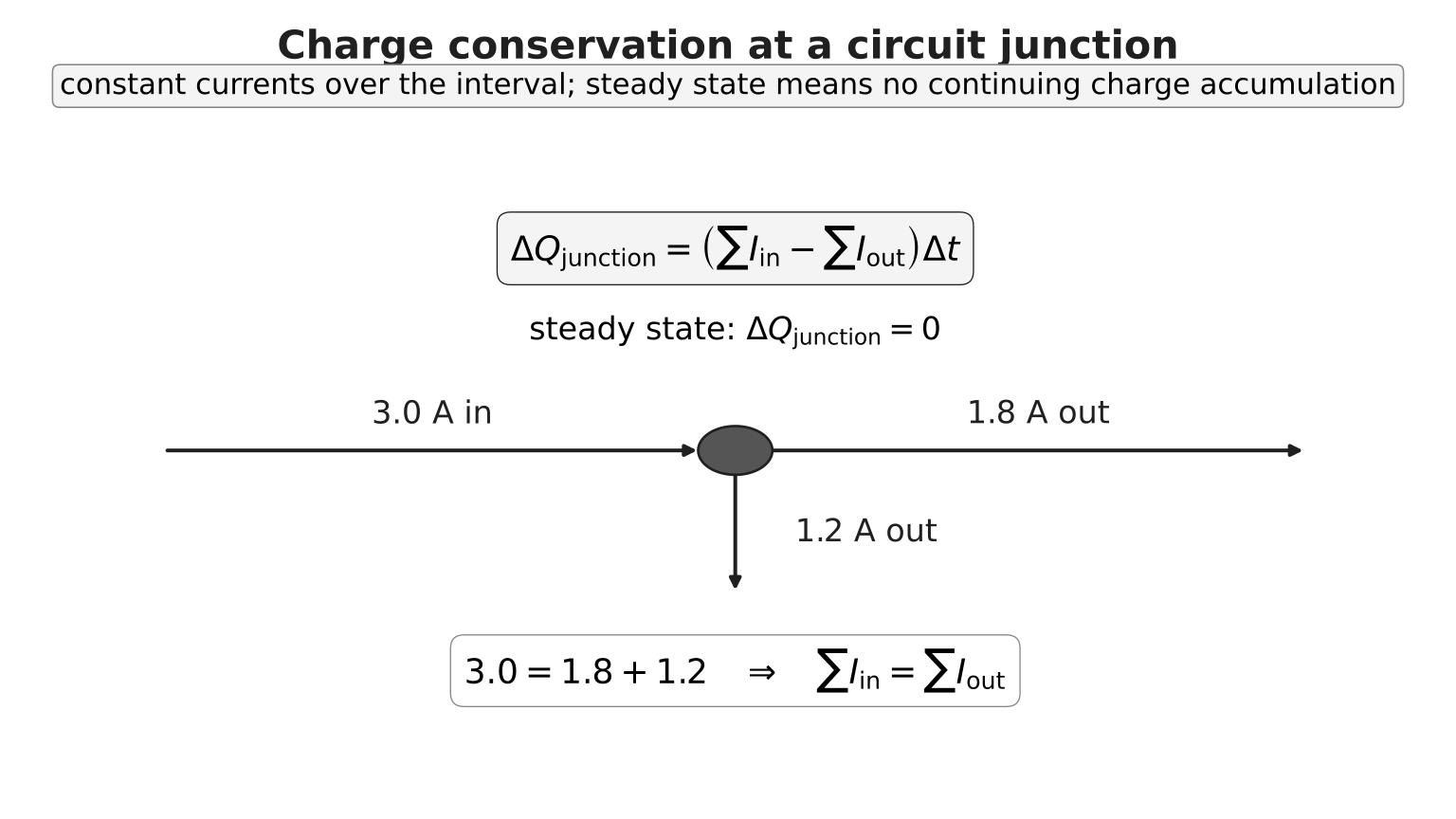
Figure: For the constant currents shown over a time interval , the junction charge would change if incoming and outgoing currents did not balance. In the steady state, no net charge accumulates, so the total current entering equals the total current leaving. The arrows show conventional-current directions.
Worked example
If enters a junction while and leave:
so:
Nuclear Conservation Accounting
The active syllabus requires candidates to apply conservation of:
- nucleon number;
- total charge;
- mass–energy
in nuclear processes.
Nucleon number
The upper number in nuclide notation counts nucleons. For syllabus nuclear equations:
Total charge and the lower number
For a nucleus, the lower number is proton number. Across a complete nuclear equation, however, lower-number balance represents total charge accounting, including emitted charged particles.
It is therefore safer to say “total charge is conserved” than “proton number is always conserved”. In beta-minus decay, a neutron changes into a proton; the daughter nucleus has a different proton number, while total charge across the full process still balances.
Worked example: alpha decay
Check nucleon number:
Check total charge number:
These checks identify a notation-consistent equation. They do not by themselves prove that energy and momentum balance; those require masses, energies and motion information.
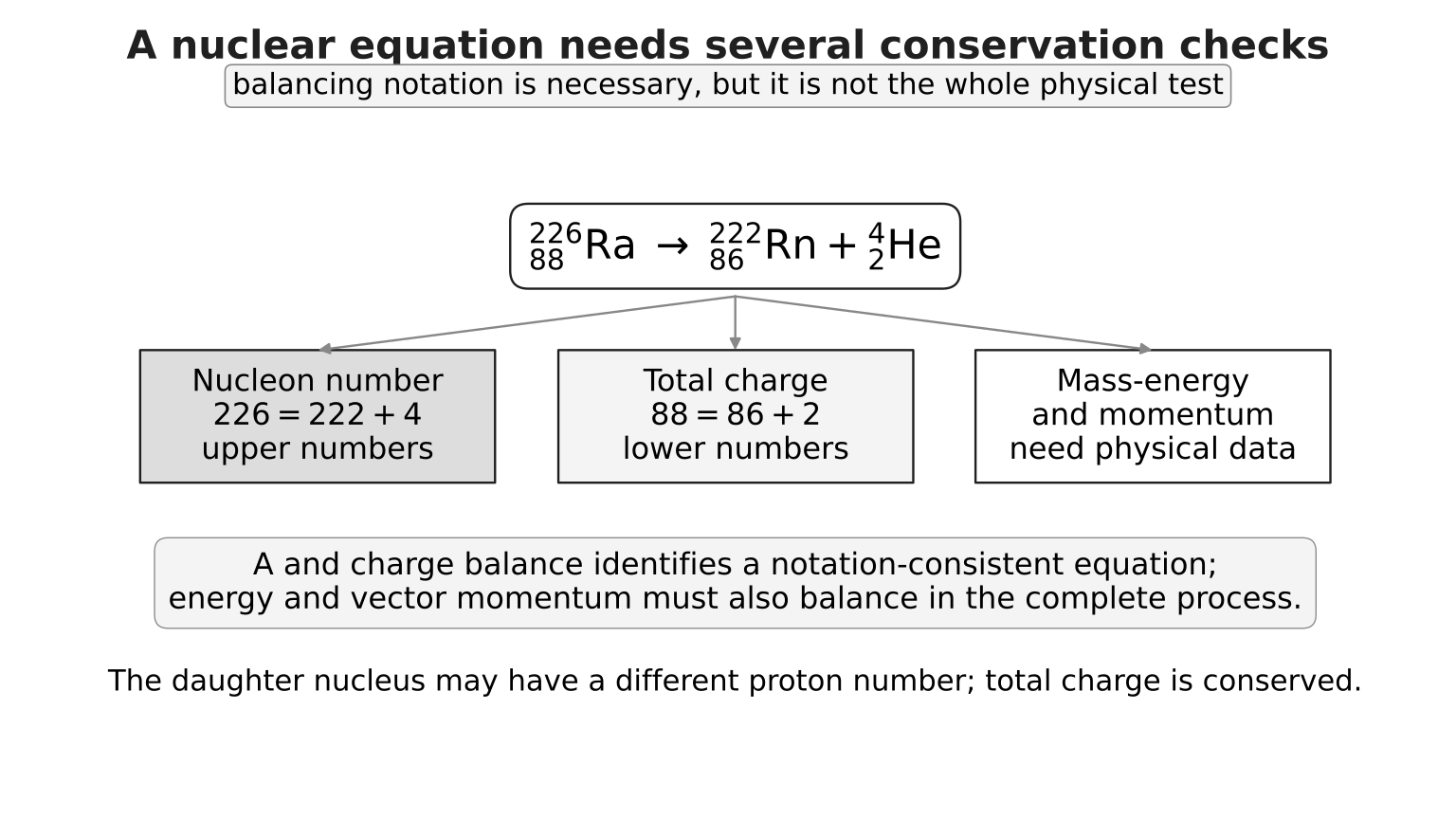
Figure: Nuclear bookkeeping has distinct layers. Upper numbers test nucleon-number balance and lower numbers test total charge balance. A physically complete analysis must also conserve total energy—including rest energy—and vector momentum; balancing only and charge is necessary but not sufficient.
Conservation of Mass–Energy
In nuclear processes, rest mass is not generally conserved as a separate quantity. The correct principle is conservation of total energy, including rest energy:
For an energy-releasing reaction, define as the energy made available as kinetic energy and/or radiation:
where the masses are total rest masses of the initial and final particles. If , the decrease in total rest energy appears as kinetic energy and/or radiation energy, subject also to momentum conservation.
For an endoergic process, external energy is required and final rest mass can exceed initial rest mass. Therefore, “products always have smaller mass” is not a conservation law.
See Nuclear Physics for mass defect and binding-energy calculations.
Angular Momentum: Framework Awareness
The 9749 curriculum framework lists angular momentum as a conserved quantity. However, the active operational learning outcomes do not require an angular-momentum formula or calculation method. Treat this as conceptual awareness rather than an additional examinable calculation topic unless a teacher explicitly extends the course.
Common Misconceptions
- “Momentum is conserved for each object.” Momentum conservation applies to the chosen system; individual objects can exchange momentum.
- “Momentum is conserved whenever forces are present in equal pairs.” Internal third-law pairs cancel in the system total; the decisive condition is the resultant external impulse.
- “Kinetic energy is always conserved in a collision.” Only perfectly elastic collisions conserve total kinetic energy.
- “Energy loss means energy disappears.” It means energy leaves the chosen store or system, or becomes less useful.
- “Current is the conserved substance.” Charge is conserved; steady current balance follows when charge does not accumulate at the junction.
- “Proton number is conserved in every nuclear process.” Total charge is conserved. A daughter’s proton number can change in beta decay.
- “Balancing and proves a nuclear reaction is possible.” Energy and momentum must also balance.
- “Mass is always conserved separately.” Nuclear processes conserve total mass–energy, not necessarily total rest mass alone.
Quick Comparison
| Quantity/account | Core condition | Typical 9749 use |
|---|---|---|
| Linear momentum | zero or negligible resultant external impulse | collisions, explosions, recoil |
| Total energy | include all stores and transfers | work, heating, radiation, nuclear processes |
| Charge | total charge cannot be created or destroyed | junctions and nuclear equations |
| Nucleon number | balance upper numbers in syllabus nuclear equations | daughter-nuclide and missing-particle identification |
| Mass–energy | include rest, kinetic and radiation energy | mass defect, binding energy, fission and fusion |
Exam Relevance
When a question says “using a conservation law”, earn clarity marks by stating:
- the chosen system;
- the condition that makes the simplified before–after equation valid;
- the direction/sign convention where needed;
- which forms or particles are included.
A good conservation equation is an accounting statement, not a memorised slogan.