Radioactive Decay
Branch note: This page deepens one part of Nuclear Physics.
9749 scope
The assessed beta-decay language is qualitative and uses neutrino generically. Positron emission is not required, and knowledge of antineutrinos or antiparticles is not required. Those details remain only in the clearly labelled enrichment support note.
Overview
Radioactive Decay is the spontaneous transformation of an unstable nucleus towards a lower-energy or more stable nuclear arrangement, accompanied by the emission of radiation. The immediate daughter nucleus may itself remain radioactive and decay again.
This topic links closely with:
Core Ideas
- unstable nuclei may decay spontaneously towards lower-energy or more stable arrangements; a daughter may still be radioactive
- radioactive decay is random for individual nuclei but statistically predictable for large samples
- alpha, beta-minus, and gamma emissions have different physical natures and different ionising and penetrating powers
- nuclear equations must conserve nucleon number and charge
- activity measures the rate of decay and is measured in becquerels
Unstable Nuclei
Some nuclei are unstable because of an unfavourable balance of:
- protons and neutrons
- strong nuclear force and electrostatic repulsion
- excess nuclear energy
Such nuclei may undergo radioactive decay towards a lower-energy or more stable arrangement. This need not produce a stable daughter in one step; radioactive decay series contain several successive unstable daughters.
Examples include:
- very heavy nuclei
- nuclei with too many neutrons
- nuclei in excited states
Spontaneous Nature of Decay
Radioactive decay is spontaneous.
This means:
- no external trigger is needed
- it occurs naturally
- it cannot be stopped by ordinary physical or chemical means
It is generally unaffected by:
- temperature
- pressure
- chemical state
- electric fields
- magnetic fields
Random Nature of Decay
Decay is random.
This means:
- it is impossible to predict when a particular nucleus will decay
- each unstable nucleus has a constant probability of decay per unit time
However, for a large sample:
- behaviour becomes predictable statistically
- count rate and activity follow exponential decay
Individual nuclei decay unpredictably, but large samples show predictable statistical behaviour.
How count readings reveal randomness
Keep the source, detector geometry and counting interval unchanged. Repeated counts from equal time intervals are not identical: they fluctuate irregularly about a mean trend. Background readings also fluctuate.
These variations are expected when independent nuclear decays occur randomly. For a large sample, the fluctuations sit around a predictable mean that decreases exponentially. One arbitrary uneven trace is not enough by itself; the inference comes from repeated measurements under unchanged conditions and a consistent statistical pattern.
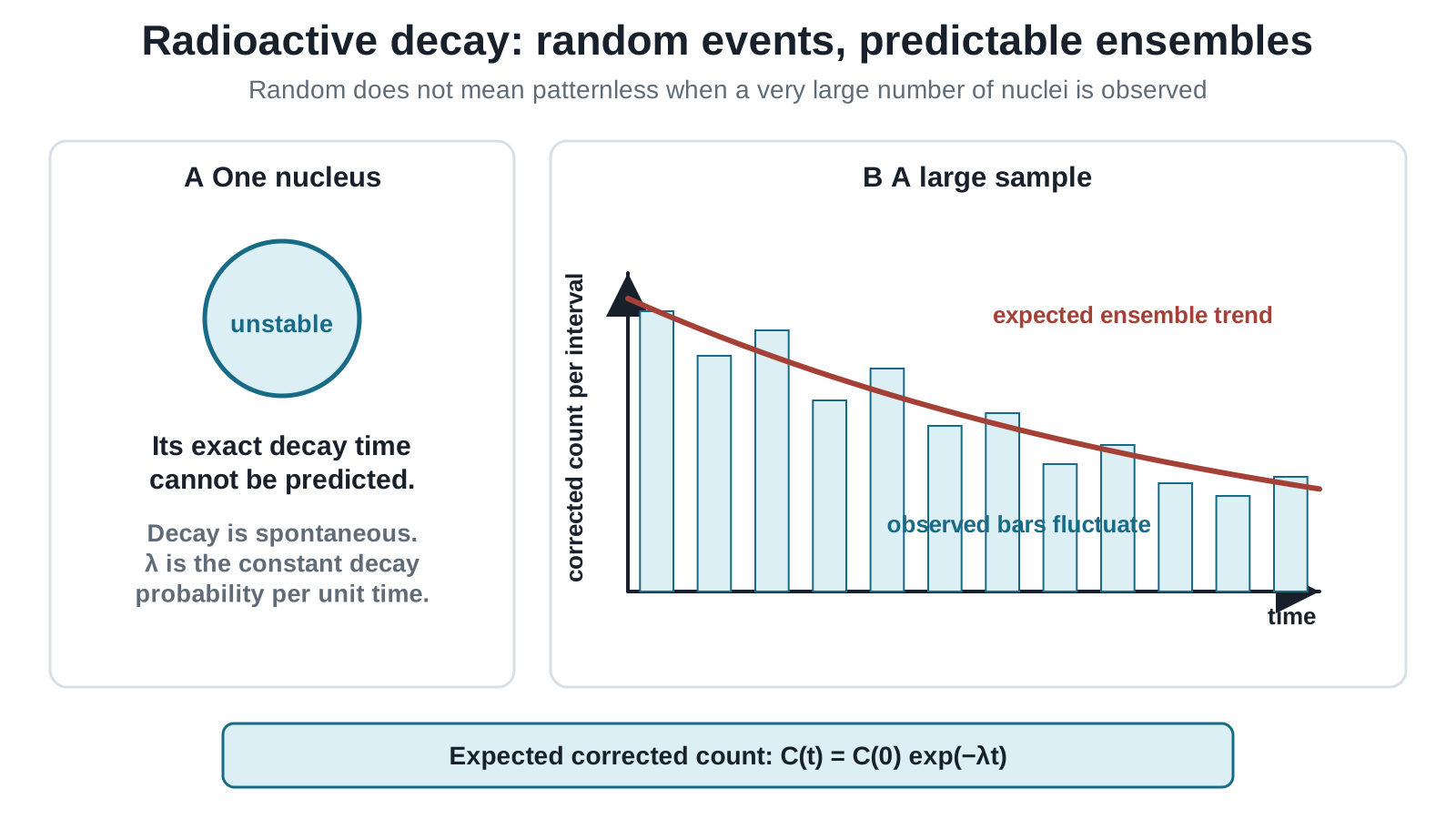
Figure: The bars represent background-corrected counts recorded in equal-duration intervals. They fluctuate because individual decays are random and independent, while the smooth curve is the predictable ensemble mean, which decreases exponentially. The schematic omits background because it has already been corrected for.
Let be the number of undecayed nuclei. Due to decay, decreases over time. Its rate of change is:
whose solution is:
where:
- is the decay constant
- is the initial number of undecayed nuclei
The decay constant is related to the half-life by:
A larger decay constant means:
- faster decay
- shorter half-life
See Half-Life.
Activity Overview
Activity measures the rate of nuclear decay:
Two meanings of
Here denotes activity, measured in becquerels. In nuclide notation such as , instead denotes nucleon number. These are different quantities that share a conventional symbol.
Over a finite time interval, activity can also be interpreted as the average number of decays per unit time.
SI unit:
Larger activity means more decays occur each second.
Activity is a property of the source. A detector normally registers only a fraction of the emitted radiation, so count rate is not automatically equal to activity. The raw measured rate also includes background:
The mean background should be estimated with the source removed, preferably over a sufficiently long counting interval. See Half-Life.
Alpha Decay
An alpha particle is a helium nucleus:
It contains:
- 2 protons
- 2 neutrons
General form:
Alpha decay occurs commonly in heavy nuclei.
Beta-Minus Decay
In beta-minus decay, a neutron changes into a proton and emits an electron.
General form:
Key changes:
- nucleon number remains unchanged
- proton number increases by 1
Beta particles are emitted with a continuous range of energies. The measured daughter-nucleus and beta-particle energy/momentum cannot by themselves complete the conservation bookkeeping. Conservation of energy and momentum therefore led physicists to predict an additional neutral, weakly interacting particle called the neutrino.
Syllabus note: Use generic neutrino language in a core 9749 answer. Positron emission, antineutrino notation and antiparticle distinctions are beyond the explicit syllabus and are kept in Beta-Decay Particle Context as enrichment.
Gamma Emission
Gamma radiation is electromagnetic radiation emitted by an excited nucleus.
Key changes:
- no change in nucleon number
- no change in proton number
Only the nuclear energy decreases.
Properties of Alpha, Beta and Gamma Radiation
| Property | Alpha | Beta-Minus | Gamma |
|---|---|---|---|
| Nature | Helium nucleus | Electron | Electromagnetic radiation |
| Charge | |||
| Relative Mass | Relatively large | Very small | Zero rest mass |
| Speed | Varies with decay energy; no single defining value | Varies with decay energy; no single defining value | in vacuum |
| Ionising Power | High | Medium | Low |
| Penetrating Power | Low | Medium | High |
Ionising Power vs Penetrating Power
Ionising Power
This is the ability of radiation to remove electrons from atoms.
Order:
Penetrating Power
This is the ability of radiation to pass through matter.
Order:
Typical shielding:
- alpha: paper, air, or the outer dead layer of skin
- beta-minus: a sheet of aluminium
- gamma: thick lead or concrete
Alpha- and beta-particle speeds vary with the energy released in a particular decay, so no single numerical speed is a defining property. Gamma intensity is attenuated progressively by shielding rather than guaranteed to be completely stopped by one finite layer.
Behaviour in Electric and Magnetic Fields
Alpha
- positively charged
- deflected toward the negative plate
- often less curved than beta under comparable field, speed and path conditions because its charge-to-mass ratio is much smaller
Beta-Minus
- negatively charged
- deflected toward the positive plate
- often more curved than alpha under comparable conditions because its charge-to-mass ratio is much larger
Gamma
- no charge
- not deflected
Field treatment is qualitative at H2 level. Direction follows the sign of charge; the amount of curvature also depends on speed, momentum, field strength and time spent in the field, so beta bends more is not an unconditional law.
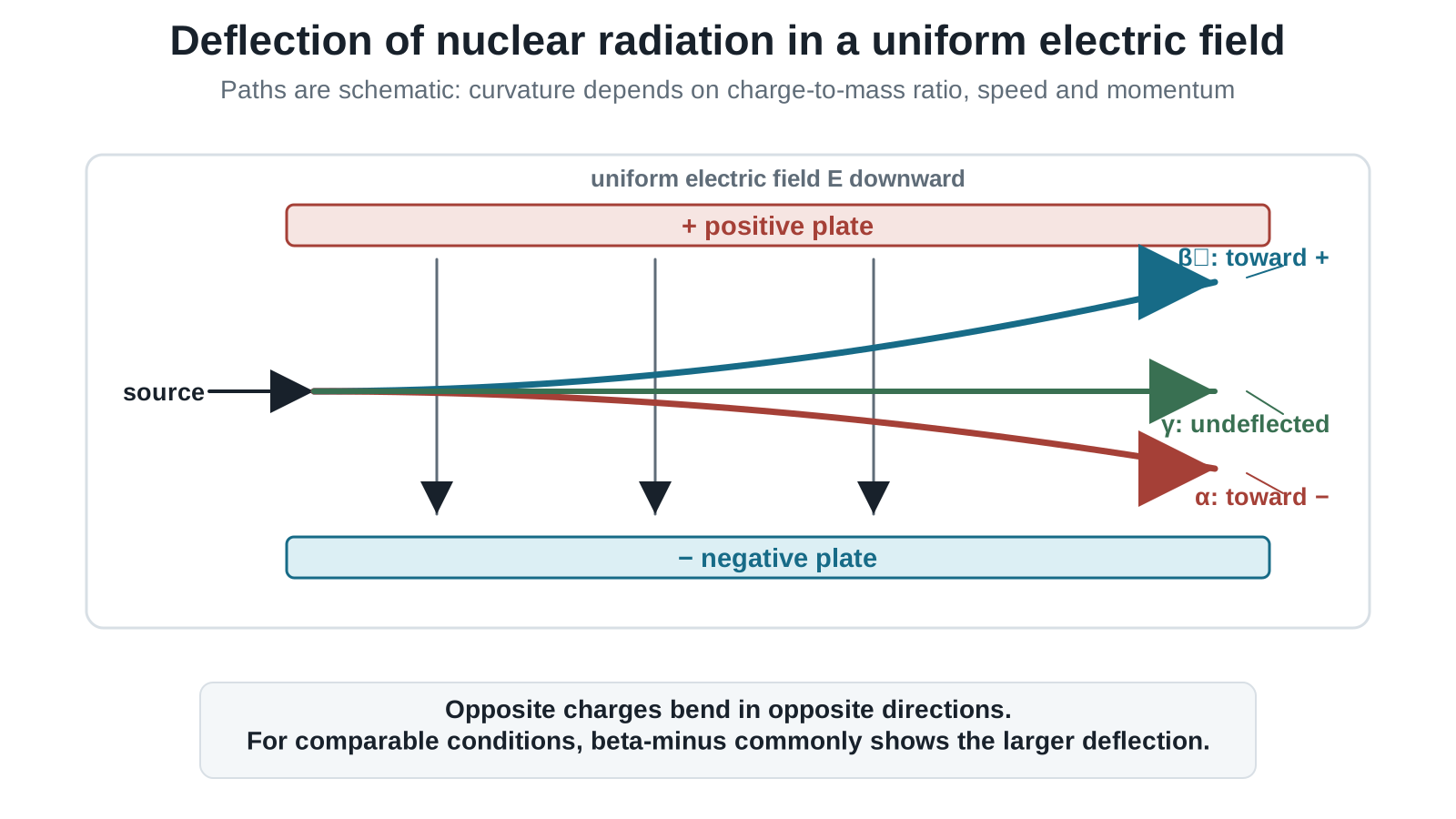
Figure: In a uniform electric field, alpha radiation deflects toward the negative plate, beta-minus radiation toward the positive plate, and gamma radiation is undeflected. The larger beta-minus curvature shown is only a comparison under suitable comparable conditions; curvature also depends on particle speed, momentum, field strength and time in the field.
Decay Equations Overview
Nuclear equations must conserve:
- nucleon number
- charge, equivalently proton number
Example alpha decay:
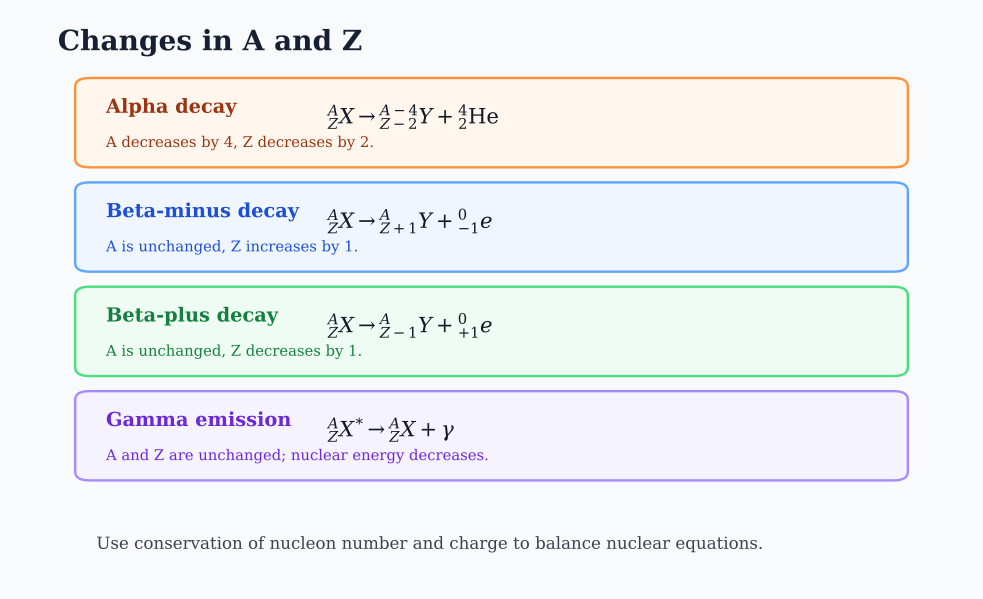
Figure: Alpha decay changes both nucleon number and proton number , beta-minus decay changes only, and gamma emission changes neither nor .
See Decay Equations and Conservation.
Conservation Laws Overview
In radioactive decay:
Conserved
- total nucleon number
- total charge
- energy
- momentum
Therefore
Nuclear equations must balance both the top and bottom numbers.
Safety Context
Radioactive emissions can ionise matter and damage living tissue.
Applications, hazards, and precautions are covered in:
Short Worked Examples
Example 1: Alpha Decay Daughter
After alpha emission:
Answer:
Example 2: Beta-Minus Decay Daughter
After beta-minus decay:
Answer:
Example 3: Gamma Emission
If excited cobalt emits gamma radiation:
- the same element remains
- the same remains
- the same remains
Only the nucleus drops to a lower energy state.
Exam Relevance
Students should be able to:
- distinguish spontaneous decay from random decay
- infer randomness from fluctuations in repeated equal-duration count measurements
- compare alpha, beta-minus, and gamma radiation
- describe ionising power, penetrating power, and field behaviour qualitatively
- balance simple nuclear equations using conservation of nucleon number and charge
- identify the correct daughter nucleus after a decay
- explain qualitatively why beta-decay energy and momentum evidence led to prediction of the neutrino
- distinguish source activity from raw and background-corrected detector count rate
Formula Sheet
Activity
Activity is the rate of nuclear decay:
Over a finite time interval, the average activity is:
Alpha Decay
Beta-Minus Decay
Gamma Emission
Common Exam Traps Overview
Students often confuse:
- alpha with beta particles
- ionising power with penetrating power
- the wrong changes in and
- gamma radiation with a charged massive particle
- decay being caused by heating
- random decay with unpredictable sample behaviour
- a fluctuating measured count with a failure of the exponential mean model
- activity with detector count rate
See Radioactive Decay Common Exam Traps.
Quick Revision Summary
- radioactive decay is spontaneous and random
- unstable nuclei may emit alpha, beta-minus, or gamma radiation
- alpha is massive, highly ionising, and weakly penetrating
- beta-minus has intermediate ionising and penetrating power
- gamma is weakly ionising and strongly penetrating
- nuclear equations conserve nucleon number and charge
- large samples decay predictably even though individual nuclei decay randomly