Motion with Air Resistance
Overview
Syllabus core
H2 Physics requires a qualitative description of bodies falling in a uniform gravitational field with air resistance. No universal drag formula is assumed here.
Learning goals
You should be able to:
- state the directions of weight and drag;
- explain why acceleration decreases during a fall from rest;
- define terminal velocity using balanced forces;
- sketch and interpret the qualitative velocity–time and acceleration–time graphs; and
- explain why one SUVAT model cannot describe the whole resisted fall.
1. Two forces with different behaviour
For a body falling vertically through still air:
- weight acts downward and is approximately constant near Earth’s surface;
- air resistance, or drag, acts opposite to the body’s velocity.
Drag generally grows as speed relative to the air grows. Its exact dependence on speed and shape is not universal, so no formula such as or should be assumed unless a question supplies it.
Choose downward as positive for the following discussion.
2. Falling from rest
Stage 1 — immediately after release
At the instant of release, speed is zero. Drag is therefore zero or negligible.
downward, so
The body begins to speed up downward.
Stage 2 — speed and drag increase
As downward speed rises, upward drag rises. Weight remains approximately constant.
where is the drag magnitude. Therefore the downward resultant force becomes smaller, so the downward acceleration becomes smaller.
The body is still speeding up because velocity and acceleration are both downward, but its speed increases at a decreasing rate.
Stage 3 — terminal motion
Eventually, drag can balance weight:
Then
The velocity is now constant and non-zero. This constant velocity is the terminal velocity relative to the air.
Balanced forces do not mean no forces
At terminal velocity, weight and drag are both present. They are equal and opposite, so the resultant force is zero.
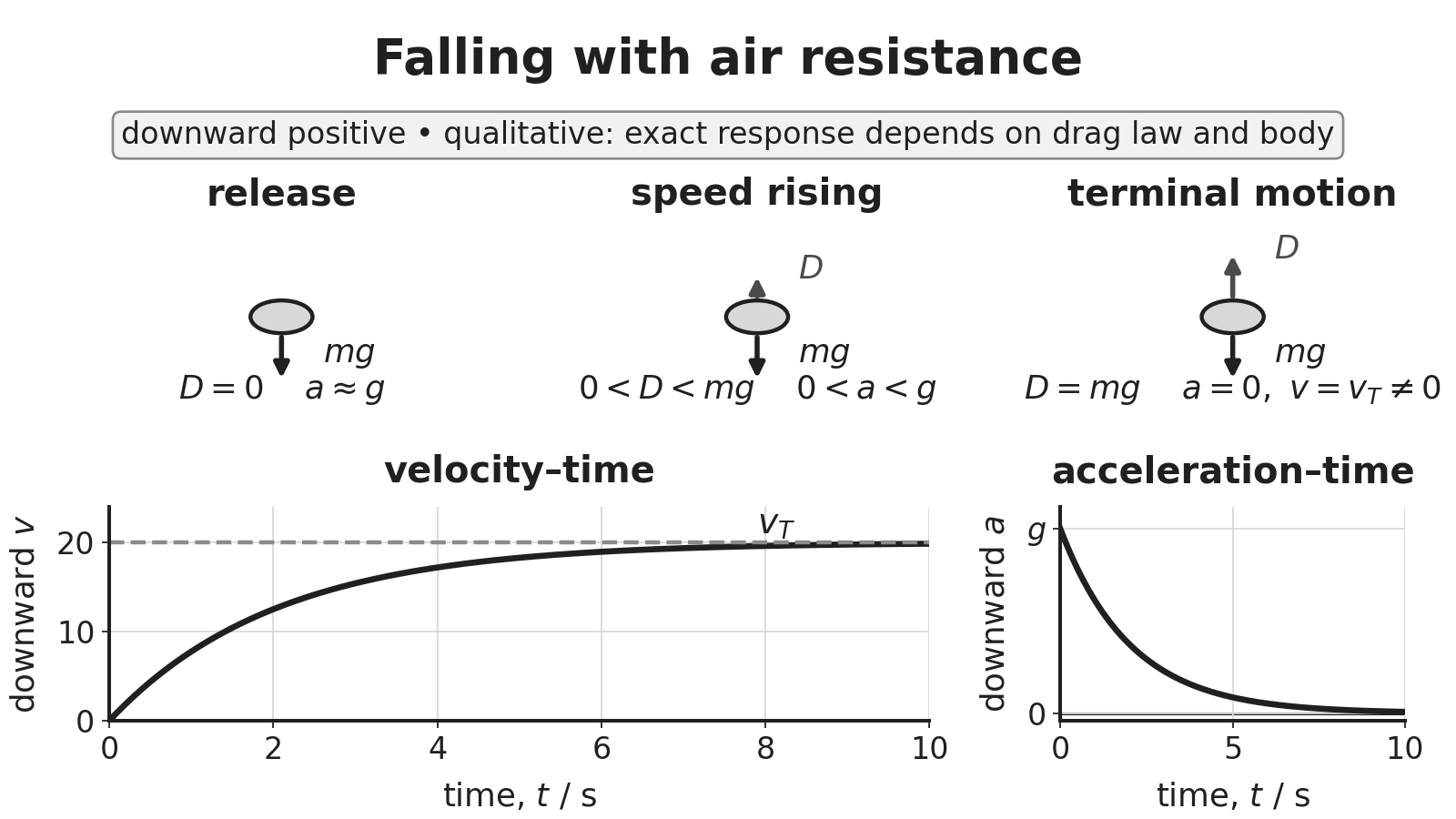
With downward chosen positive: speed increases upward drag increases the downward resultant force decreases acceleration decreases drag balances weight at terminal speed. The – curve approaches a horizontal asymptote, while the – curve falls from about towards zero. Neither curve reaches its limiting value abruptly in the idealised model.
3. Reading the graphs
Velocity–time graph
- It starts at for release from rest.
- Its initial gradient is approximately .
- The gradient decreases as drag rises.
- The curve approaches a horizontal line at terminal velocity.
The height gives velocity; the gradient gives acceleration.
Acceleration–time graph
- It starts near downward.
- It decreases as drag rises.
- It approaches zero at terminal motion.
Area under the acceleration–time graph gives the change in velocity. Initial velocity is still required to obtain absolute velocity.
4. Why SUVAT cannot cover the whole fall
The constant-acceleration equations require one constant over the selected interval. During a resisted fall,
changes because changes with speed. Therefore one SUVAT equation set cannot describe the complete approach to terminal velocity.
SUVAT may still be used over an explicitly justified short interval in which acceleration is approximated as constant, or before drag becomes significant if the question permits that approximation.
Compare with Constant Acceleration Models.
5. What controls terminal speed qualitatively?
Terminal speed occurs when the drag magnitude has grown to equal weight. It can therefore change with:
- mass and weight;
- shape and cross-sectional area;
- properties of the fluid; and
- body orientation.
A parachute increases effective area and drag at a given speed. The new balance is then reached at a lower terminal speed.
6. Useful extension — thrown upward with drag
This extension strengthens force-direction reasoning but does not introduce an exact drag law.
Choose upward as positive.
Ascent
The ball moves upward, so drag acts downward. Weight also acts downward. While drag is non-zero, the downward acceleration magnitude is greater than .
Highest point
At the highest point, momentarily. In still air, drag is momentarily zero, but weight remains. Thus acceleration is downward, not zero.
Descent
The ball moves downward, so drag acts upward. The downward acceleration magnitude is less than until terminal motion is approached.
When the ball returns to its launch height, its speed is less than its launch speed because drag has transferred mechanical energy to the surroundings.
Drag always opposes instantaneous velocity
Its direction reverses when the direction of motion reverses. It does not always point upward or always point downward.
7. Common misconceptions
| Misconception | Correction |
|---|---|
| Terminal velocity means the object stops | Terminal velocity is constant and non-zero |
| Forces vanish at terminal velocity | Weight and drag remain but balance |
| Acceleration becomes negative during the fall | For the simple fixed-configuration fall from rest described above, downward-positive acceleration remains positive and approaches zero. It can become negative if drag exceeds weight, such as just after a parachute opens. |
| Drag has one universal formula | The relation depends on the physical regime; use only information supplied |
| at the top means | Weight remains, so acceleration is downward |
8. Short qualitative practice
Question 1
A raindrop is released from rest and eventually reaches terminal speed. Explain why its acceleration decreases although its speed is still increasing.
Answer: Increasing speed produces greater upward drag. Weight is approximately constant, so the downward resultant force and acceleration decrease. Velocity and acceleration remain in the same downward direction, so speed still rises until the forces balance.
Question 2
A parachute opens while a skydiver is moving downward. Explain the immediate and later motion.
Answer: Drag suddenly increases and can exceed weight, giving an upward resultant and upward acceleration. Since velocity is initially downward, the skydiver slows down. As speed falls, drag falls until it again balances weight at a lower terminal speed.
Core ideas
Drag opposes motion and changes with speed; weight remains approximately constant. Terminal velocity occurs when the two forces balance, leaving zero acceleration but non-zero constant velocity.
Exam relevance
Qualitative explanations should form a causal chain from speed to drag, resultant force, acceleration and subsequent velocity change. Do not replace this chain with the unsupported phrase “it reaches terminal velocity.”