Kinematic Quantities and Sign Conventions
Overview
Kinematics describes how an object moves. Before using equations, we need a precise language for position, path length, direction and change.
Learning goals
By the end of this note, you should be able to:
- choose an origin and positive direction;
- distinguish distance from displacement and speed from velocity;
- calculate average speed, average velocity and average acceleration;
- explain what instantaneous speed and velocity mean;
- use the signs of velocity and acceleration to describe motion; and
- distinguish momentary rest from remaining at rest.
1. Start with a reference frame
To describe one-dimensional motion, first choose:
- an origin, where the coordinate is zero;
- a positive direction; and
- a clock reading or time interval.
The coordinate gives the object’s position relative to the origin. A negative coordinate does not mean a negative distance. It means that the object is on the negative side of the chosen origin.
A coordinate is not a distance travelled
Position tells where the object is relative to the origin. Distance travelled accumulates how much path the object has covered.
2. Distance and displacement
Distance travelled
Distance travelled is the total path length covered.
- It is a scalar.
- It is never negative.
- It depends on the actual route.
- SI unit: metre, .
Displacement
Displacement is the directed change from the initial position to the final position.
In one dimension,
The sign of records direction relative to the chosen positive axis. In two or three dimensions,
The displacement vector depends only on the initial and final positions, not on the route between them.
For every journey,
Equality holds for motion along a straight line without reversing direction.
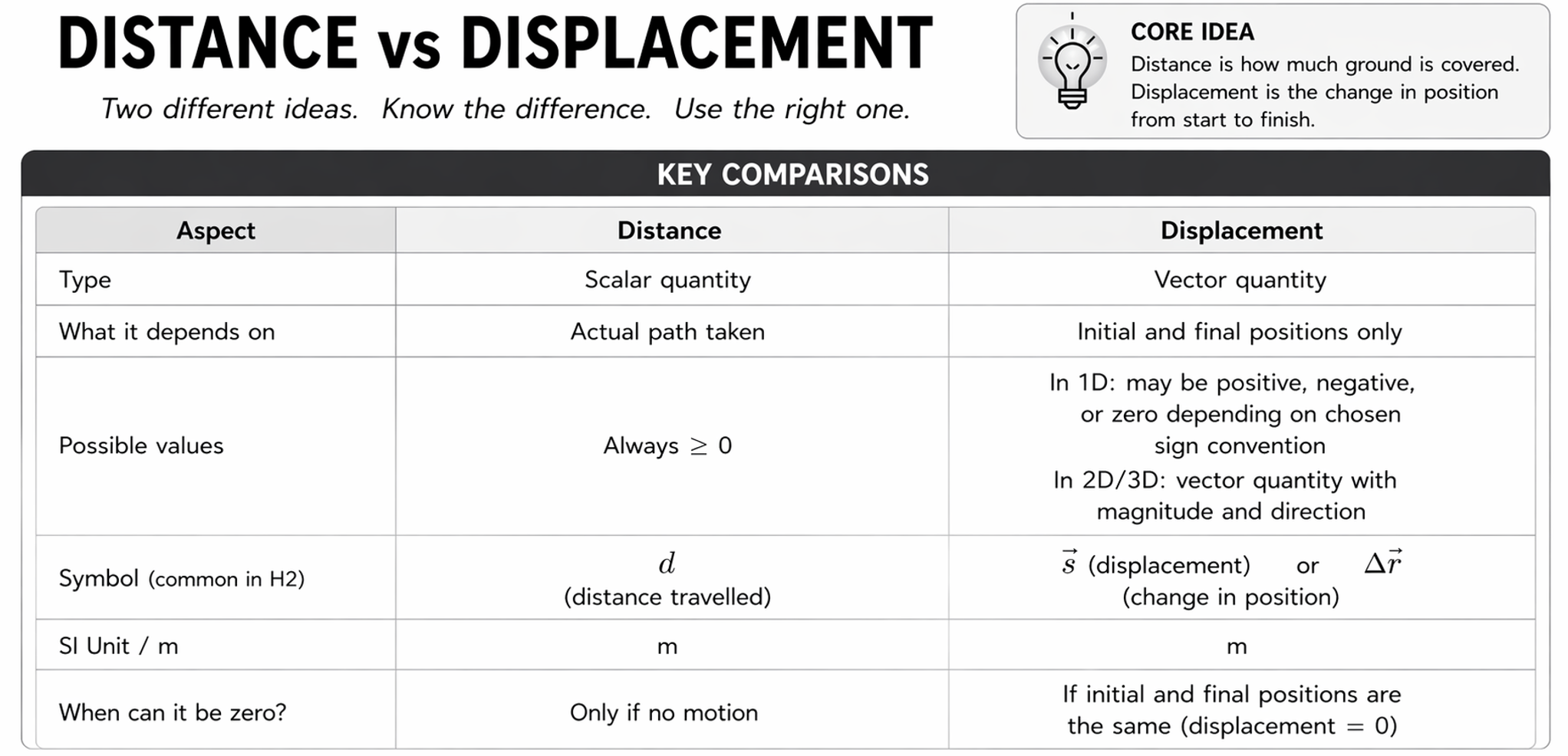
The path length gives distance, whereas the directed arrow from initial to final position gives displacement. A traveller who returns to the starting point has zero displacement but a positive distance travelled.
Worked example 1 — a return journey
A student walks east and then west. Choose east as positive.
The displacement is east. Distance is not generally the magnitude of the net displacement. For this piecewise straight journey, distance is the sum of the magnitudes of the two segment displacements, whereas net displacement is their signed sum.
3. Speed and velocity
Average speed
Average speed is a non-negative scalar.
Average velocity
In one dimension,
Average velocity includes direction. A return journey can therefore have zero average velocity even though its average speed is non-zero.
Common comparison
Average speed is generally not the magnitude of average velocity. They are equal only when the distance travelled equals the magnitude of displacement, such as straight-line motion without reversal.
Instantaneous velocity and speed
Average velocity describes a finite interval. Instantaneous velocity describes motion at one instant:
Instantaneous speed is the magnitude of instantaneous velocity:
In one dimension, speed is . A speedometer approximates instantaneous speed, not average speed over the whole journey.
4. Acceleration
Acceleration is the rate of change of velocity:
SI unit: .
Velocity can change because:
- its magnitude changes;
- its direction changes; or
- both change.
An object moving around a circle at constant speed is accelerating because its velocity direction changes. The detailed treatment is in Circular Motion.
Worked example 2 — change of direction
A trolley’s velocity changes from to in . Take right as positive.
The speed changed from to , a change of . That is not the velocity change. The velocity change is because direction matters.
5. Sign convention in one dimension
The choice of positive direction is arbitrary. Consistency is not.
For vertical motion, either convention is valid:
- upward positive: upward is positive and gravitational acceleration is ;
- downward positive: downward is positive and gravitational acceleration is .
Here is the positive magnitude of gravitational acceleration. Its usual near-Earth value is approximately .
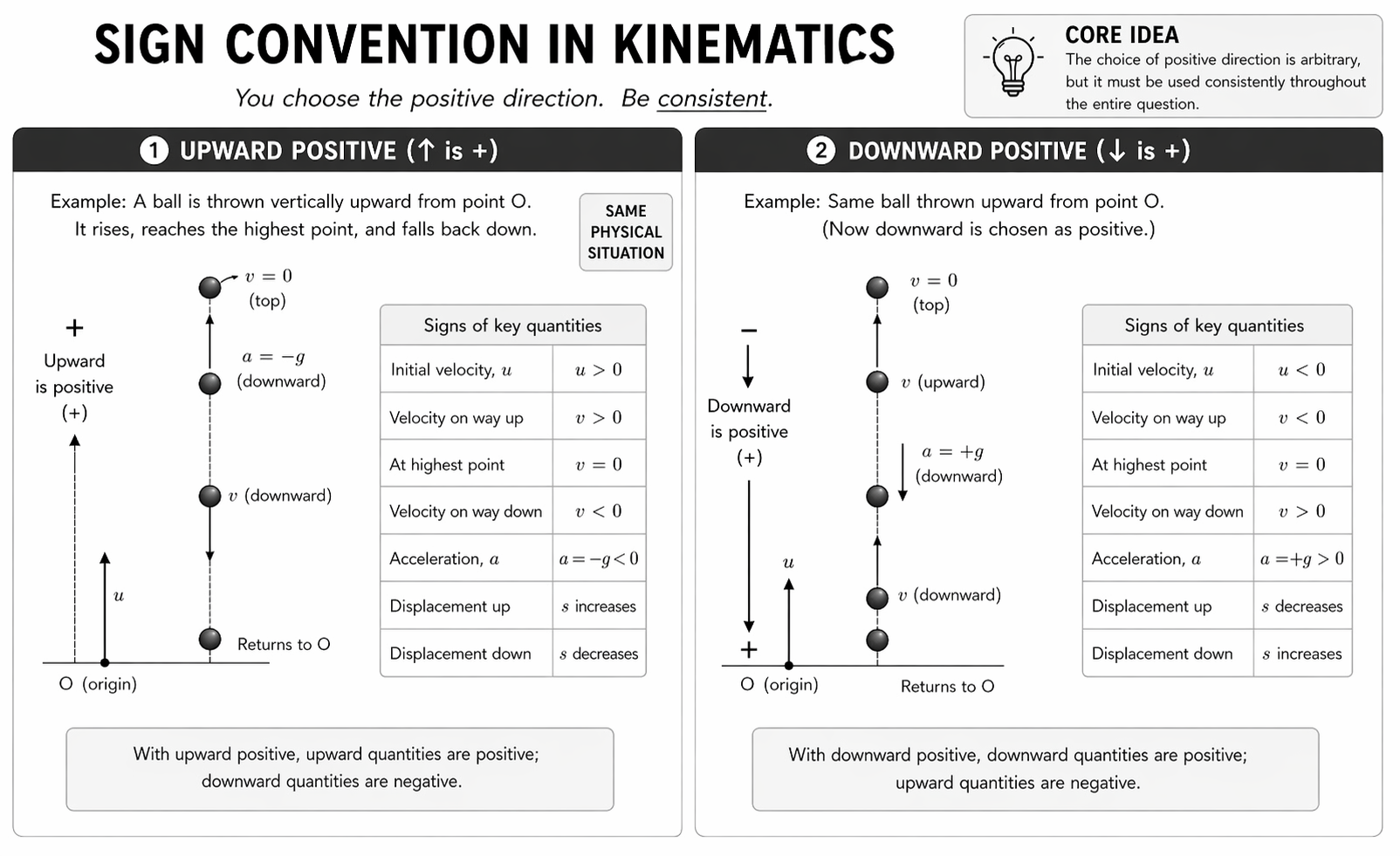
The same vertical throw is described using two valid sign conventions. The chosen origin and chosen positive direction are separate decisions. Changing the positive direction changes the algebraic signs of , , and displacement, but it does not change the physical motion.
A reliable sign routine
- Draw a positive-axis arrow.
- Assign signs from direction, not from whether a quantity is “initial” or “final”.
- Keep that convention throughout one modelled interval.
- Interpret a negative answer as direction relative to the chosen axis.
6. Is the object speeding up or slowing down?
Speed depends on the magnitude of velocity. Over an interval in which and retain non-zero signs:
| Velocity and acceleration | Effect on speed |
|---|---|
| Same direction/sign | Speed increases |
| Opposite directions/signs | Speed decreases |
Examples with right chosen positive:
- , : moving right and speeding up.
- , : moving right and slowing down.
- , : moving left and speeding up.
- , : moving left and slowing down.
Negative acceleration does not automatically mean slowing down
Negative acceleration means acceleration points in the negative direction. Whether speed rises or falls depends on the direction of velocity.
7. Turning points and rest
At a one-dimensional turning point,
at one instant, and the velocity changes sign across that instant.
The acceleration need not be zero. At the highest point of a vertical throw with negligible air resistance, for example, momentarily but when upward is positive.
Do not confuse:
- momentarily at rest: at one instant; and
- remaining at rest: position stays constant over a finite interval, so throughout that interval.
8. First-learner checklist
Before solving a motion problem, ask:
- What is the origin?
- Which direction is positive?
- Is the quantity a scalar or a vector/component?
- Does the question ask for distance or displacement?
- Does it ask for speed or velocity?
- Has direction changed during the interval?
Quick check
- Can distance travelled be negative?
- Can displacement be zero after motion has occurred?
- Can acceleration be non-zero while speed is constant?
- If and , is the object speeding up or slowing down?
Answers: no; yes; yes, if direction changes; slowing down while it continues moving in the negative direction.
Core ideas
Choose the reference frame first; distinguish path length from directed change; distinguish magnitude from signed component; and compare velocity with acceleration before deciding whether speed changes.
Exam relevance
Definition, sign-convention and change-in-velocity errors often propagate through an entire structured calculation. State the positive direction, preserve signed quantities and interpret rather than discard a negative result.