Kinematics Graphs and Calculus
Overview
Motion graphs compress a whole journey into a picture. The key is to identify what the height, gradient and signed area mean for the particular axes.
Learning goals
You should be able to:
- distinguish distance–time from displacement–time graphs;
- distinguish speed–time from velocity–time graphs;
- obtain velocity from a displacement–time gradient;
- obtain acceleration from a velocity–time gradient, including a tangent for non-uniform acceleration;
- obtain displacement from signed velocity–time area;
- obtain distance by summing absolute velocity–time areas; and
- translate one motion description between displacement, velocity and acceleration graphs.
1. A three-question routine
For any graph, ask:
- Height: what physical quantity is plotted vertically?
- Gradient: what rate of change does the gradient represent?
- Area: do the axes give the area a useful physical meaning?
Do not assume that graph height, gradient and area all have the same interpretation.
2. Scalar and vector graph pairs
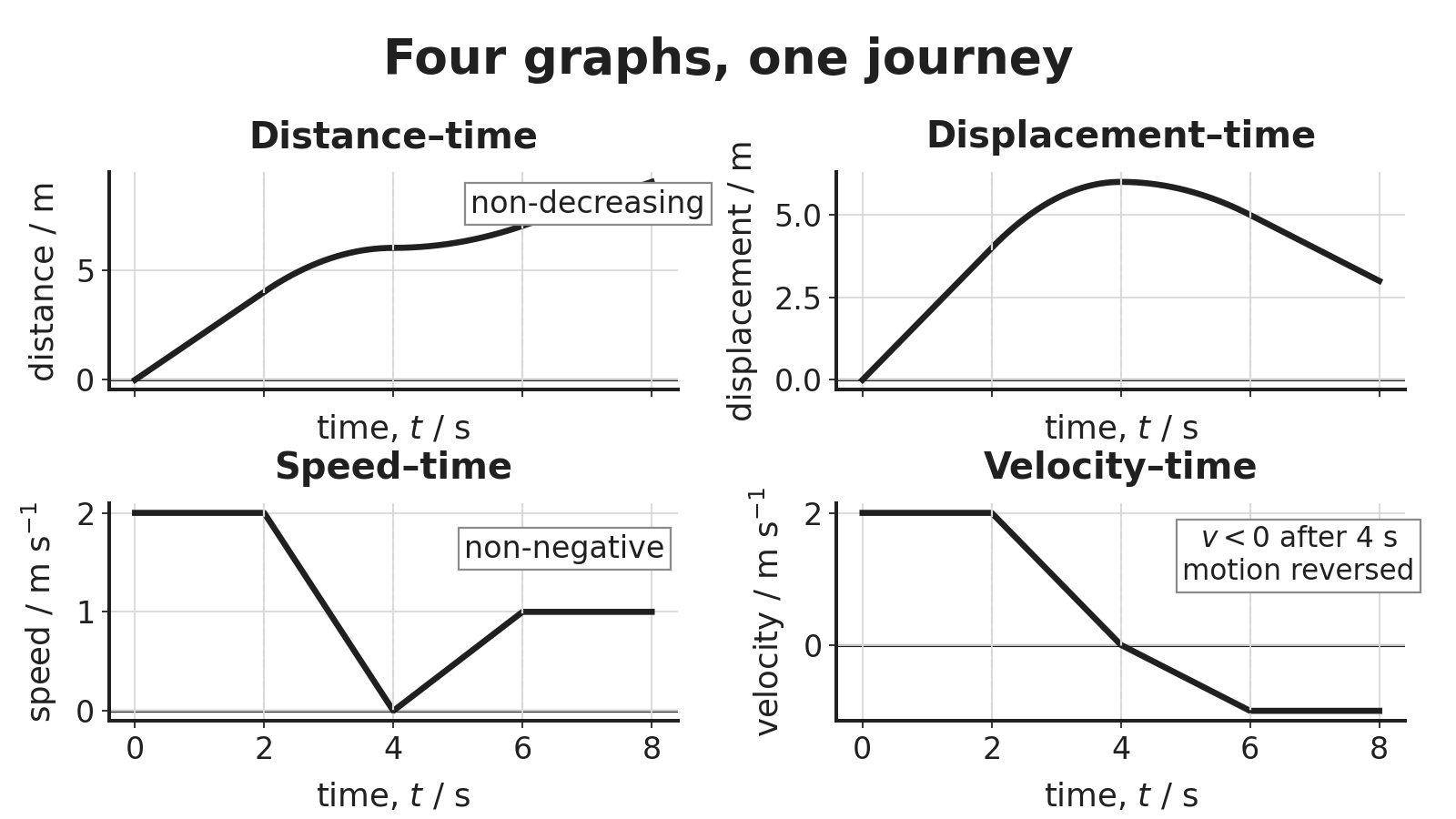
Read the labelled graphs rather than relying on panel position. Distance accumulates and cannot decrease; speed is never negative. Displacement can rise or fall, and velocity can cross the time axis. For a speed–time graph, area gives distance; for a velocity–time graph, signed area gives displacement. All four graphs must represent the same journey and share the same event times.
Distance–time graph
- Vertical coordinate: accumulated distance travelled.
- Gradient: speed.
- The graph cannot slope downward because total distance already travelled cannot decrease.
- A horizontal section means no additional distance is being covered: the object is at rest.
Displacement–time graph
- Vertical coordinate: displacement from the chosen origin.
- Gradient: velocity.
- A negative gradient means motion in the negative direction.
- A horizontal section means .
Speed–time graph
- Vertical coordinate: speed, so it is non-negative.
- Area between curve and time axis: distance travelled.
- It cannot show which direction the object moves.
Velocity–time graph
- Vertical coordinate: signed velocity.
- Gradient: acceleration.
- Signed area between curve and time axis: displacement.
- Distance travelled is the sum of the magnitudes of all positive and negative areas.
3. Displacement–time gradients
For an interval,
which is the gradient of a secant joining two graph points.
At one instant,
which is the gradient of the tangent at that instant.
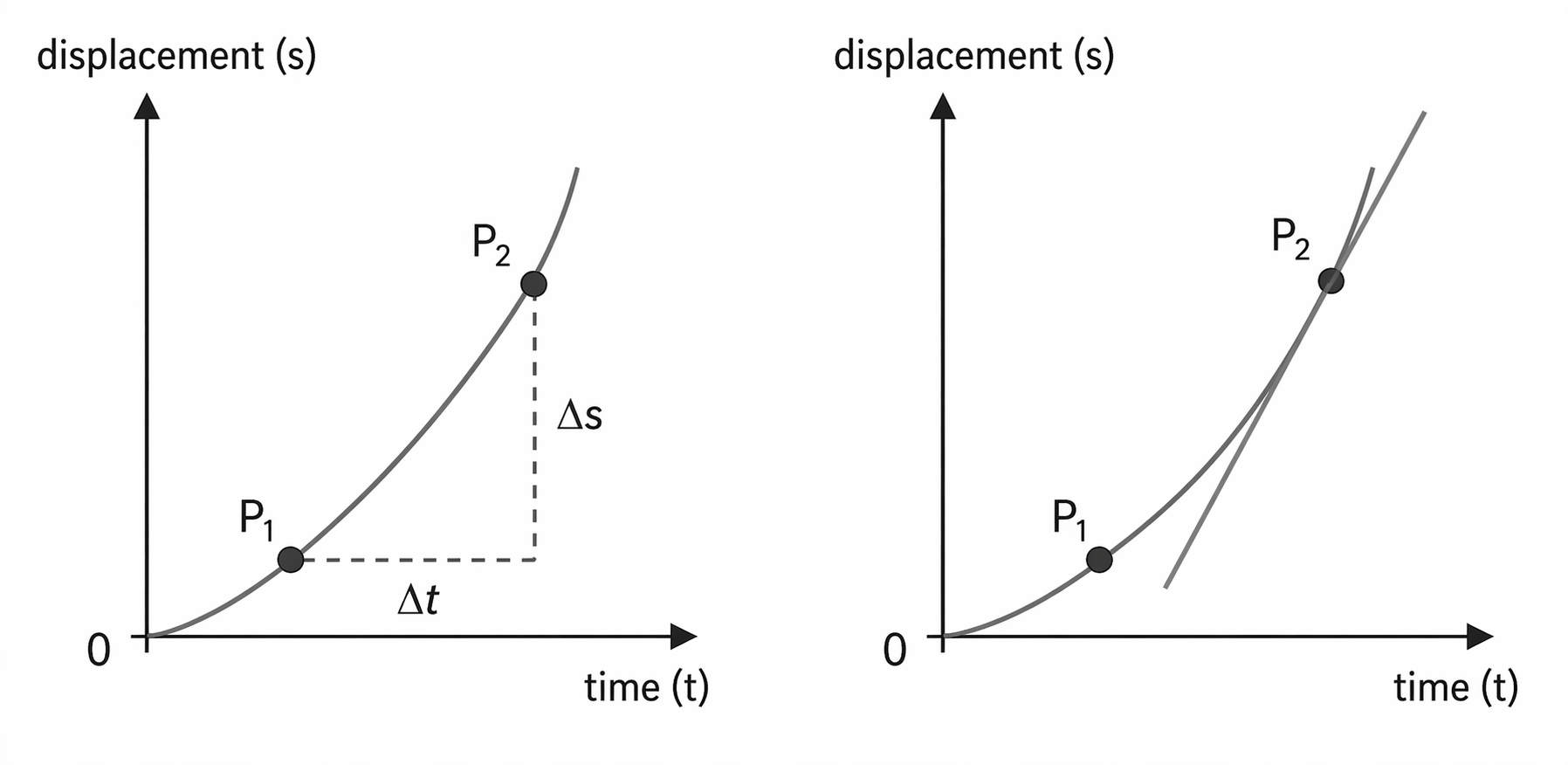
The line joining and is a secant: its gradient gives average velocity over that interval. The line touching the curve at is a tangent: its gradient gives instantaneous velocity at . The tangent is a local straight-line approximation, not the object’s path through space.
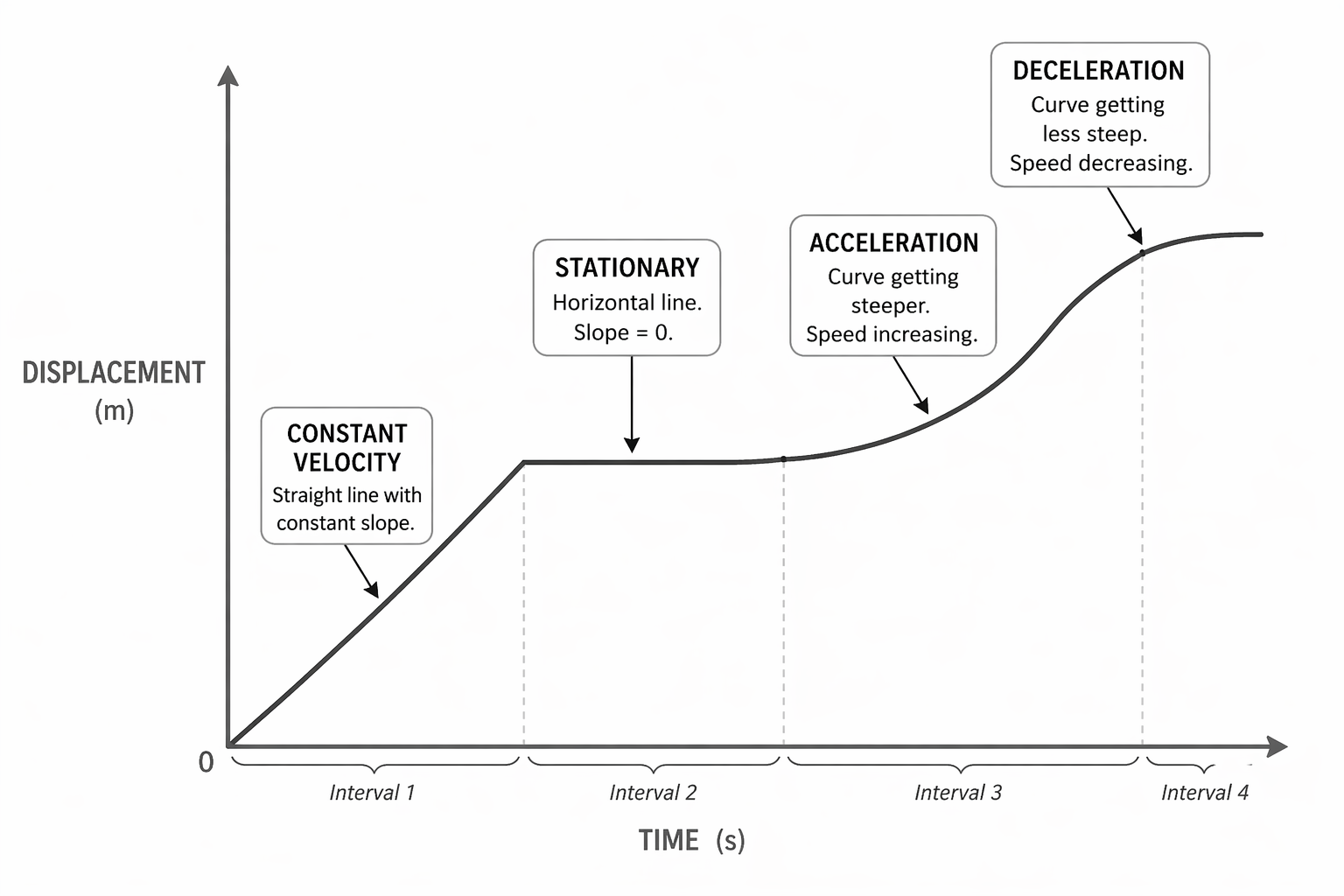
Graph height gives displacement from the chosen origin; local gradient gives velocity. A rising curve that becomes less steep still has , but its speed is decreasing. At a stationary point ; a direction reversal occurs only if the gradient changes sign across it.
Reading curve shape carefully
- positive gradient: ;
- negative gradient: ;
- greater magnitude of gradient: greater speed;
- gradient becoming more positive: positive acceleration;
- gradient becoming more negative: negative acceleration.
“Steeper” must refer to the magnitude of gradient when discussing speed. A steep negative gradient represents a large speed in the negative direction.
4. Velocity–time gradients and areas
The average acceleration over an interval is
At an instant,
Thus acceleration is the gradient of the velocity–time graph.
Displacement follows from
This is the signed area between the velocity curve and the time axis:
- area above the axis is positive displacement;
- area below the axis is negative displacement.
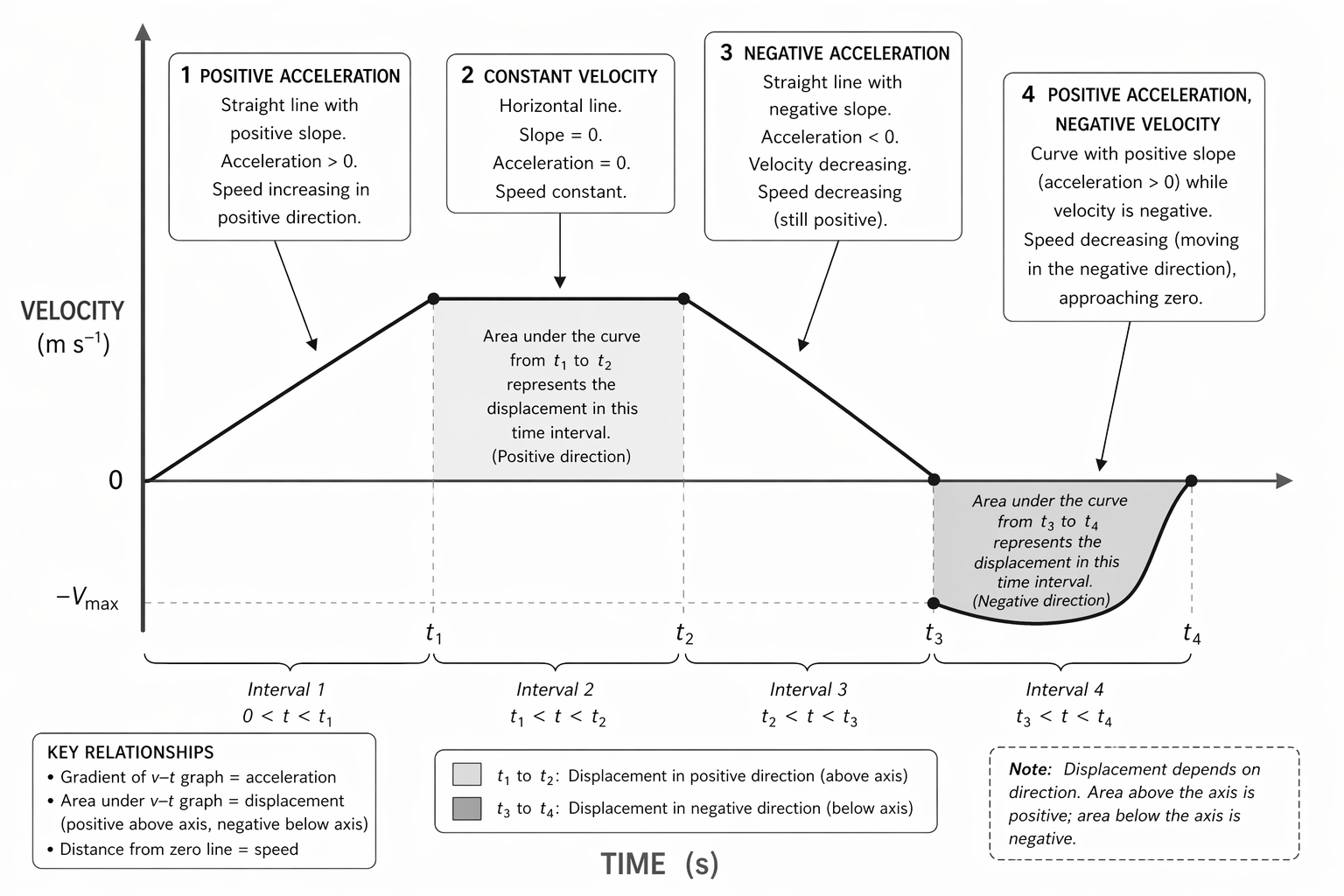
The graph’s height is velocity and its gradient is acceleration. The light area above the axis contributes positive displacement; the dark area below contributes negative displacement. Net displacement is the algebraic sum, whereas distance travelled is the sum of area magnitudes. Initial position is still required to determine absolute position.
Crossing the axis
At , the object is momentarily at rest. It reverses direction only if the graph crosses the axis and velocity changes sign.
Worked example 1 — displacement versus distance
An object moves with for , then for .
Positive area:
Negative signed area:
Therefore,
but
5. Non-uniform acceleration
Non-constant acceleration means that the gradient of the velocity–time graph is not constant. If acceleration varies smoothly, the graph is generally curved. If acceleration changes between different constant values, the graph may instead be piecewise linear. An ideal discontinuity in velocity requires separate treatment and is not assigned an ordinary finite acceleration at that instant.
For non-uniform acceleration, a tangent gradient at the chosen instant gives instantaneous acceleration. A bounded signed area over a stated interval gives displacement. These are separate operations: gradient uses rise/run near one instant, whereas area accumulates velocity over a time interval.
Worked example 2 — tangent and area from a model
Suppose a velocity is described over by the dimensionally explicit model
where is measured in seconds and in . The curved – graph means acceleration is not constant.
Instantaneous acceleration is the tangent gradient:
At ,
Displacement from to is the area:
The result is positive because velocity is positive throughout this interval.
6. Acceleration–time graphs
Because
signed area under an acceleration–time graph gives change in velocity. This is a useful additional relationship; the named core graph operations emphasise displacement–time gradients and velocity–time gradients/areas.
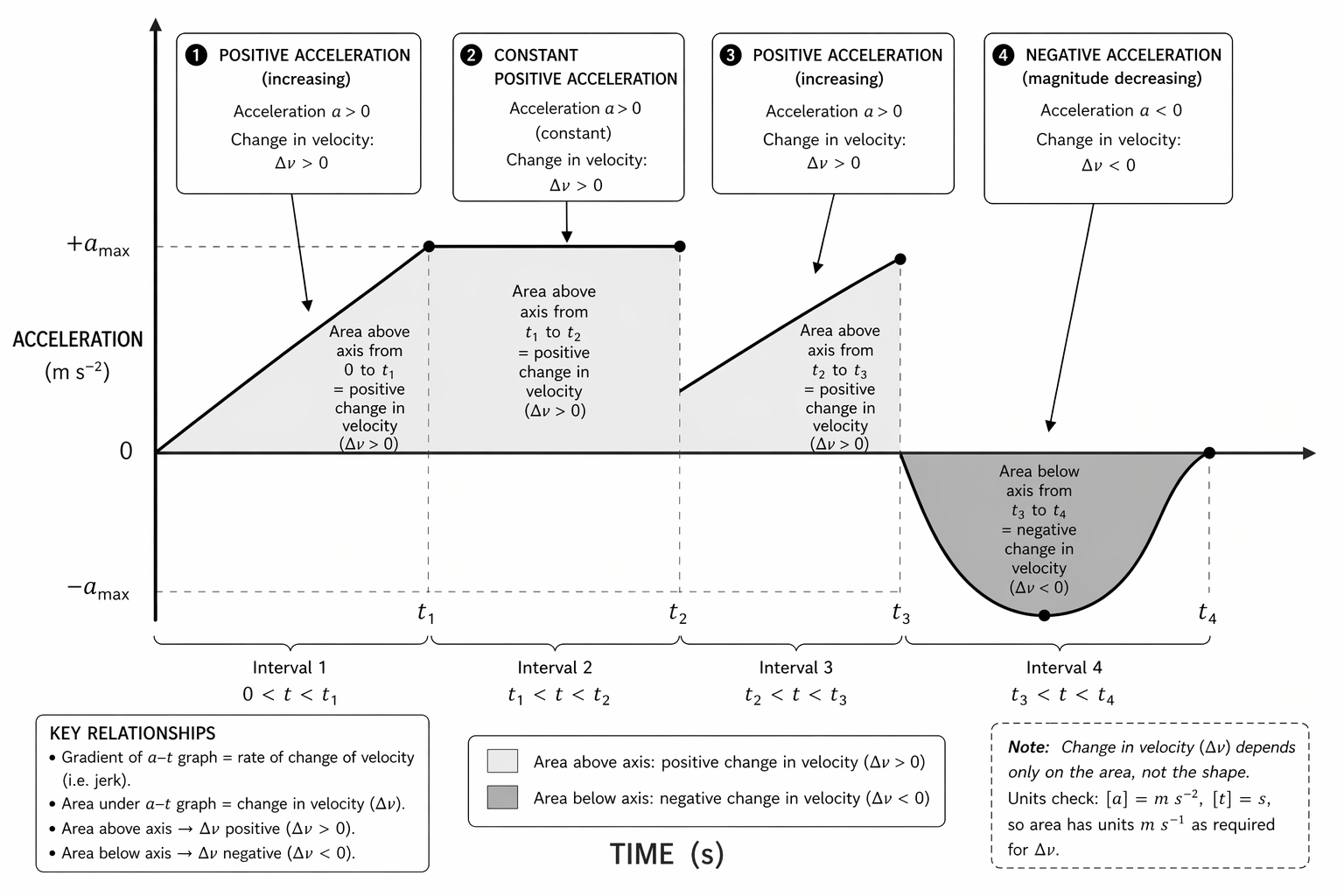
Signed area between the acceleration curve and time axis gives . Positive area increases the algebraic velocity; negative area decreases it. To find the final velocity, use ; without , the graph alone does not reveal the direction of motion. Any discussion of jerk is enrichment, not a central Topic 02 outcome.
A positive – area does not prove positive motion
It proves . An object could still have negative velocity if it began with a sufficiently large negative velocity.
7. Translating between graph types
Consider this one-dimensional journey with finite transitions:
- to : constant velocity ;
- to : velocity decreases uniformly from to ;
- to : at rest;
- to : velocity decreases uniformly from to .
Velocity–time description
- horizontal at from to ;
- straight line from to from to ;
- on the axis from to ;
- straight line from to from to .
Acceleration–time description
- from to ;
- from to ,
- from to ;
- from to ,
Displacement–time description
- straight rising line with gradient from to ;
- a rising curve whose positive gradient decreases smoothly to zero from to ;
- horizontal from to ;
- a downward curve whose gradient becomes increasingly negative from to .
The position/displacement curve should normally be continuous. A vertical jump would imply an instantaneous change in position, which is not physical in the elementary model. A sharp corner idealises an abrupt velocity change.
8. Dimensional checks
| Operation | Units | Quantity obtained |
|---|---|---|
| gradient of – | velocity | |
| gradient of – | acceleration | |
| area under – | displacement | |
| area under – | change in velocity |
9. Exam routine
- Read both axes and units.
- Decide whether height, gradient or signed area is needed.
- For a curved graph, draw a large tangent triangle.
- Split areas at every axis crossing or change of shape.
- State sign and unit.
- Ask whether an initial condition is needed.
Core ideas
Graph height names the plotted quantity, gradient gives a rate of change, and a physically meaningful area accumulates a quantity over time. Sign and initial conditions remain essential.
Exam relevance
Questions commonly mix tangent construction, signed area and graph sketching. Label axes and units, use a large tangent triangle, split areas at axis crossings and state whether the result is displacement, distance, acceleration or change in velocity.