Constant Acceleration Models
Overview
The SUVAT equations are not universal motion formulae. They describe one interval and one component in which acceleration is constant.
Learning goals
You should be able to:
- derive the constant-acceleration equations;
- state when they apply;
- choose an equation efficiently;
- solve vertical and multi-stage problems with consistent signs; and
- recognise when air resistance or another effect makes acceleration variable.
1. The model and symbols
For one chosen direction and one modelled interval:
| Symbol | Meaning |
|---|---|
| signed displacement during the interval | |
| velocity at the start of the interval | |
| velocity at the end of the interval | |
| constant acceleration during the interval | |
| duration of the interval |
The model requires:
- straight-line motion, or one resolved component of motion;
- constant acceleration over the selected interval; and
- one consistent positive direction.
Constant acceleration may be a good approximation when the resultant force on a constant-mass body is constant. A constant driving force alone does not guarantee constant acceleration if resistance changes.
2. Deriving the equations
Equation 1:
From the definition of constant acceleration,
Rearranging gives
Equation 2:
Constant acceleration means velocity changes linearly with time. Therefore the average velocity over the interval is the mean of the endpoint velocities:
Since average velocity is displacement divided by time,
so
Not a universal average
The formula is valid because velocity varies linearly with time. It is not generally valid for non-uniform acceleration.
Equation 3:
Substitute into :
Therefore,
Equation 4:
Use and . Multiplying the second relation by gives
Since ,
Hence, without dividing by ,
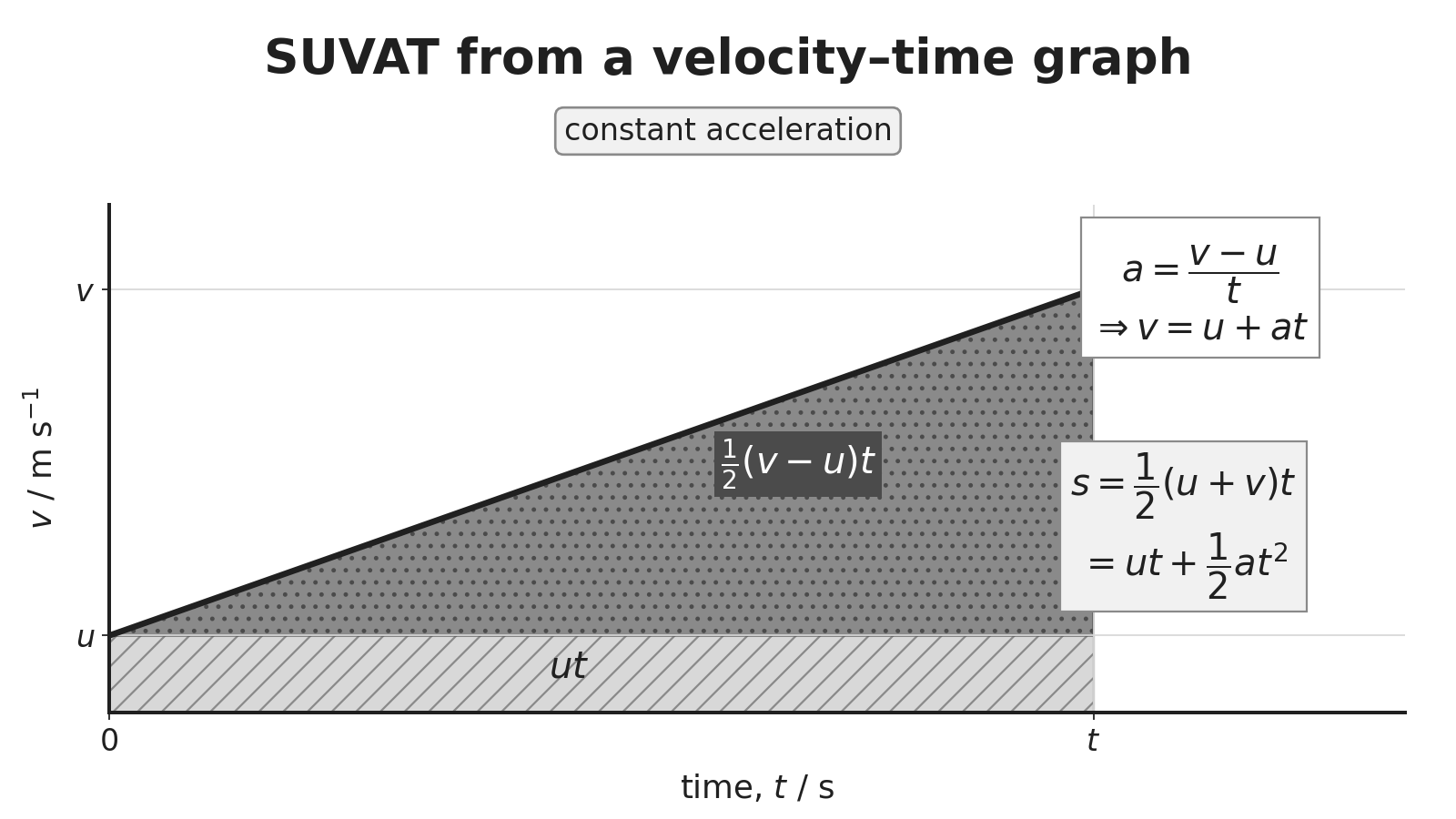
For constant acceleration, the velocity–time graph is a straight line. Its gradient gives , and its trapezium area gives . Substitution and elimination then produce the remaining equations. The figure supports the derivation; it does not remove the need to state the constant-acceleration assumption.
3. The equation set
Each equation omits one of the five variables. Choose the equation that omits the quantity you neither know nor need.
| Equation | Variable omitted |
|---|---|
4. A repeatable solution routine
- Isolate one interval and one component.
- Draw and state the positive direction.
- List signed .
- Check that acceleration is constant.
- Choose the equation omitting the unnecessary unknown.
- Substitute with units.
- Interpret sign and check scale.
5. Worked example — horizontal motion
A train moves at and accelerates uniformly at for . Choose the direction of travel as positive.
Known: , , .
Final velocity:
Displacement:
Both answers are positive, consistent with motion and acceleration in the positive direction.
6. Motion under gravity without air resistance
Near Earth’s surface, if air resistance is negligible, gravitational acceleration is approximately uniform and vertically downward.
If upward is positive,
If downward is positive,
The magnitude is positive; its sign in an equation comes from the chosen axis.
Worked example — vertical throw
A ball is projected vertically upward at . Neglect air resistance and choose upward as positive. Find the time to maximum height and the maximum displacement above launch.
At maximum height, , but .
Using an equation that omits time,
The ball is momentarily at rest at the top, but its acceleration remains downward.
7. Multi-stage motion
One SUVAT model cannot cross a boundary where acceleration changes. Split the journey. If motion is continuous, the final velocity of one stage becomes the initial velocity of the next.
Worked example — two stages
A cyclist starts from rest and accelerates at for . The cyclist then brakes uniformly at until stopping. Choose forward as positive.
Stage 1 final velocity:
Stage 1 displacement:
For Stage 2, , and :
Total displacement is
The accelerations were different, so treating the full journey with one value of would be invalid.
8. When SUVAT does not apply
Do not use one SUVAT set across an interval in which acceleration changes, such as:
- falling while air resistance grows with speed;
- motion with a changing resultant force;
- a multi-stage journey with different accelerations; or
- a curved path treated as one unsigned one-dimensional motion.
For falling with drag, see Motion with Air Resistance.
For ideal projectile motion, SUVAT may be applied separately to each component because horizontal acceleration is constant at zero and vertical acceleration is constant at when air resistance is negligible. Both components use the same time. See Projectile Motion.
9. Common mistakes
- using speed where signed velocity is required;
- assigning a sign before choosing the axis;
- using at the top to claim ;
- averaging and when acceleration is not constant;
- applying one equation set across multiple stages; and
- treating a negative answer as automatically wrong rather than interpreting its direction.
Quick check
- Why is valid under constant acceleration?
- What does a negative displacement answer mean?
- Can SUVAT model a whole fall that approaches terminal speed?
Answers: velocity changes linearly with time; displacement is opposite to the chosen positive direction; no, because acceleration changes.
Core ideas
Derive before memorising, test constant acceleration before selecting an equation, and use one signed model per interval and component.
Exam relevance
Marks depend on modelling as well as substitution: state the positive direction, show the selected equation, retain signs and split the journey wherever acceleration changes.