Fluid Forces and Resistive Motion
Branch note: This note covers the required derivation, pressure origin of upthrust, Archimedes’ principle, floatation and qualitative viscous resistance.
Overview
This branch note develops pressure in fluids, hydrostatic pressure, upthrust, floatation, drag and terminal speed as force-balance ideas.
Core Ideas
- Pressure is scalar, but pressure forces act normal to surfaces.
- Hydrostatic pressure difference depends on vertical depth difference.
- Upthrust is the resultant of fluid-pressure forces and equals the weight of displaced fluid.
- Floating equilibrium requires for the object.
- Terminal speed means zero resultant force while velocity is non-zero.
1. Pressure is scalar; pressure force has direction
Pressure is defined by the normal force distributed over area :
Pressure is a scalar measured in pascals:
At a point in a fluid at rest, pressure has the same value in every direction. The force that the fluid exerts on a small surface is normal to that surface, with magnitude when pressure is uniform over the area.
2. Derivation of hydrostatic pressure
Density is defined by
Consider a stationary vertical fluid column of cross-sectional area , height and uniform density . Let pressure at the top be and at the bottom be .
The column volume and mass are
Forces on the column are:
- upward force at the bottom;
- downward force at the top;
- weight downward.
The column is in equilibrium, so
Dividing by gives
Thus the pressure difference depends on vertical depth difference, not distance along a sloping container or the container’s shape.
Numerical pressure example
For water of density , the gauge-pressure increase over a vertical depth of is
Gauge and absolute pressure
If the free surface is at atmospheric pressure ,
whereas is the gauge pressure relative to the atmosphere. State which pressure is required.
3. Origin of upthrust
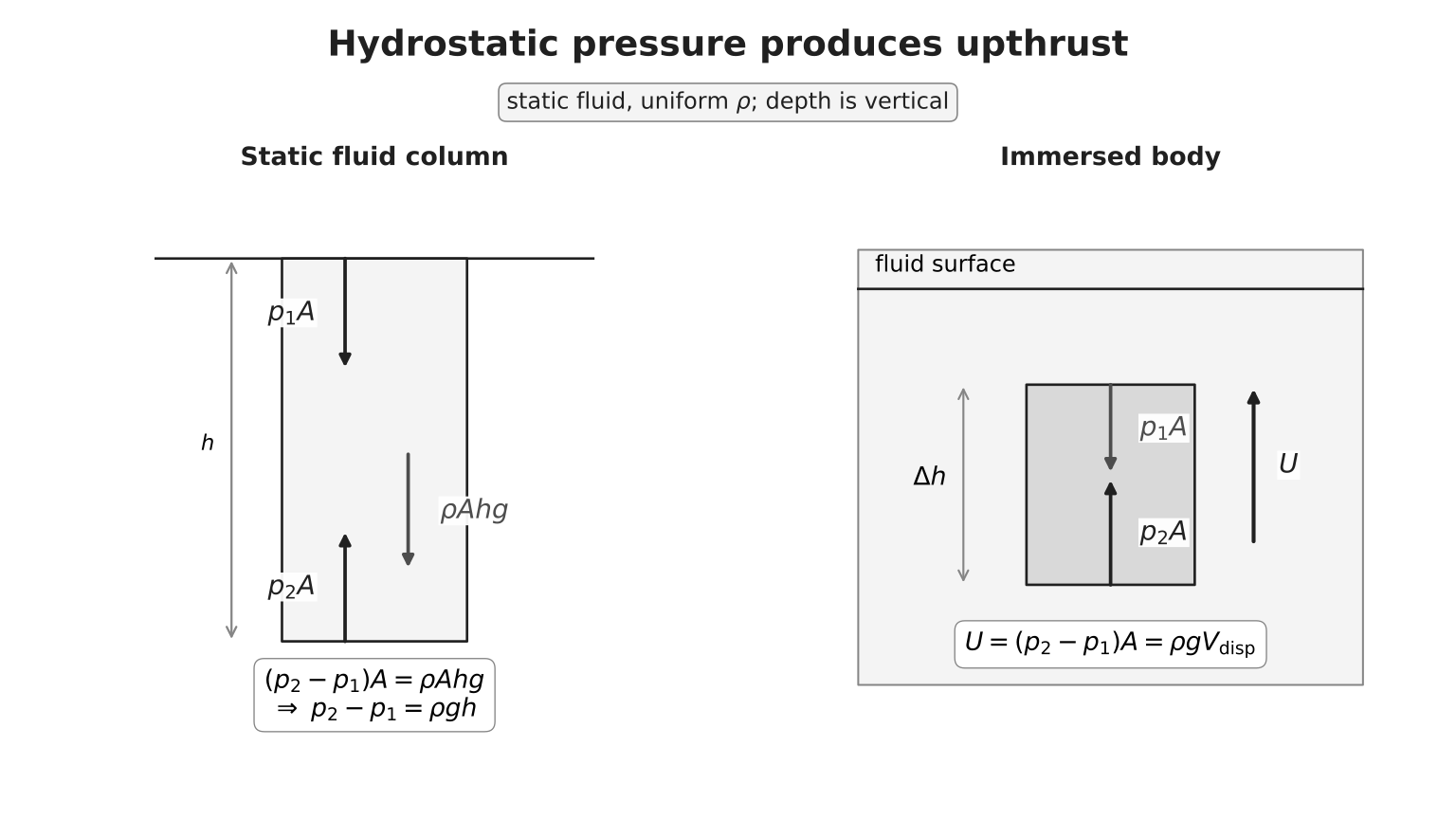
Figure: The top face at depth experiences downward force , while the bottom face at greater depth experiences larger upward force . For the symmetric teaching body, horizontal forces cancel. The upward resultant is . A common reference pressure cancels, so upthrust depends on the pressure difference.
For the displayed vertical-sided body,
Using and ,
This equals the weight of displaced fluid. Archimedes’ principle generalises the result to submerged or floating objects of arbitrary shape:
The upthrust is equal in magnitude and opposite in direction to the weight of the fluid displaced.
For a partially immersed object, is only the submerged volume. For a fully immersed object, it equals the object’s external volume.
4. Floating, sinking and neutral buoyancy
Floating in equilibrium
If upthrust and weight are the only vertical forces,
Therefore
and the submerged volume fraction is
This shows why a lower-density object floats with part of its volume above the surface.
Fully submerged object
For a fully submerged body with no other vertical forces:
- if , then and it accelerates downward initially;
- if , then and it accelerates upward initially;
- if , neutral buoyancy is possible.
These statements concern the initial resultant before drag or contact forces alter the balance.
5. Worked floatation example
A block of density floats in water of density .
At equilibrium,
Hence
So of the block’s volume is submerged and is above water.
6. Drag and viscous resistance
Drag is a fluid force opposing the velocity of an object relative to the fluid. Its magnitude can depend on speed, shape, size, orientation, fluid density and viscosity.
The 9749 syllabus requires qualitative understanding; there is no universal drag formula for every regime. Relations such as
must be used only when supplied or when an explicit model is stated.
7. Terminal speed as a force sequence
For a body released from rest and falling downward through a stationary fluid:
- weight acts downward;
- upthrust acts upward;
- drag is initially zero if relative speed is zero;
- as downward speed increases, upward drag increases;
- the downward resultant decreases;
- when , acceleration is zero;
- velocity then remains constant at terminal speed while all three forces continue to act.
Enrichment — analytical illustration beyond the explicit Topic 04 outcome
The qualitative force sequence above is core. The exact curves below assume the additional model and are included to show one mathematically consistent example, not a universal drag law.
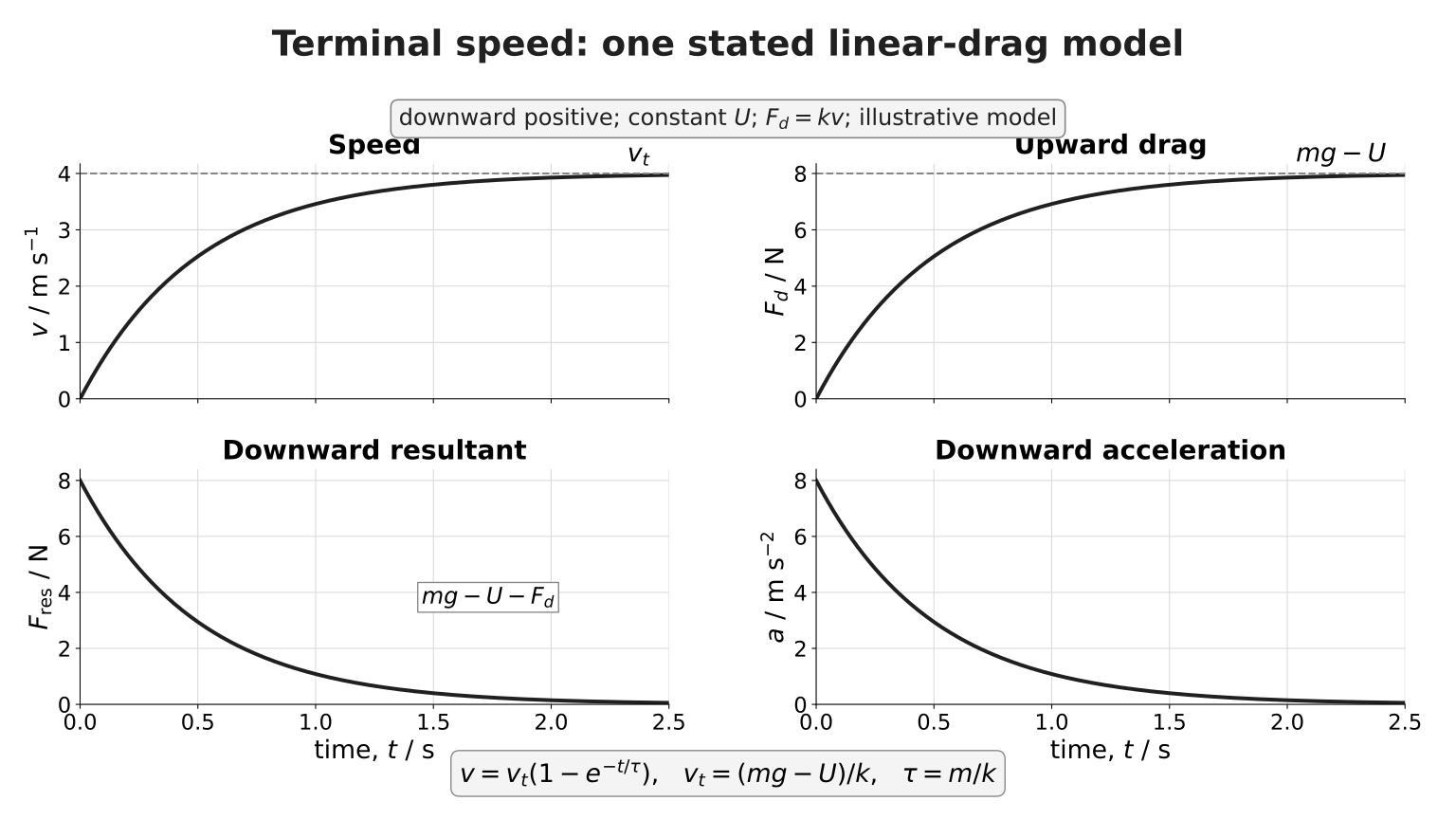
Figure: For the stated illustrative model with constant and downward positive, the exact solution is , where and . Drag approaches , while resultant force and acceleration approach zero. The asymptotes are consequences of this model, not universal time laws for every falling body.
8. Worked terminal-speed example
A sphere of mass falls through a liquid. Its upthrust is . At terminal speed, its upward drag is .
Check the force balance:
The forces balance to the shown precision, so the acceleration is zero. This does not imply that the sphere is stationary.
Exam Relevance
Fluid-force questions often test model conditions. State whether pressure is gauge or absolute, use vertical depth difference for , use displaced volume for upthrust, and treat terminal speed as balanced forces.
9. Common mistakes
- calling absolute pressure when atmospheric pressure must be included;
- using sloping distance rather than vertical depth;
- saying pressure “acts upward” instead of distinguishing scalar pressure from normal pressure force;
- using the whole object volume when it is only partially immersed;
- assuming for every immersed object;
- omitting upthrust from terminal-speed balance when it is not negligible;
- treating a supplied drag law as universal;
- saying terminal velocity means no forces act.