Charged Particles in Fields
Branch note: This page deepens the motion part of Electric Fields. It is deliberately self-contained because charged-particle deflection is a common exam context.
Syllabus focus
Topic 13 requires force and motion in a uniform electric field. Crossed electric and magnetic fields are assessed later and appear here only as a forward link.
Overview
Charged Particles in Fields focuses on how charged particles move when placed in an electric field. This combines ideas from Electric Fields, Forces, and Kinematics.
The key principle is:
An electric field exerts force on a charged particle, causing acceleration.
Before calculating, identify the directions of , and the initial velocity . A negative charge has force and acceleration opposite to the field direction.
Core Ideas
- a charged particle in an electric field experiences
- positive charges accelerate in the field direction
- negative charges accelerate opposite to the field direction
- a uniform electric field gives constant acceleration
- sideways entry into a uniform field gives projectile-like parabolic motion
- energy methods are often faster when a particle moves through a known p.d.
Exam Relevance
This branch note is tested through:
- force and acceleration direction for positive charges and electrons
- deflection between parallel plates
- component-based kinematics for parabolic paths
- speed calculations from p.d. using energy conservation
- a forward connection to crossed fields in the later Magnetic Fields topic
Definition
For charge in electric field :
Direction
Positive Charge
- force is in the direction of
Negative Charge
- force is opposite to
Magnitude
Why It Matters
This topic is the bridge between field ideas and motion:
- force from the field produces acceleration
- uniform electric fields lead to constant acceleration
- horizontal-vertical resolution gives standard deflection methods
- energy methods give faster speed calculations in some questions
Key Representations
Acceleration in a Uniform Field
Using Newton’s second law:
Hence:
For magnitude:
Important Trends
- larger charge gives larger acceleration
- stronger field gives larger acceleration
- larger mass gives smaller acceleration
Electrons accelerate very strongly because their mass is very small.
Changing mass does not change the electric force ; it changes the acceleration .
Uniform Electric Field Between Parallel Plates
For plates with potential difference and separation :
This field is approximately uniform in the central region.
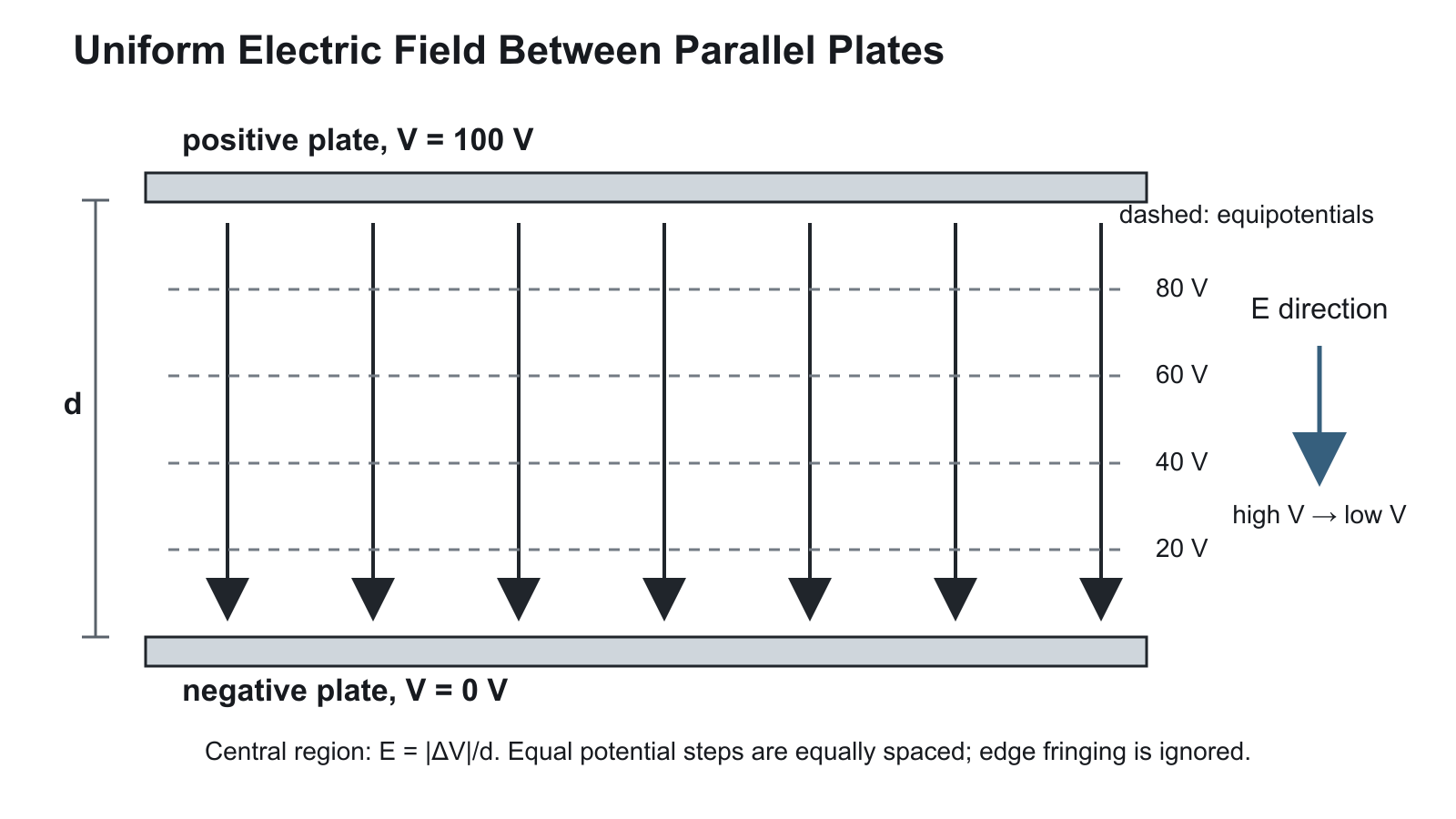
Figure: Between large oppositely charged parallel plates, the central electric field is approximately uniform. The field direction is from the positive plate to the negative plate, and the equipotentials are perpendicular to the field lines.
Hence force is constant:
So acceleration is constant.
This model is for the central region and neglects fringing. If gravity might be important, compare with before neglecting weight.
For a chosen one-dimensional component, use the signed-scalar form .
Motion Parallel to the Field
If initial velocity is along the field direction:
Positive Charge
- speeds up if moving with the field
- slows down if moving against the field
Negative Charge
Opposite behaviour.
Use SUVAT Equations
Since acceleration is constant:
Motion Opposite to the Field
If a particle enters with velocity opposite to its acceleration:
- it decelerates
- it may momentarily stop
- it then reverses direction
This is mathematically the same as one-dimensional motion under constant acceleration.
Motion Perpendicular to the Field
Suppose a particle enters horizontally into a vertical electric field.
Horizontal Direction
No horizontal force:
- velocity remains constant
Vertical Direction
Constant acceleration:
Here is the signed vertical component of the electric field.
Thus:
Usually .
Combined Motion: Parabolic Path
Because there is:
- uniform motion horizontally
- constant acceleration vertically
the trajectory is a parabola, similar to projectile motion.
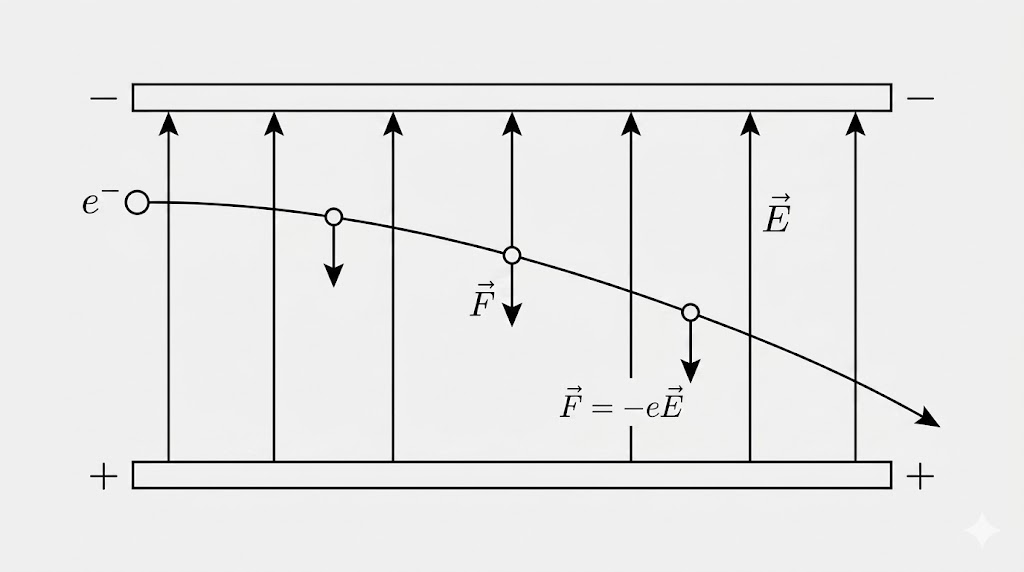
Figure: A charged particle entering sideways into a uniform electric field keeps constant horizontal velocity while accelerating in the field-force direction, giving a parabolic path. For an electron, is opposite to .
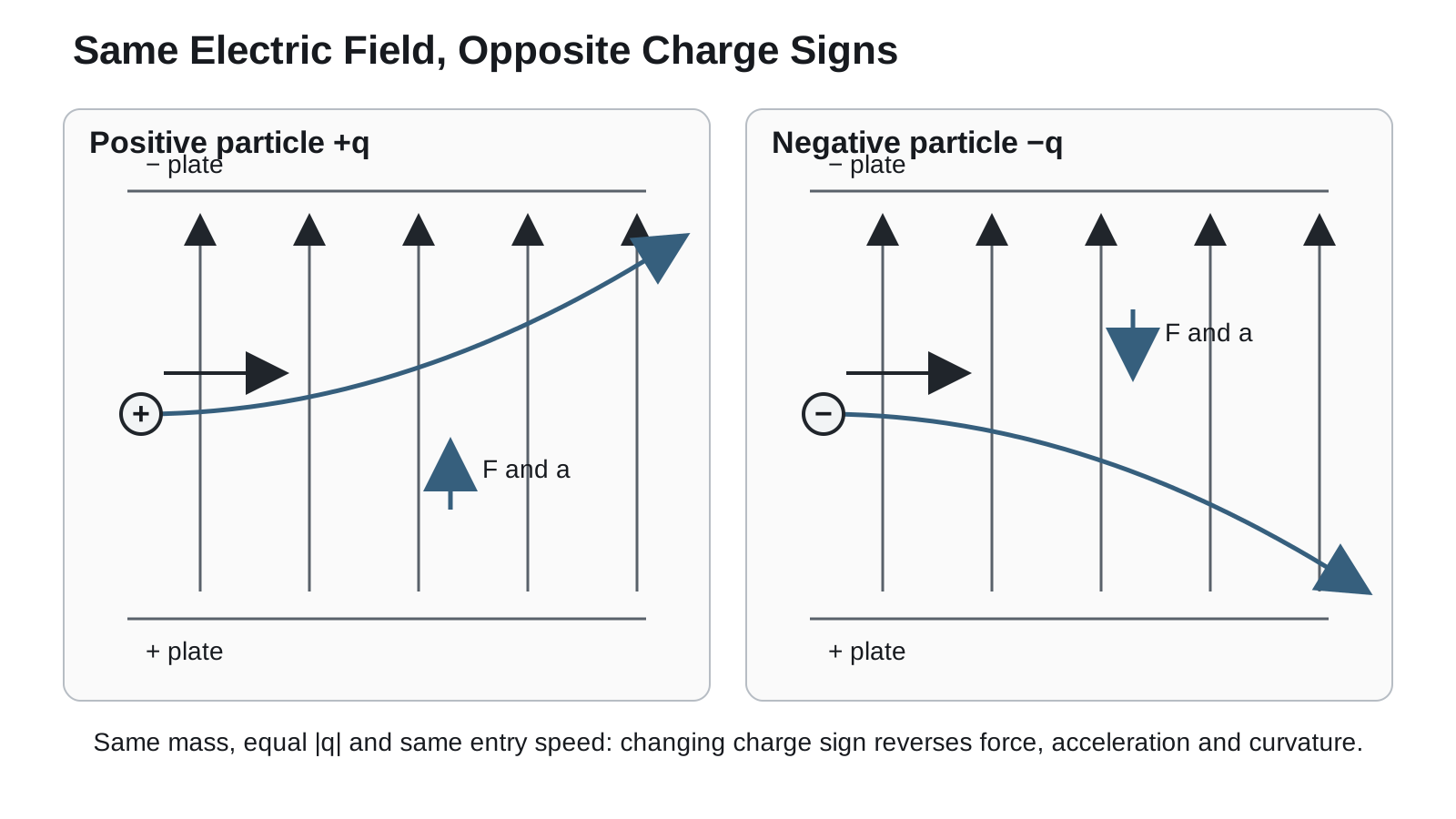
Figure: Positive and negative particles entering with the same horizontal velocity curve in opposite directions in the same field. Changing the particle sign reverses and , not .
Standard Strategy
- Resolve motion into and directions.
- Solve time using horizontal motion.
- Use that time in vertical motion.
- Find displacement, velocity, or angle.
Deflection Between Parallel Plates
If plate length is and horizontal entry speed is :
Time in the Field
Vertical Deflection
Vertical Exit Speed
Exit Angle
where .
For , eliminating time gives the signed path equation
The sign of determines the bending direction. After the particle leaves the plates, the electric force disappears (if external fields are negligible), so the path becomes a straight line tangent to the parabola at the exit.
Particle Initially at Rest
If released from rest in a uniform field:
Then the particle accelerates directly along the force direction.
Use SUVAT or energy methods.
Energy Perspective
Moving through potential difference :
Change in electric potential energy:
If no other forces act:
Hence:
This is useful for speed calculations.
Electrons in Fields
Electrons are common exam examples.
Charge:
where:
Important Reminder
Electron force is opposite to electric field direction.
Comparison with Gravity
Motion in a uniform electric field is mathematically similar to projectile motion in gravity.
| Gravity | Electric Field |
|---|---|
| acceleration | acceleration component |
| downward | depends on charge sign |
| same for all masses ideally | depends on |
See Gravitational vs Electric Fields.
Forward link: crossed fields
Later syllabus topic
A velocity selector combines electric and magnetic forces. Its derivation belongs under Magnetic Force, not the Topic 13 core. First master motion in one uniform electric field.
Common Mistakes
- Using field direction as electron motion direction
- Forgetting horizontal velocity stays constant
- Using the wrong sign of acceleration
- Mixing force and field so that
- Using the energy formula with the wrong sign of
- Forgetting to resolve into components
- Assuming the path is circular instead of parabolic
Quick Exam Method
Parallel Motion
Use:
- signed components of
- SUVAT
Deflection Question
- Find the field:
- Find the acceleration:
- Find the time:
- Solve the vertical motion.
Summary
Core equations:
The crossed-field velocity-selector relation belongs to the later Magnetic Force topic and is included here only as a forward link, not as a Topic 15 core equation.