Projectile and Relative Motion
Overview
This page is a bridge concept page linking one-dimensional kinematics to later two-dimensional motion.
Students who understand:
- displacement
- velocity
- acceleration
- components
- constant acceleration
can extend those ideas naturally into projectile motion and relative motion.
This page introduces the framework only. Full treatment belongs in:
Main hub: Kinematics
Why It Matters
This page helps students carry one-dimensional kinematics into two-dimensional motion without immediately jumping into the full projectile chapter.
Definition
Projectile motion is analysed by separating motion into perpendicular components, while relative motion compares velocities from different frames of reference.
1. Why This Page Matters
Many students can solve straight-line SUVAT questions but struggle when motion occurs in two dimensions.
The key idea is:
treat motion separately along perpendicular directions.
Usually:
- horizontal ()
- vertical ()
This depends strongly on Vectors.
2. From 1D to 2D Motion
Key Representations
In one dimension:
- one displacement
- one velocity
- one acceleration
In two dimensions, each has components:
Solve each direction separately, then combine if needed.
3. Projectile Motion (Bridge View)
A projectile is an object moving under gravity after launch.
Examples:
- thrown ball
- kicked football
- launched stone
Ignoring air resistance:
- horizontal acceleration = 0
- vertical acceleration = downward
Initial Velocity Components
If launched with speed at angle above horizontal:
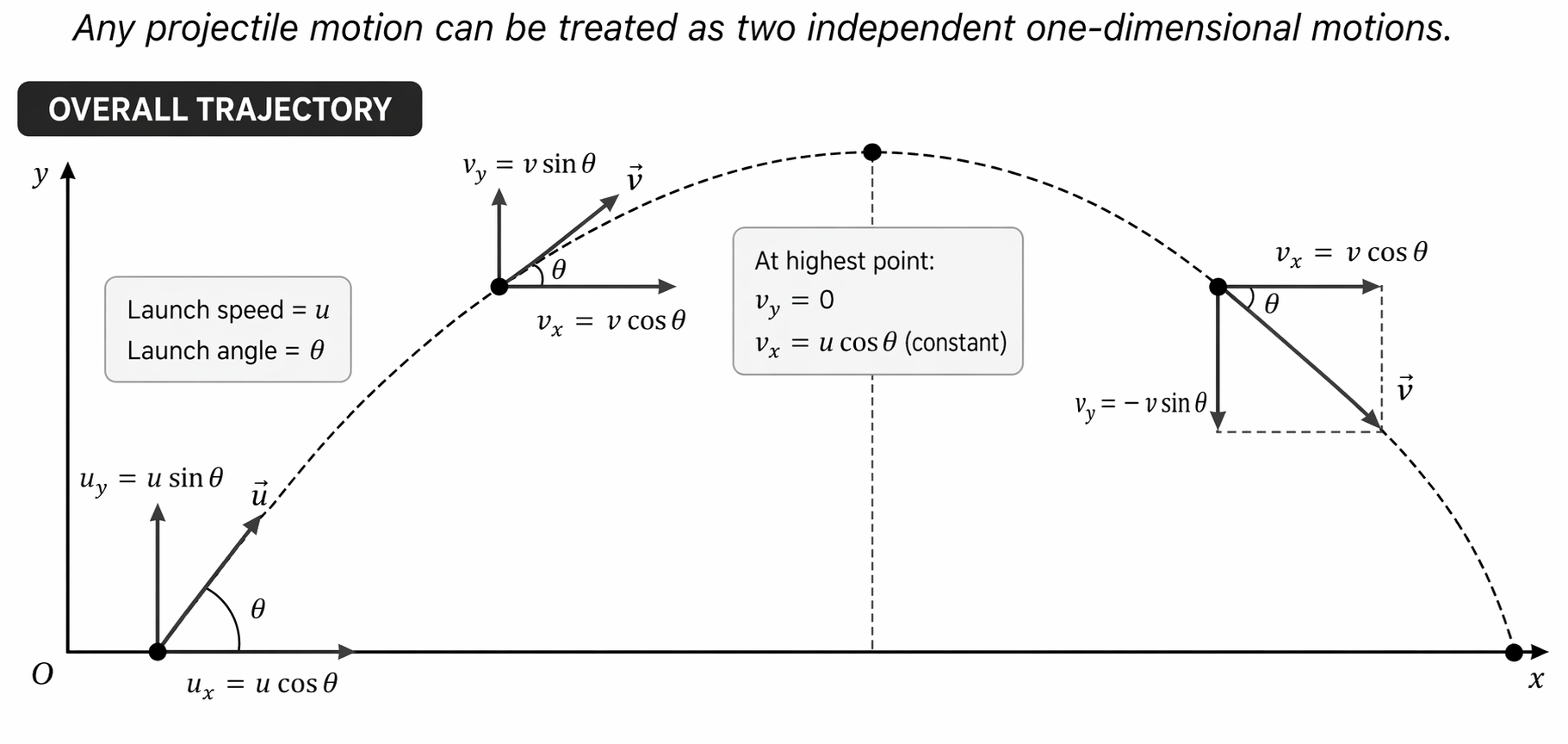
Figure: Projectile motion is analysed by resolving velocity into horizontal and vertical components. The horizontal component stays constant, while the vertical component changes under gravity.
The next diagram shows the same decomposition carried through the full flight, including the highest point and the velocity components later in the motion.
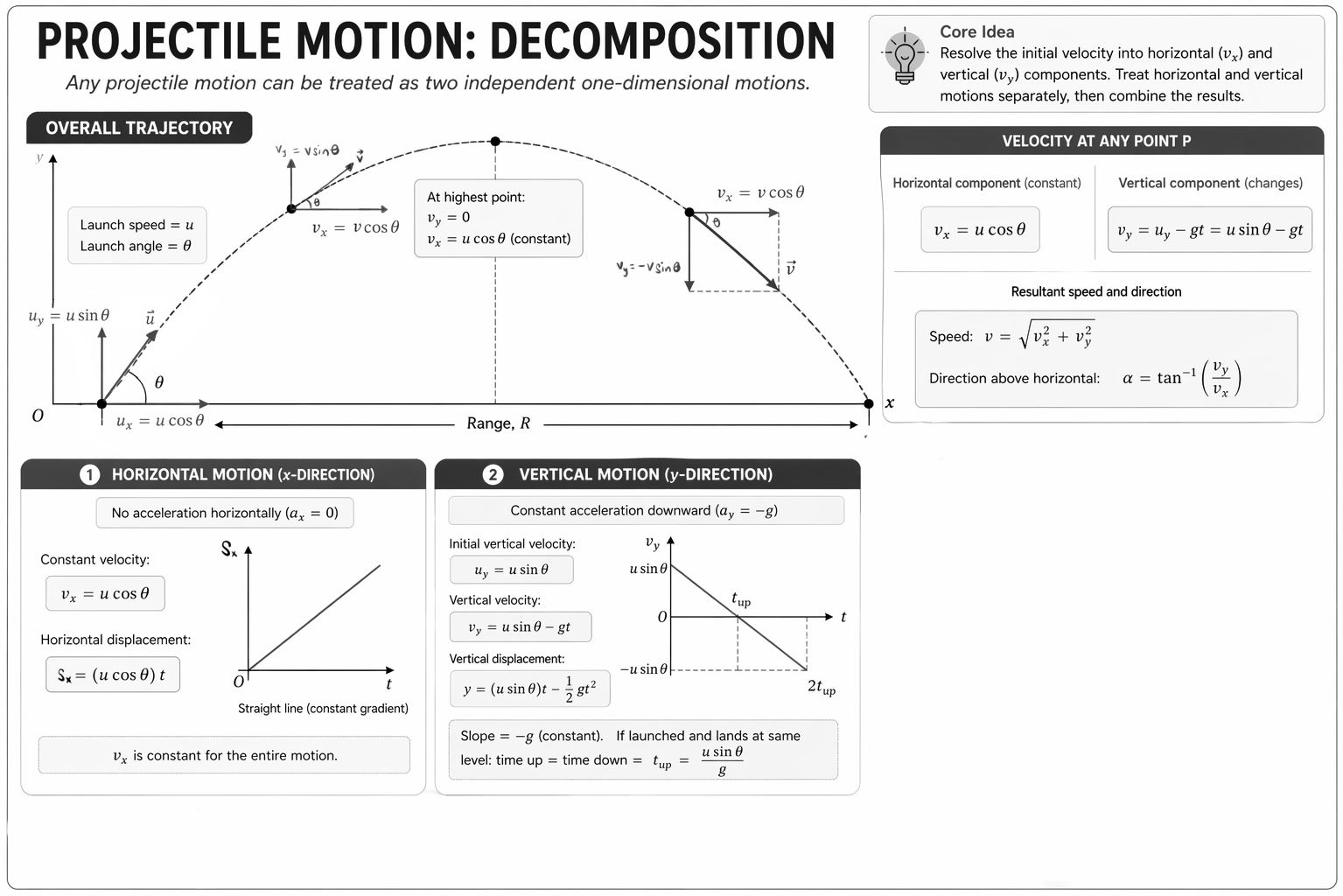
Figure: Projectile motion can be decomposed into independent horizontal and vertical motions, with (v_x) constant, (v_y) changing under gravity, and (v_y=0) at the highest point.
These become the starting values for each direction.
4. Independent Horizontal and Vertical Motion
Horizontal Direction
Hence:
So horizontal velocity remains constant.
Vertical Direction
Take upward positive:
Then:
Most Important Link
The horizontal and vertical motions share the same time .
This is often the key to solving questions.
5. Highest Point Idea
At the maximum height:
But:
So the projectile is not force-free at the top.
6. What Belongs to Topic 03
This page does not fully cover:
- time of flight formulas
- range formulas
- maximum height derivations
- non-level launch/landing cases
- advanced projectile problems
See:
7. Relative Motion
Relative motion describes how one object appears to move from another moving object.
Vector Form
Read as:
velocity of A relative to B.
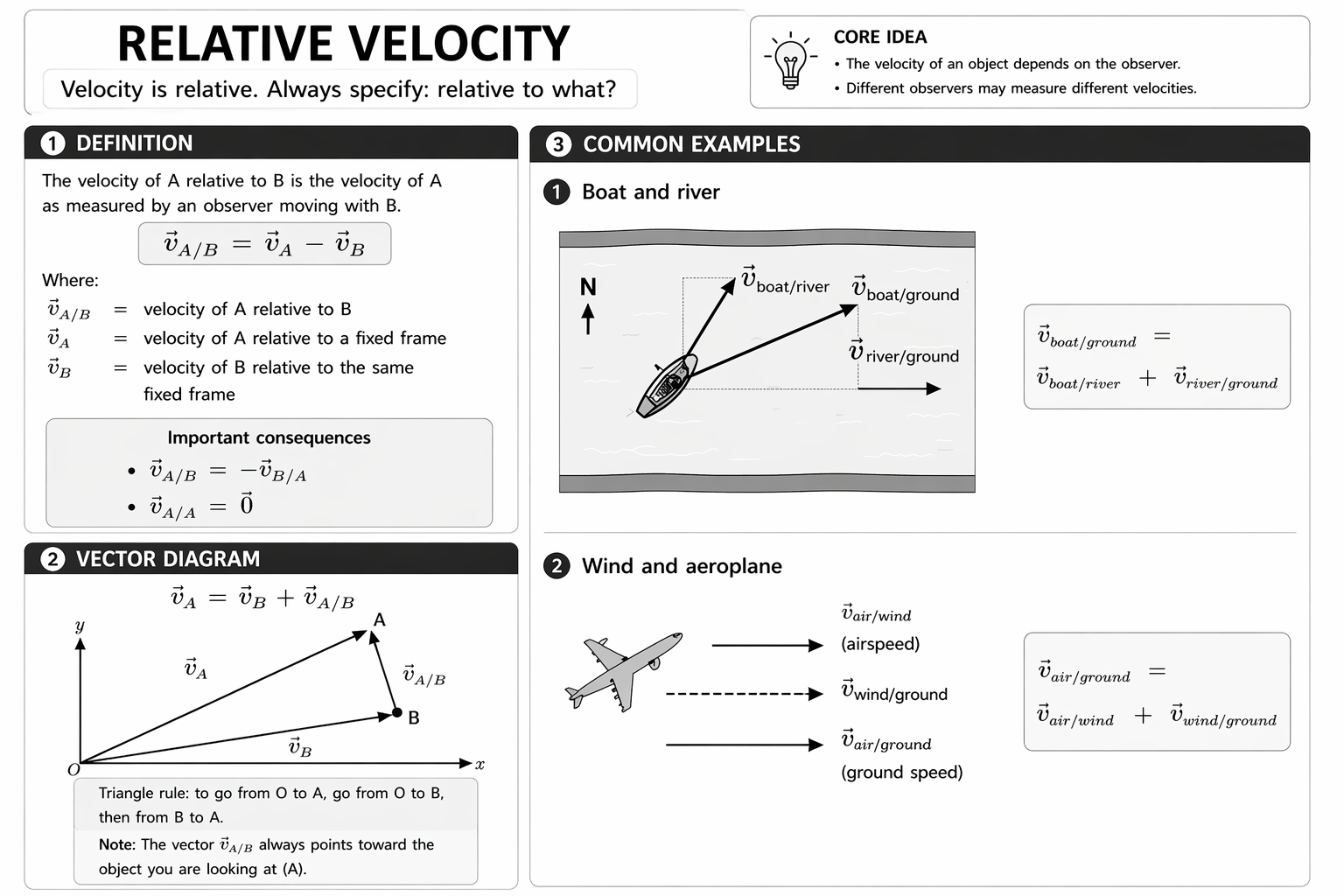
Figure: Relative velocity compares motion from different frames of reference and is found by vector subtraction, with common examples including boat-current and aircraft-wind problems.
One-Dimensional Cases
Same Direction
Car A: 25 m s
Car B: 18 m s
A moves away from B at 7 m s.
Opposite Directions
If A moves right at 20 and B moves left at 15:
Relative speed:
because directions oppose.
8. Why Relative Motion Matters Later
Used in:
- boats crossing rivers
- aircraft in wind
- pursuit problems
- collision approach speed
- moving observers
9. Common Exam Pitfalls
Projectile Motion
- mixing and quantities in one equation
- forgetting to resolve initial velocity
- using different times for horizontal and vertical motion
- assuming acceleration becomes zero at top
Relative Motion
- adding velocities without checking direction
- forgetting relative velocity is subtraction of vectors
10. Quick Worked Examples
Example 1: Horizontal Launch
Ball leaves table horizontally at 6.0 m s.
Then initially:
Horizontal motion starts with speed; vertical motion starts from rest.
Example 2: Throw at Angle
Ball launched at 10 m s at .
Example 3: Relative Speed
Two runners move in same direction:
- Runner A = 8 m s
- Runner B = 6 m s
Relative speed:
11. Summary
- Two-dimensional motion is handled by components.
- Horizontal and vertical motions are independent.
- Time links both directions.
- For projectiles: horizontal acceleration = 0, vertical acceleration = downward.
- Relative velocity compares one object’s motion from another frame.