Projectile Motion
Topic hub: This page is the main hub for Projectile Motion.
Overview
A projectile is an object that has been launched or released and then moves under gravity alone in the ideal model. Its motion may look two-dimensional, but the calculation becomes manageable when it is separated into two perpendicular one-dimensional motions:
- horizontal motion at uniform velocity; and
- vertical motion at uniform acceleration.
The two component motions occur simultaneously. They use the same time , but horizontal quantities must stay in horizontal equations and vertical quantities must stay in vertical equations.
This topic builds on:
Core Ideas
- Model the projectile after release as moving under gravity alone.
- Resolve the initial velocity into horizontal and vertical components.
- Use and with a clearly stated sign convention.
- Apply constant-acceleration equations separately in the horizontal and vertical directions.
- Link the two component calculations using the same elapsed time .
- Use same-level shortcut results only when the launch and landing heights are the same.
2. The ideal projectile model
Unless a question states otherwise, assume:
- air resistance is negligible;
- the gravitational field is uniform over the motion, so is constant;
- gravity acts vertically downward;
- Earth’s curvature and rotation are negligible; and
- the projectile can be represented as a particle.
Choose the launch point as the origin, set at launch, take horizontally in the direction of launch, and take vertically upward. Then
and the acceleration components are
where is the magnitude of gravitational acceleration near Earth’s surface.
Model before formula
A statement such as “horizontal velocity is constant” is not true for every real object moving through air. It follows from the ideal assumption that the only force after release is vertical gravity, so the horizontal resultant force and horizontal acceleration are zero.
3. Resolve the launch velocity
Suppose the projectile is launched with speed at launch angle above the horizontal. Its initial velocity components are
Here is the magnitude of the launch velocity, whereas and are signed components relative to the chosen axes.
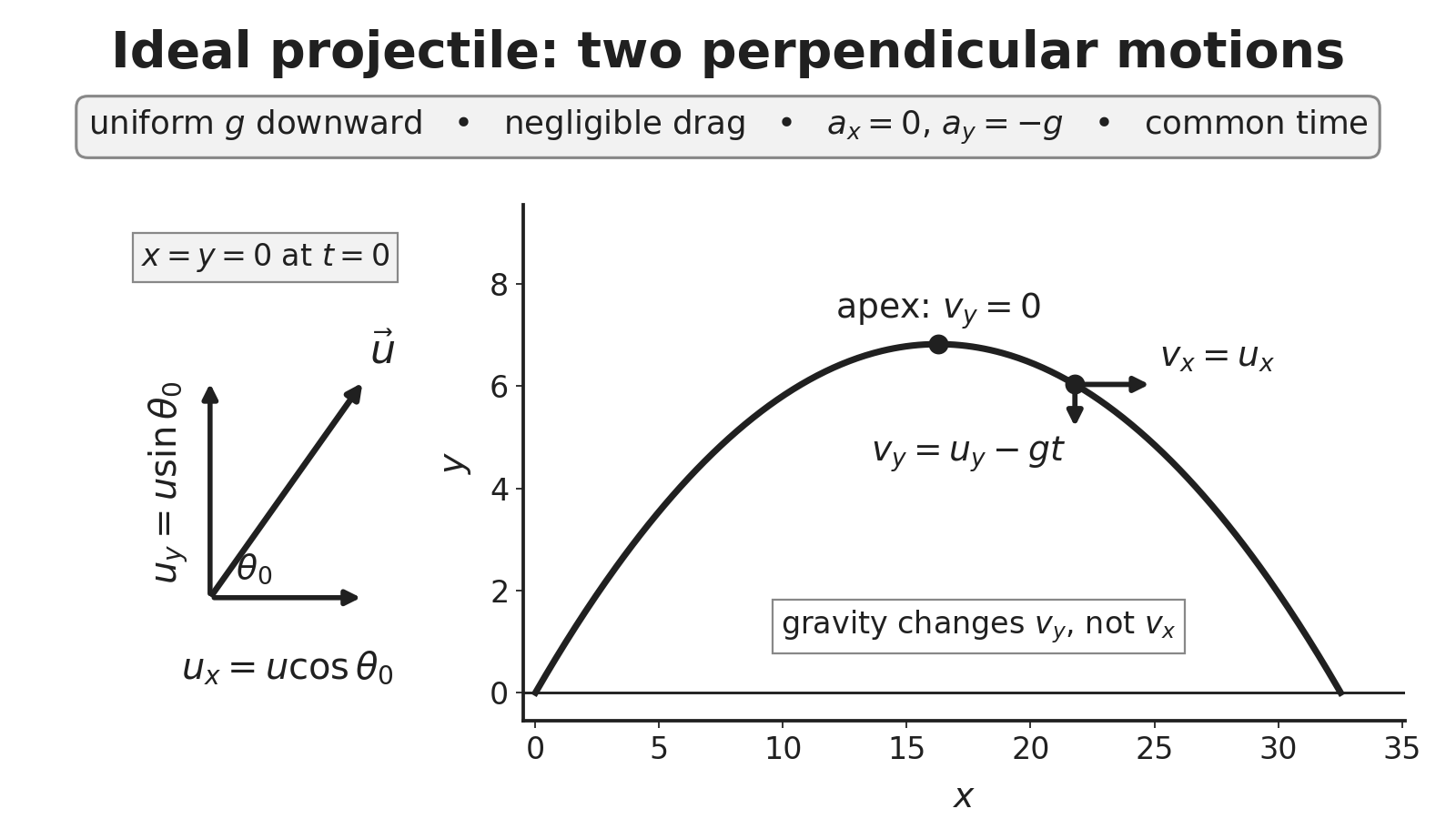
Figure: The ideal trajectory is generated by two simultaneous component motions. Horizontally, , so remains constant. Vertically, , so decreases uniformly, becomes zero at the apex, and is negative during descent. The figure’s launch reference and assumptions are essential: the component equations use the same , measured from the same launch event.
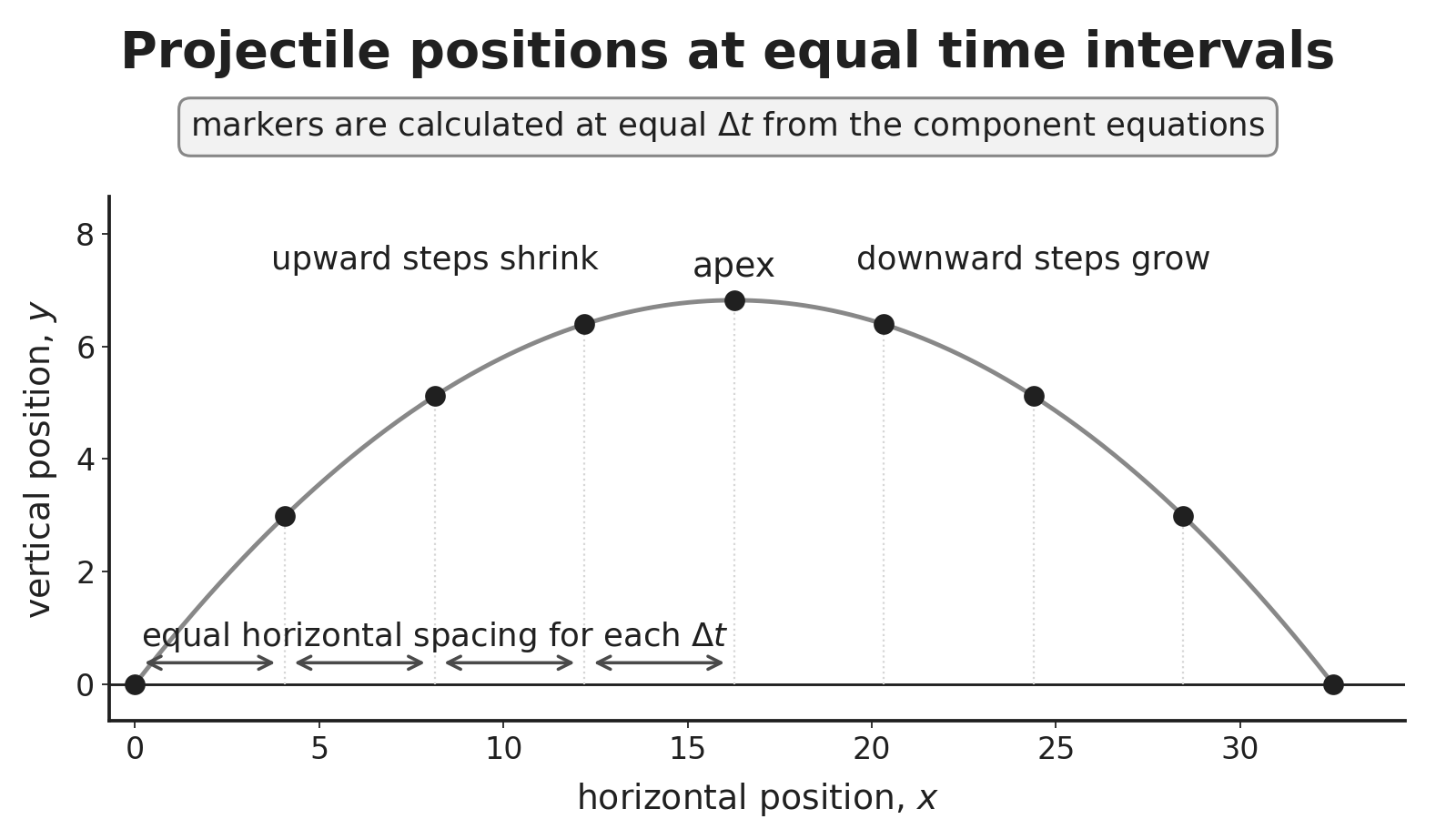
Figure: Each marker shows the projectile after the same time interval . Because is constant, consecutive markers have equal horizontal spacing. The signed vertical displacements over successive intervals are not equal: the upward increments become smaller, then the increments become downward and grow in magnitude. At the apex itself, the instantaneous gradient is zero. This is a direct visual description of uniform horizontal velocity combined with uniform downward acceleration.
Why the components can be treated separately
Newton’s second law applies independently along perpendicular axes. In the ideal model, gravity has no horizontal component, so it changes but not . This is what “independent component motions” means.
It does not mean the two motions occur at different times. At any instant, the projectile has one position and one velocity
4. Component equations
With the launch point as and upward positive:
Horizontal component
Because ,
The horizontal displacement–time graph is therefore a straight line, and its gradient is the constant horizontal velocity.
Vertical component
Because ,
The vertical displacement is signed. A landing point below the launch point has .
Reconstructing the velocity
Once and are known at the same instant,
gives the speed. If is the direction below or above the horizontal, its magnitude obeys
Use the signs of the components and the physical diagram to state the correct quadrant or words such as “below the horizontal”.
5. Read the same motion from graphs
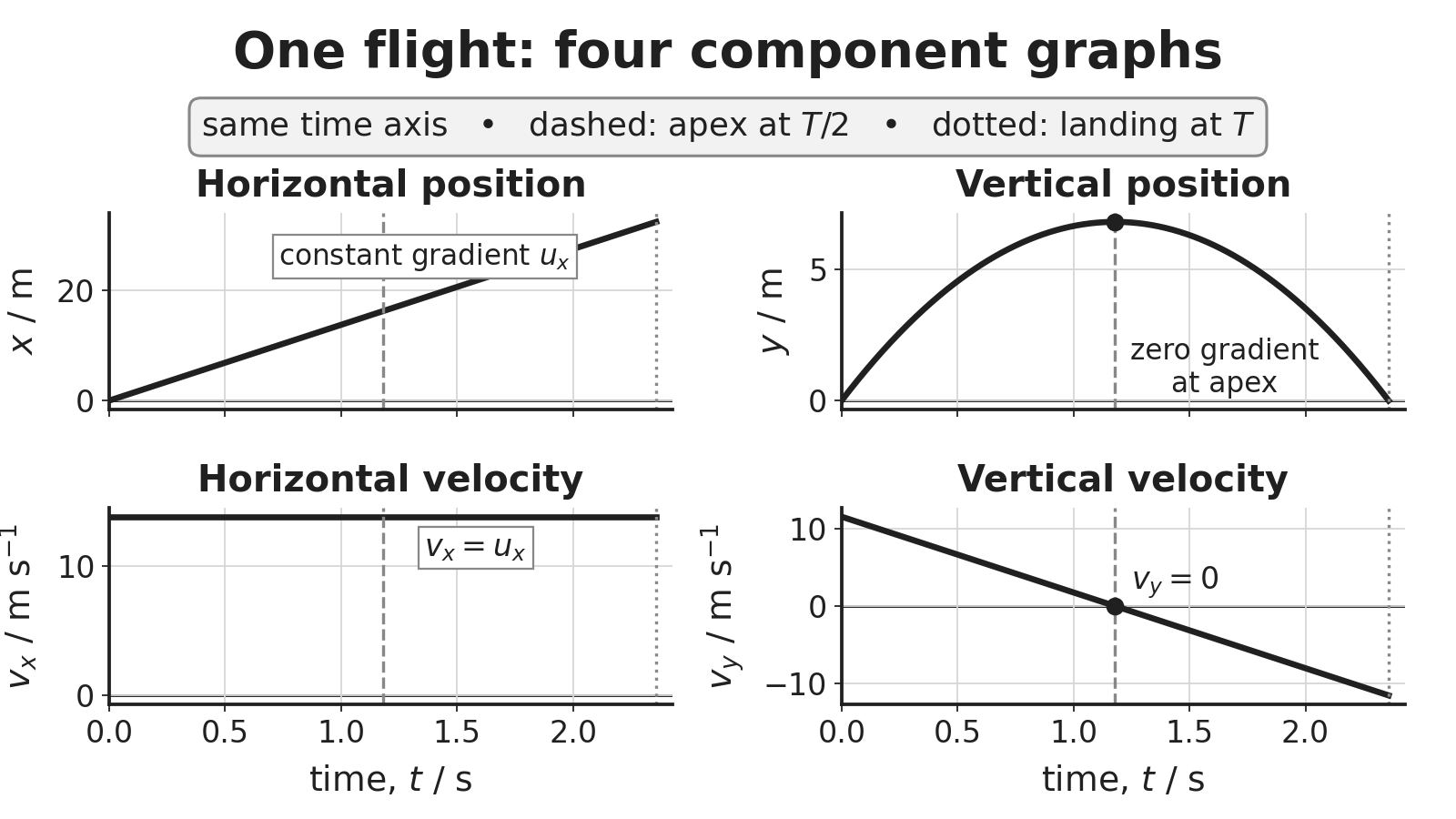
Figure: All four graphs describe the same ideal same-level flight and therefore share one time axis. The straight - graph and horizontal line show uniform horizontal motion. The concave-down - graph has gradient : its gradient becomes zero at the apex and negative during descent. The straight - graph has constant gradient and crosses zero at the same apex time. At landing, returns to zero; reaches the range .
These graphs make two important distinctions visible:
- momentarily at the apex, but throughout the flight;
- for a non-vertical launch, at the apex, so the projectile is still moving.
For a purely vertical launch, . Both velocity components are then momentarily zero at the top, although acceleration is still .
6. A reliable problem-solving workflow
- Draw and define axes. Mark the positive and directions, launch point, landing point, and known displacements.
- State the model. Decide whether drag is neglected and may be treated as constant.
- Resolve the launch velocity. Write and with signs.
- Make a component table. Keep -quantities separate from -quantities.
- Choose the component containing the target event. Examples: at the apex; a known at landing.
- Solve for the common time if needed. Use that same time in the other component.
- Reconstruct vector quantities. Combine and only after both have been found for the same instant.
- Check the result. Include units, direction, sign, and whether a conditional shortcut was actually valid.
| Quantity | Horizontal component | Vertical component |
|---|---|---|
| Initial velocity | ||
| Acceleration | ||
| Velocity at time | ||
| Displacement at time |
Do not mix components
An equation along may contain , , , and , but not or . Time is the shared variable that links the two component solutions.
7. Apex and same-level results
Two useful apex results do not require the eventual landing level to equal the launch level. They require the ideal model, , and enough unobstructed flight for the projectile to reach its natural apex.
Time to the apex
At the apex, . Therefore
so
Maximum height above the launch point
At the apex, . Using with ,
so
This is measured above the launch point. If the launch point is already above the ground, it is not automatically the maximum height above the ground.
If the launch point is at height above a chosen datum, the natural apex is at relative to that datum. If the projectile is intercepted before reaching this natural apex, is not the greatest height actually attained during the truncated flight.
Additional results for same-level launch and landing
The following figure, time-of-flight result, range result, and symmetry statements additionally require:
- launch and landing at the same vertical level;
- negligible air resistance; and
- uniform downward .
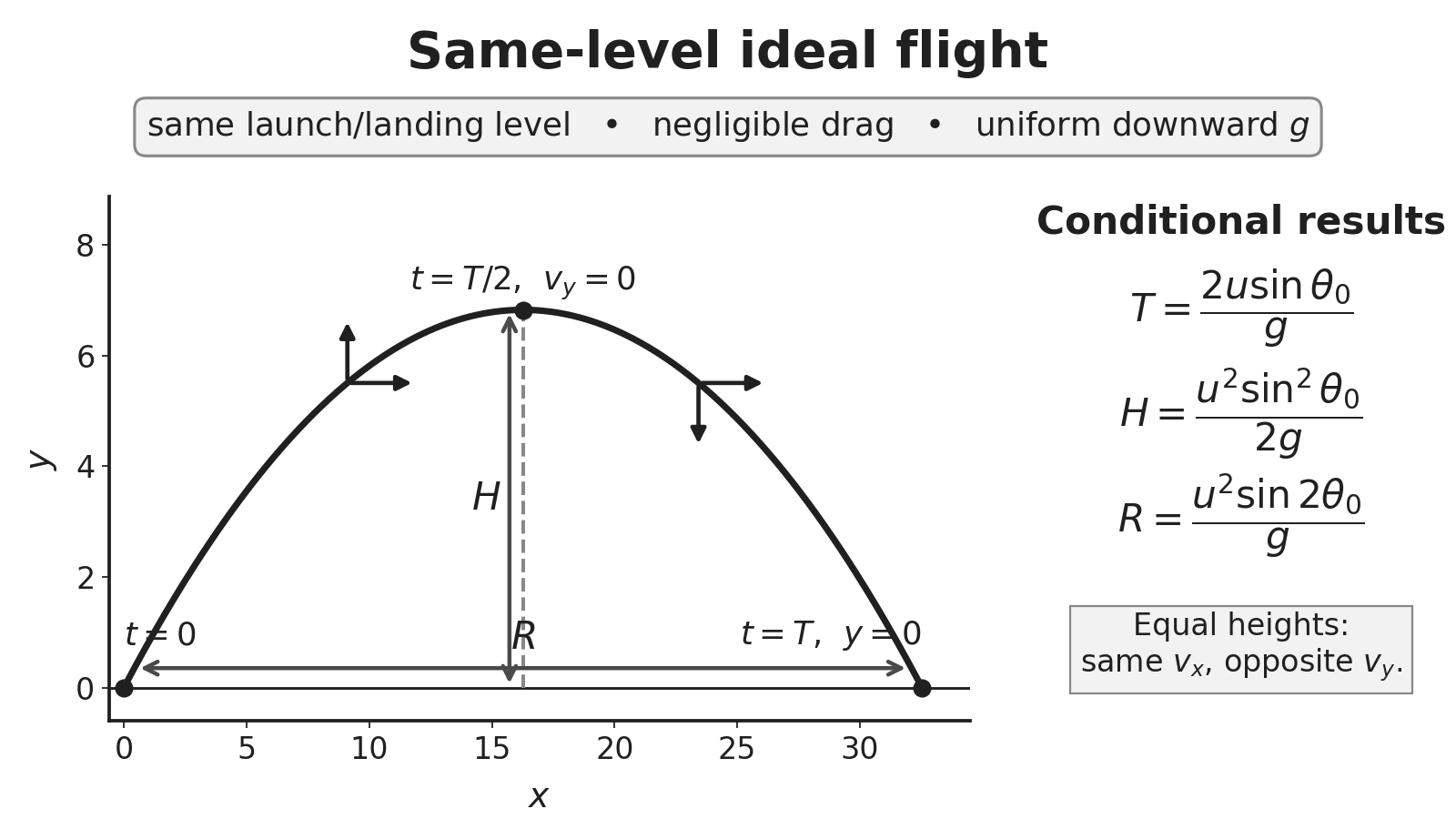
Figure: Under the stated same-level ideal conditions, the vertical displacement is zero at both launch and landing. The apex occurs halfway through the flight at , and is measured vertically above the launch level. The horizontal distance to landing is . Equal-height points have equal speed magnitudes with opposite vertical velocity components, which explains the ideal symmetry; this conclusion must not be transferred to non-level or drag-affected motion.
Time of flight
At same-level landing, again:
Factoring gives
The root describes the launch event. The later landing time is
Hence only for same-level ideal flight.
Horizontal range
Horizontal motion gives . Substituting the same-level flight time,
Using ,
Symmetry under the ideal same-level conditions
At landing,
Therefore the landing speed equals the launch speed,
and the landing direction has the same angular magnitude below the horizontal. This follows from the component equations; it is not a general statement for drag or different landing heights.
8. Worked example: angled same-level launch
A ball is launched at at above the horizontal and lands at the launch level. Neglect air resistance.
Step 1: resolve the launch velocity
Retain the unrounded calculator values for later steps; the rounded values are shown only for reporting.
Step 2: find the flight time from vertical motion
At landing, . Taking the non-zero root and using the unrounded ,
Step 3: find the range from horizontal motion
Step 4: interpret the landing velocity
Under the same-level ideal conditions, the unrounded components reverse only in the vertical direction:
The landing speed is
directed below the horizontal. The negative indicates downward motion; it does not make the speed negative.
9. Horizontal launch from a height
A horizontal launch is a non-level projectile problem. The launch angle is , so
Do not use the same-level formulas for or .
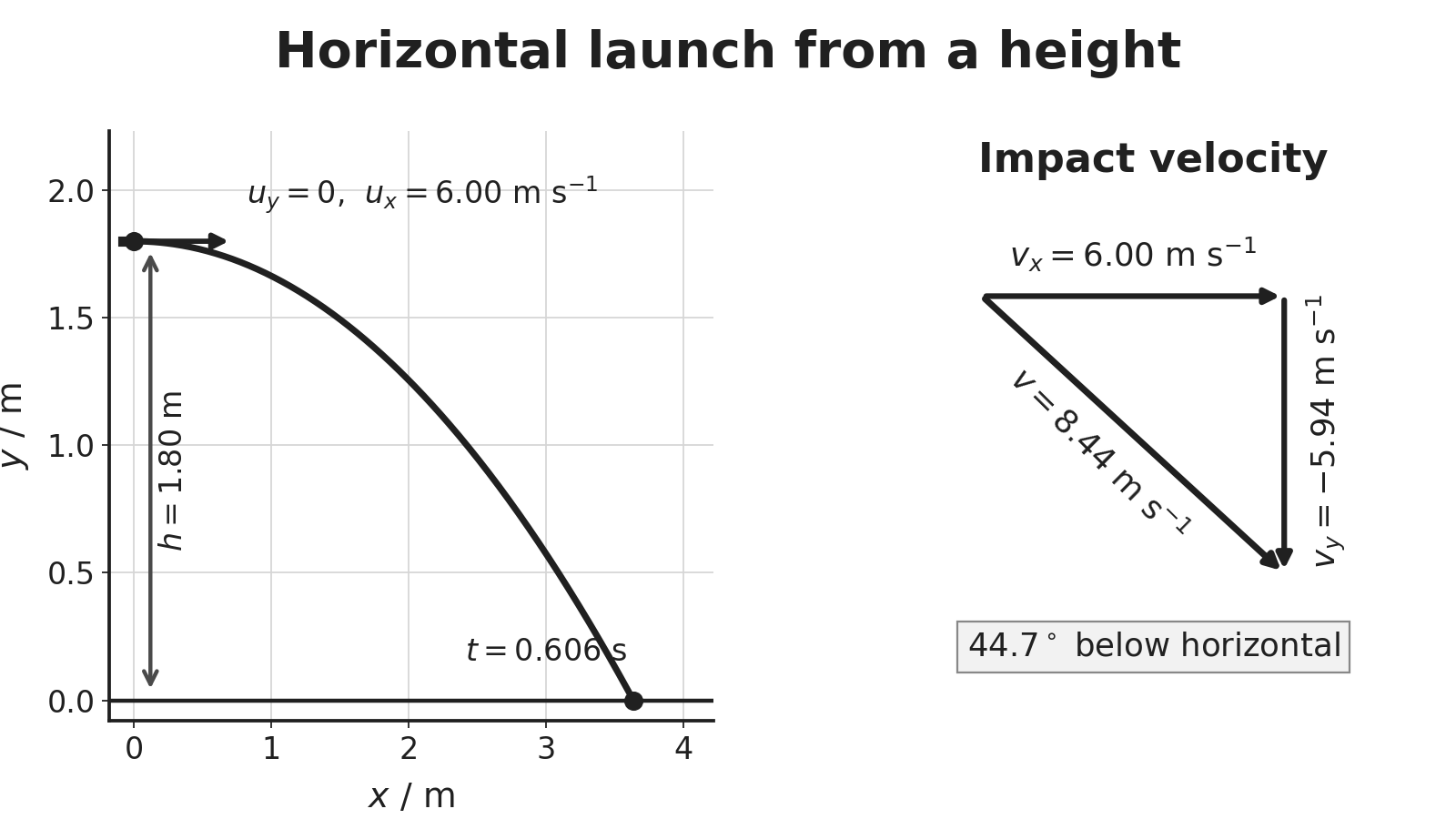
Figure: A ball leaves the edge horizontally, so its initial vertical velocity is zero but its vertical acceleration is immediately . The drop height determines the common flight time through vertical motion. That time then determines horizontal displacement. At impact, the unchanged and downward must be combined as perpendicular components to obtain the speed and direction.
Worked example
A ball leaves a table horizontally at from a height of . Take upward as positive and neglect air resistance. Carry unrounded values through the calculation and round final answers to three significant figures.
At landing,
Vertical motion gives
so
The horizontal distance is
At impact,
Therefore
and
The impact velocity is at below the horizontal.
10. Enrichment — deriving the parabolic path
Beyond the explicit 9749 outcome
The syllabus requires you to describe and explain the perpendicular component motions. This elimination-of-time derivation is a helpful mathematical extension, but it should not replace the component method.
For a non-vertical launch, eliminate using
Substituting this into the vertical displacement equation gives
This has the form , so the ideal trajectory is a parabola in the chosen – coordinates.
The conclusion depends on uniform downward gravity and negligible air resistance. With appreciable drag, the trajectory is generally not an exact parabola and is not symmetric.
11. Enrichment — launch angle and range relation
Beyond the explicit 9749 outcome
The complementary-angle and 45-degree range results are useful consequences of the same-level ideal model. Treat them as conditional deductions, not universal projectile facts.
For fixed under the same-level ideal conditions, let denote the launch angle being varied over , with no earlier interception. Define
the maximum possible range within this conditional model. Then
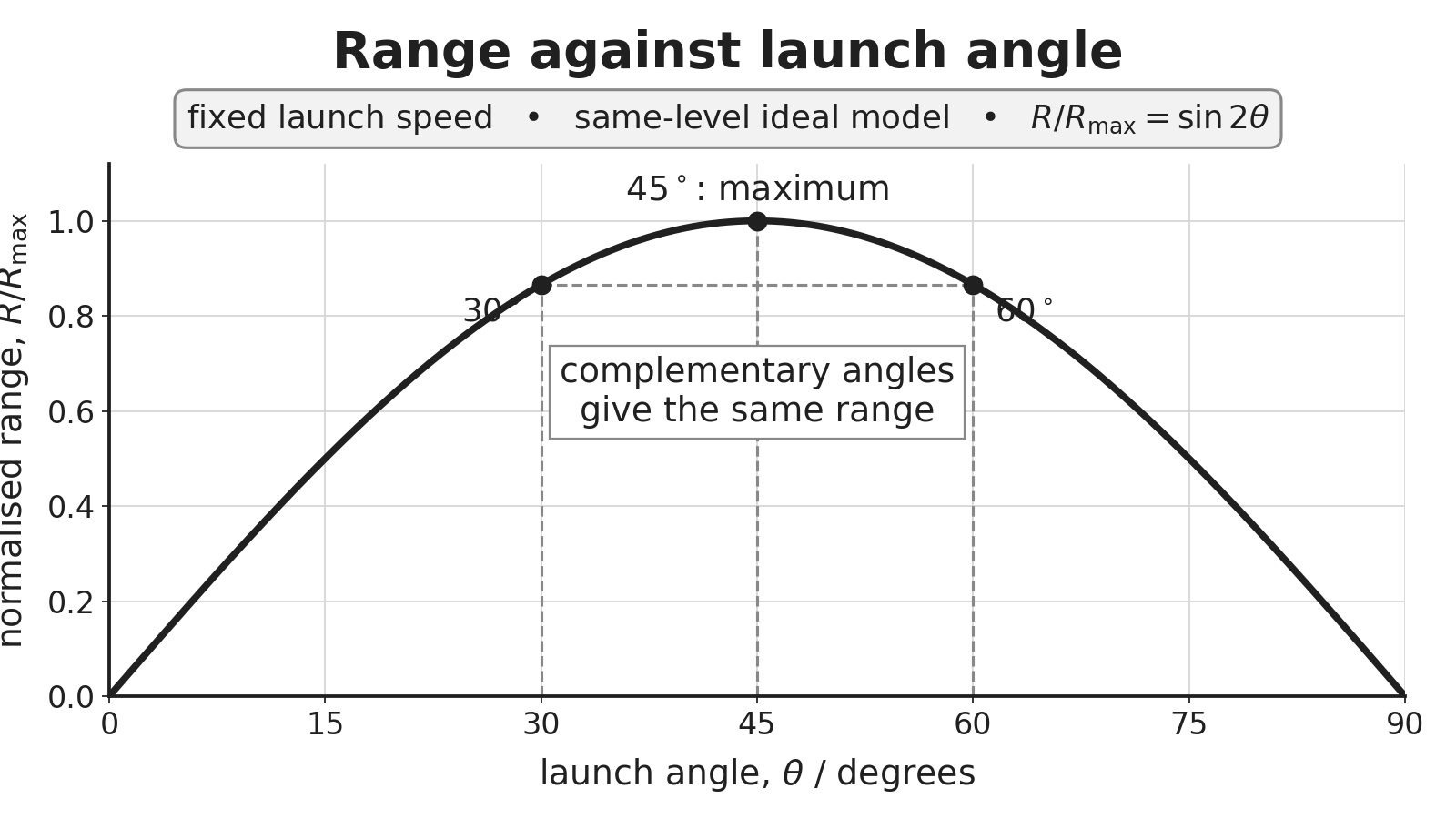
Figure: The plotted curve is calculated from , not sketched by eye. Its maximum occurs at . Complementary angles such as and give the same range because . The higher-angle projectile stays in flight longer and rises higher, even though the ideal same-level ranges match.
Since , maximum range occurs when
so
This 45-degree result is conditional. It can fail when launch and landing heights differ or when air resistance is significant.
12. Common misconceptions and corrections
| Misconception | Correction |
|---|---|
| “The projectile carries a forward force after release.” | In the ideal model, no horizontal force is required to maintain constant horizontal velocity. |
| “Horizontal and vertical motions have different times.” | They are components of one motion and share the same time coordinate. |
| “Acceleration is zero at the apex.” | Only is zero there; acceleration remains vertically downward at . |
| “The projectile is always momentarily at rest at the apex.” | A non-vertical projectile still has . A vertical launch is the special case. |
| “Range is always .” | That result requires same-level launch and landing, uniform , and negligible drag. |
| “The maximum height formula gives height above the ground.” | It gives height above the launch point unless another reference level is explicitly included. |
| “Landing speed always equals launch speed.” | This is true for ideal same-level flight, not for different landing heights or appreciable drag. |
| “A negative vertical velocity means negative speed.” | Velocity components are signed; speed is a non-negative magnitude. |
13. Formula summary with conditions
General ideal component equations from the launch origin
Apex height in the ideal model
If and the projectile reaches its natural apex before interception,
This is the height above the launch point; it does not require same-level landing.
Additional results only for same-level ideal flight
These results should be understood through their derivations and conditions. When the landing height differs from the launch height, return to the component equations.
Exam Relevance
- State the positive directions before assigning signs.
- Resolve the launch velocity before using SUVAT.
- Use vertical motion to locate events such as the apex or landing; then transfer the same time to horizontal motion.
- Do not quote a same-level result in a non-level problem.
- Show the component reasoning or derivation when a structured question asks you to establish a projectile result.
- Give vector answers with both magnitude and direction.